



ARK Investment Management has abandoned its plan for a crypto index ETF, and the version designed to strip Bitcoin out of the basket is going with it.
On Friday, Nov. 20, ARK filed two requests with the SEC to withdraw the registration statements for a 20-asset crypto index fund and an “ex-Bitcoin” twin. Both were first filed on Jan. 23, 2026.
Neither fund was ever declared effective, and no shares were sold.
For Bitcoin investors, the timing tells its own story. Since those filings, Bitcoin has fallen less than every other large asset the funds were built around.
The bigger question is whether multi-coin products can win demand while Bitcoin keeps doing most of the heavy lifting.
What ARK Filed With the SEC
The two Form RW letters, signed by ARK’s Kellen Carter, ask the SEC to consent to withdrawing registration files No. 333-292914 and No. 333-292915 under Rule 477 of the Securities Act.
The stated reason is brief. ARK “does not intend to proceed with the planned distribution” of either fund’s shares.
That is standard withdrawal language, and the letters give no further explanation. Anything beyond that is interpretation, and we will treat it that way.
Both funds were planned as commodity pools listed on NYSE Arca. Neither would have held coins directly. Instead, they were to take long positions in futures on a large-cap crypto index and keep the rest in cash and U.S. Treasuries as collateral.

How the Ex-Bitcoin Crypto Index ETF Would Have Worked
The index tracks the 20 largest crypto assets by market value, excluding stablecoins and memecoins, and rebalances quarterly.
The ex-Bitcoin prospectus added a twist. Alongside the index futures, the fund would short CME Bitcoin futures so that “the portion of the performance of the Index arising from bitcoin or bitcoin cash is eliminated.”
In other words, investors would get the rest of the market while Bitcoin was hedged out.
The filing was candid about the difficulty. Bitcoin’s weight in the index shifts with prices and rebalancing, so the short position would need regular resizing. ARK warned that the “hedge ratio may drift, causing tracking error.”
According to the S-1, Bitcoin, Ether, XRP, Solana and Cardano made up about 88.15% of the index as of Dec. 31, 2025. Every remaining constituent carried a weight of 3% or less.
So once Bitcoin was removed, the ex-Bitcoin fund would have leaned heavily on four assets.
Bitcoin Fell the Least Since January
Those four assets have had a harder year than Bitcoin.
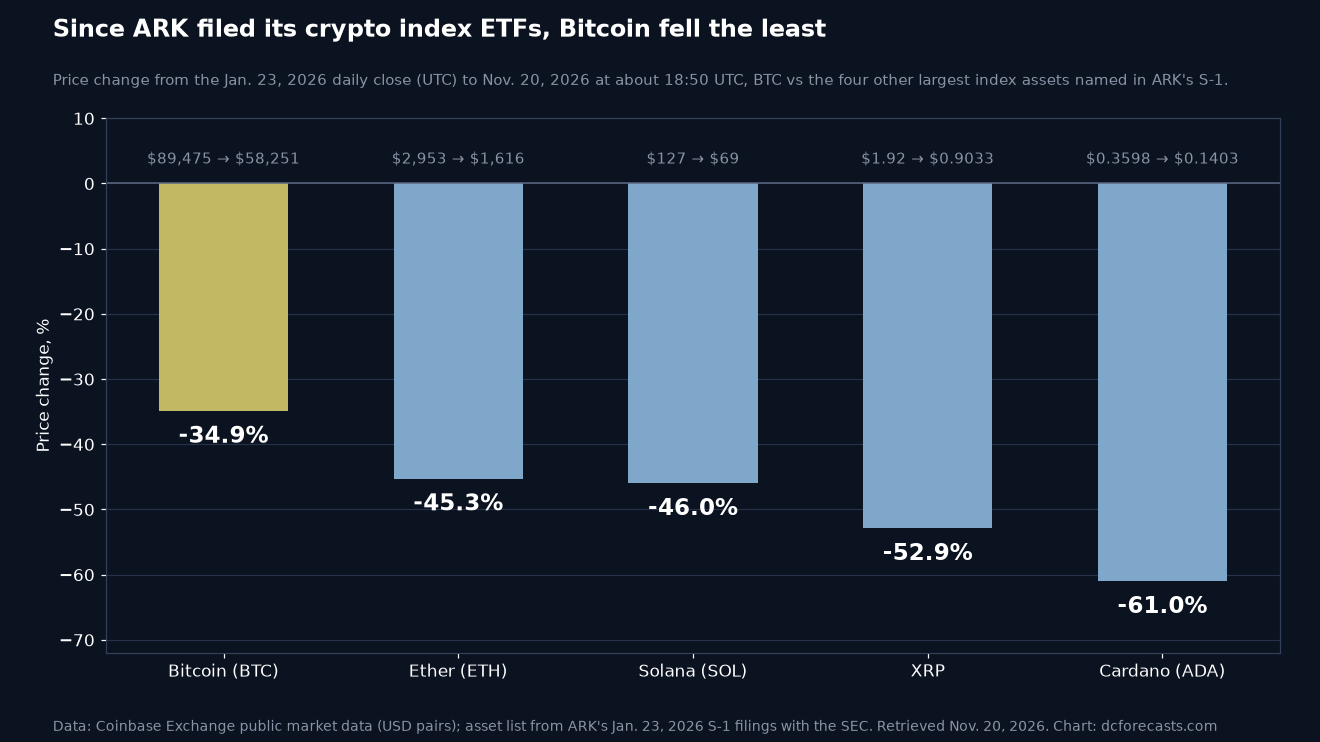
From the Jan. 23 daily close to Friday evening, Coinbase Exchange data shows Bitcoin down 34.9%, from $89,475 to about $58,251.
That is a real drawdown, and we will not dress it up. But every other heavyweight did worse. Ether fell 45.3%, Solana 46.0%, XRP 52.9% and Cardano 61.0%.
The relative picture is clearest in the ETH/BTC ratio. Ether was worth 0.0330 BTC on Jan. 23. On Friday it bought about 0.0277 BTC, a drop of roughly 16% against Bitcoin.
The ratio did not fall in a straight line. It hit a 2026 low of 0.0258 on June 6, then climbed back above 0.032 in late August and September before sliding again.
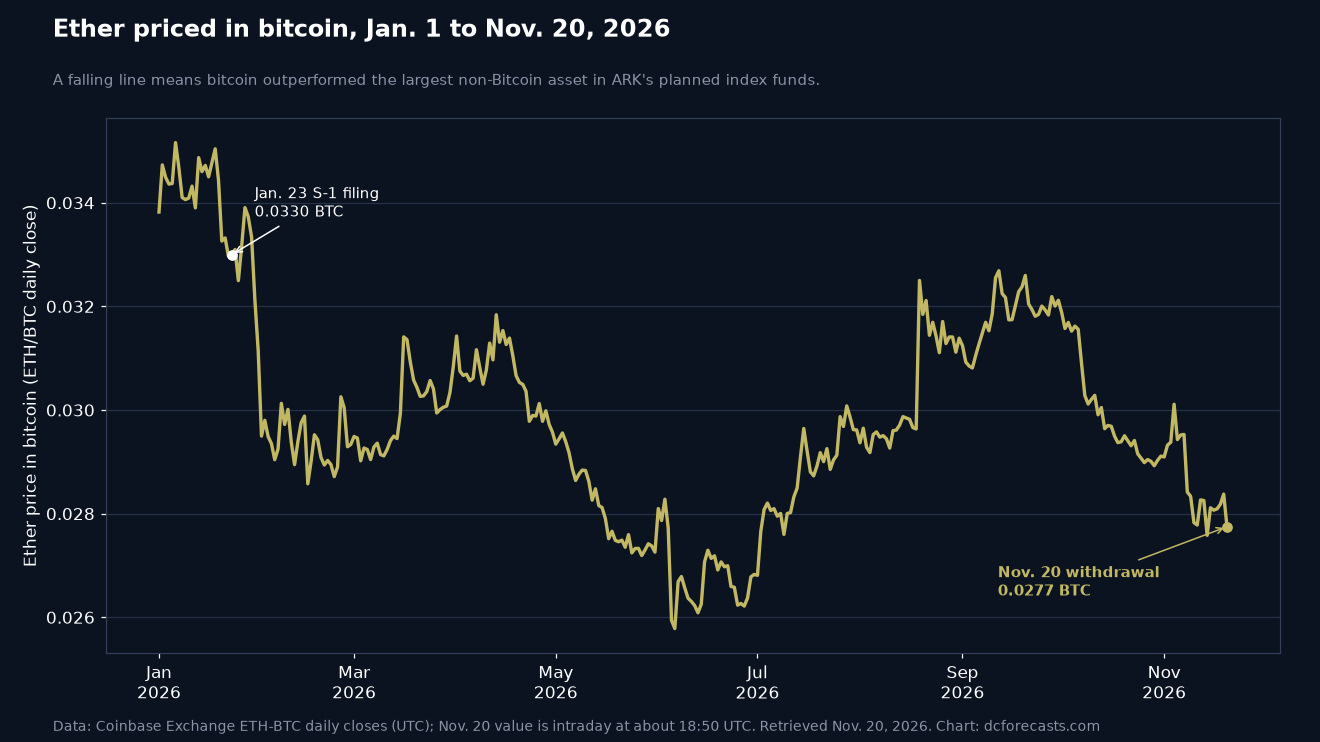
For us, the key takeaway is simple. A product engineered to remove Bitcoin would have removed this year’s most resilient large crypto asset.
What It Says About Crypto ETF Demand
ETF demand has been soft across the board. Farside Investors data shows U.S. spot Bitcoin ETFs lost $582.3 million on Nov. 19 alone, a day when BlackRock’s fund set its one-day outflow record.
ARK’s own Bitcoin ETF, ARKB, run with 21Shares, has not been spared. It shed $115.5 million in November through Nov. 19, leaving cumulative net inflows since its January 2024 launch at $854 million, according to Farside.
Still, the broader category remains large. Farside’s table puts cumulative net inflows across all U.S. spot Bitcoin ETFs at about $53.6 billion.
Multi-asset funds face a tougher pitch. Even an actively managed fund can end up anchored on Bitcoin, as we saw when T. Rowe Price’s crypto ETF put 38% in Bitcoin in its first quarterly report.
We believe ARK’s decision fits that pattern. When investors buy crypto through an ETF, Bitcoin is usually where they start, and a hedged-out version faces a harder sell.
Does Bitcoin Still Lead the Crypto ETF Market?
The withdrawals do not close the door on index products. They show that one prominent manager chose not to bring these two to market after ten months on file.
For Bitcoin, the evidence points in a constructive direction. It has held its value better than its largest peers in a falling market, and spot Bitcoin ETFs still hold tens of billions in net inflows despite recent redemptions.
Fixed supply, deep institutional plumbing and a regulated ETF market give Bitcoin an advantage that index wrappers have yet to match.
The next test is whether ETF outflows ease as prices stabilize. If they do, the asset that ARK’s ex-Bitcoin fund was built to leave out may again be the first to benefit.
DC Forecasts is a leader in many crypto news categories, striving for the highest journalistic standards and abiding by a strict set of editorial policies. If you are interested to offer your expertise or contribute to our news website, feel free to contact us at [email protected]












Discussion about this post