



The number of Bitcoin addresses holding a balance set a record of 57.31 million on Nov. 4, 2026, more than a year into a drawdown that has cut the BTC price roughly in half.
That figure comes from Coin Metrics’ daily count of addresses with any non-zero balance.
The latest reading, for Nov. 20, is 57.21 million. That is 2.5 million more than a year earlier, even though Bitcoin’s daily reference price fell 32% over the same 12 months.
For Bitcoin investors, this is one of the clearest on-chain signs that the network keeps widening while the price corrects.
The question is whether this drawdown looks more like 2022, when the holder base grew, or 2018, when it shrank.
Bitcoin Addresses Kept Growing as the Price Fell
Bitcoin’s daily reference price peaked at $124,824 on Oct. 6, 2025, according to Coin Metrics. By Nov. 20, 2026, it was at $58,851, a decline of 52.9%.
Over that same stretch, funded addresses rose from 54.35 million to 57.21 million. That is a gain of about 2.85 million, or 5.2%.
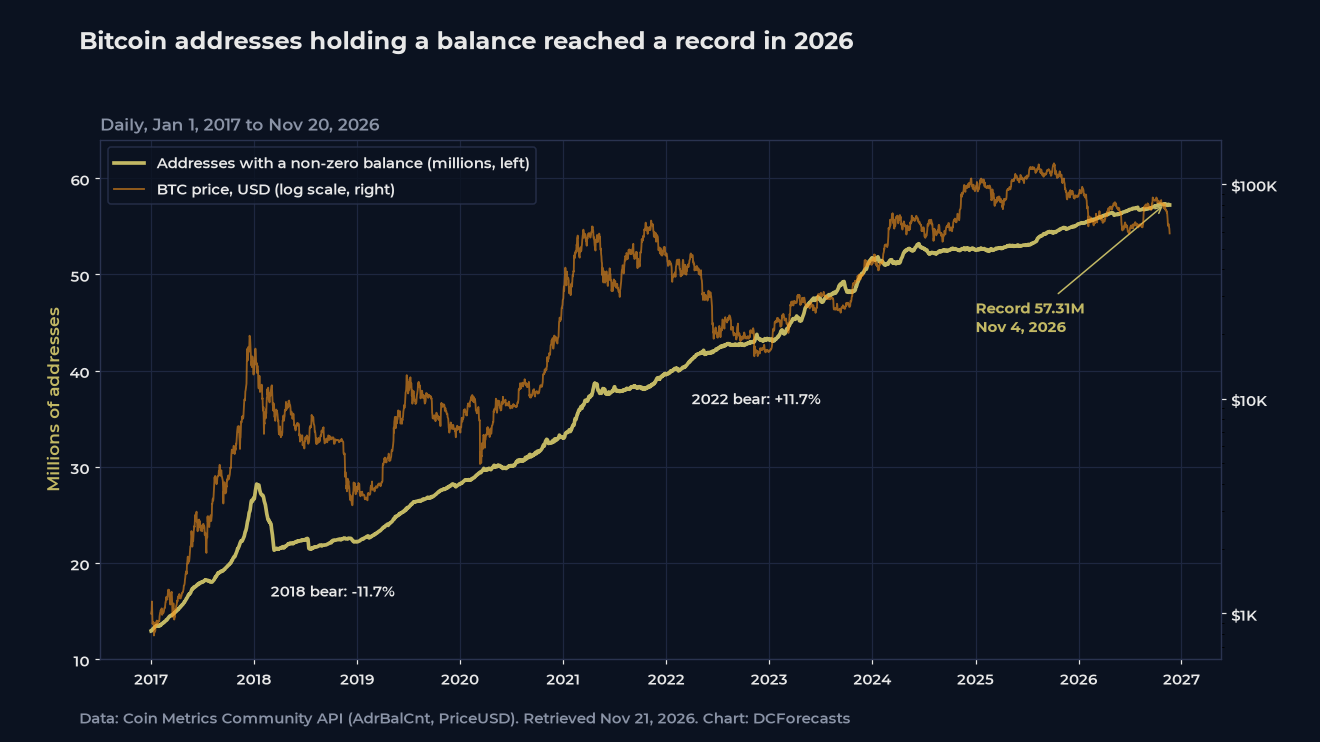
The count has slipped slightly since the record. It is down about 98,000 addresses, or 0.17%, since Nov. 4.
We read that as noise rather than a trend. Day-to-day swings of roughly 40,000 to 57,000 addresses happened several times in November alone.

The count also hit its high less than three weeks before Bitcoin traded near $57,800 on Saturday morning, so the record was set deep inside this correction, not before it.
What Happened to Funded Addresses in 2018 and 2022?
The past two bear markets give very different templates.
From the December 2017 high to the December 2018 low, Bitcoin’s price fell 83.8%. Funded addresses fell 11.7% over the same period, from 25.31 million to 22.35 million.
Most of that drop came early. The count peaked at 28.20 million on Jan. 10, 2018, then fell to 21.32 million by March 13.
We believe that slide was largely a clean-up of small balances rather than an exodus of holders. Daily network fees had peaked near 1,496 BTC on Dec. 22, 2017, Coin Metrics data shows, and fell to roughly 26 to 36 BTC a day by March. Cheaper fees made it practical for services and users to consolidate scattered coins into fewer addresses.
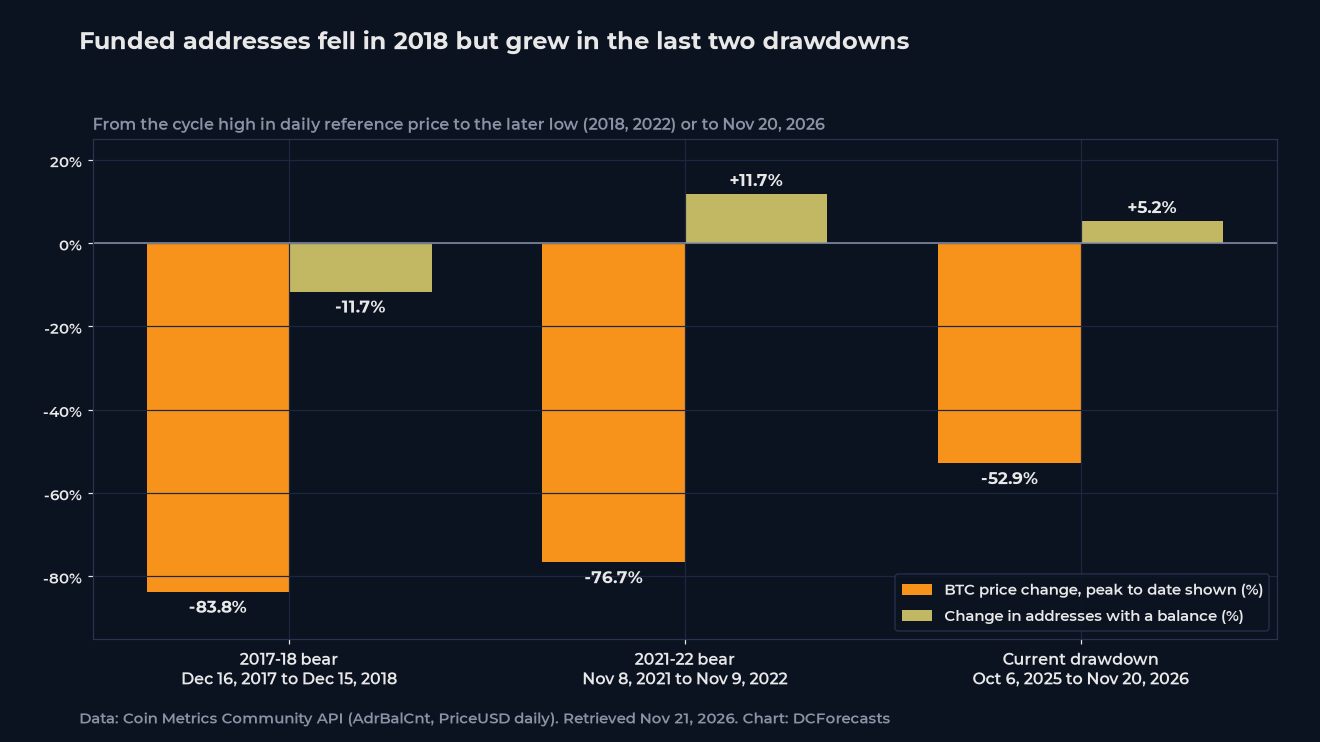
The 2022 cycle went the other way. From the November 2021 high to the November 2022 low, Bitcoin fell 76.7%, yet funded addresses rose 11.7%, from 38.49 million to 43.00 million.
So far, the current drawdown is following the 2022 pattern, with a smaller price decline and a smaller but still positive gain in addresses.
Growth Has Slowed, and We Think We Know Why
There is a fair caveat here.
The pace of growth is slower than in earlier years. Measured from Nov. 20 to Nov. 20, funded addresses rose 23.6% in 2019, 19.2% in 2021 and 14.7% in 2023.
In 2024, the gain was 5.8%. It was 3.8% in 2025 and 4.6% in the latest 12 months.
We believe a large part of that slowdown reflects where new demand now lives rather than weaker demand.
U.S. spot Bitcoin ETFs began trading in January 2024. Their custodians hold coins for large numbers of shareholders in a relatively small number of addresses. The same goes for exchanges, brokers and corporate treasuries.
A new ETF buyer adds exposure to Bitcoin without adding an address on the blockchain. That makes the 4.6% growth in self-held balances more notable, not less.
What Address Counts Can and Can’t Tell Us
Address data needs careful handling.
One person can control many addresses, and one exchange address can represent thousands of customers. Dust, tiny leftover amounts, can inflate the count, while consolidation can shrink it.
That is why we focus on direction and on comparisons across cycles rather than treating 57.21 million as a head count of Bitcoin owners.
It also helps to read this alongside other on-chain data. As we found when we looked at Bitcoin exchange balances, coins held on trading venues barely moved during the latest slide. Daily transactions also hit a record in October before cooling, as we covered in our look at network activity.
Taken together, those readings point to a market where the price has corrected sharply, but the user base has not been washed out.
The Signal We Would Watch Next
For us, the key takeaway is simple. Bitcoin addresses holding a balance reached a record during one of the deepest price drops of this cycle.
That does not tell us where the bottom is, and it does not guarantee a quick rebound. But it does show that more wallets are choosing to hold BTC, not fewer.
We would watch two things in the coming weeks. First, whether the count reclaims its Nov. 4 high while the price is still under pressure. Second, whether any sharp drop resembles 2018-style consolidation or a genuine decline in holders.
Bitcoin’s supply is fixed at 21 million coins, and the base of addresses sharing it keeps widening. If that pattern holds, the next recovery could start from a wider base of funded addresses than any before it.
DC Forecasts is a leader in many crypto news categories, striving for the highest journalistic standards and abiding by a strict set of editorial policies. If you are interested to offer your expertise or contribute to our news website, feel free to contact us at [email protected]










Discussion about this post