



Bitdeer sold all 281.1 bitcoin it mined in the week to November 20, and its own bitcoin balance stayed at zero for yet another week.
The Singapore-based miner published the figures in its weekly update on Saturday, listing output of 281.1 BTC, sales of 281.1 BTC and a net addition of zero.
That is not a one-off. Across the 24 weekly updates from June 12 to November 20, Bitdeer reported mining 6,362.5 BTC and selling 6,363.0 BTC.
For Bitcoin investors, the useful part is what that steady flow reveals about miner supply, and how much of it the market has already taken in.
The bigger question is whether a sell-everything miner is a warning sign or simply what a maturing industry looks like.
What Bitdeer Reported This Week
Bitdeer’s update describes the zero as “pure holdings,” a figure that excludes bitcoin deposited by customers.
Output rose 9.8% from 256.1 BTC in the week to November 13, and sales rose by exactly the same amount because the company sold every coin.
At Saturday’s price of about $57,900, according to CoinGecko, last week’s sales were worth roughly $16.3 million.
The weekly peak in our 24-week sample came on October 9, when Bitdeer reported 300.6 BTC of output. The low was 194.4 BTC in the week to June 12.

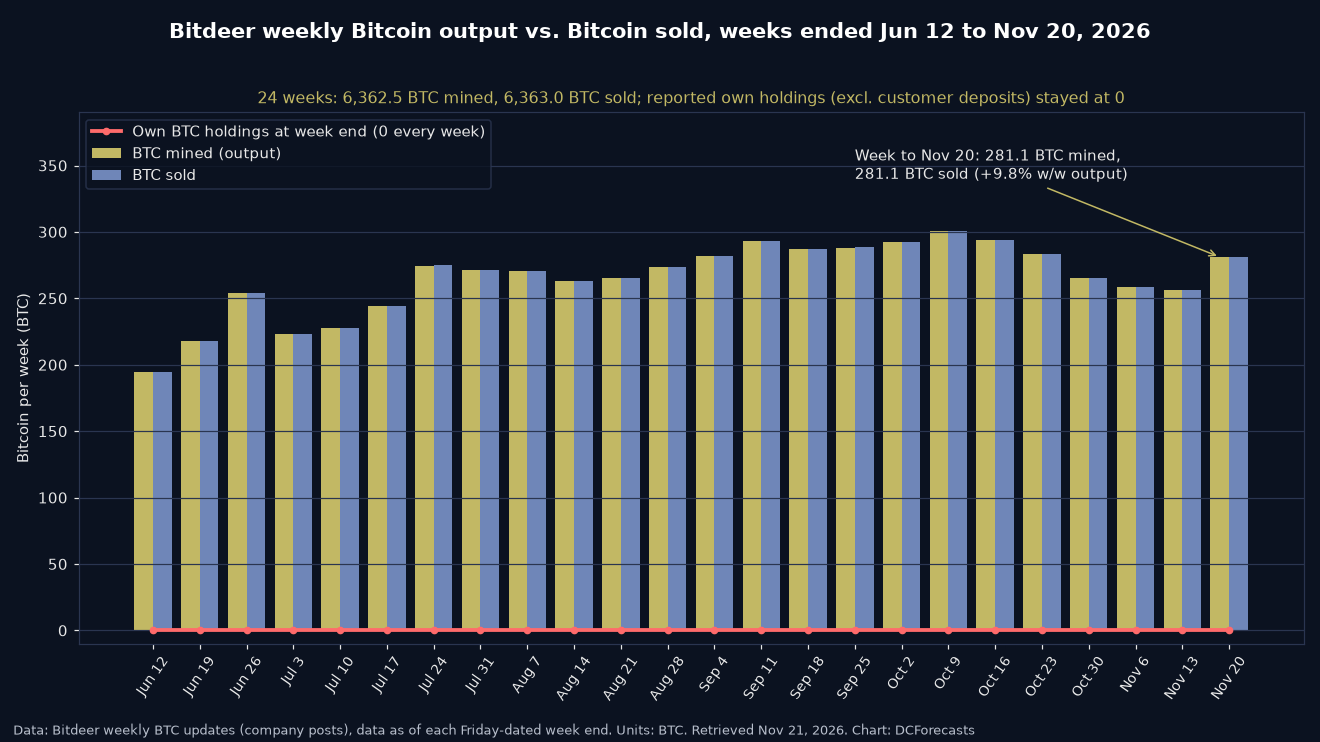
Sales matched output almost to the decimal. Only two weeks differed, by 0.3 BTC and 0.2 BTC, and in both cases Bitdeer sold slightly more than it mined.
Why Bitdeer Sells Every Coin It Mines
The answer sits in the company’s third-quarter results, furnished to the US Securities and Exchange Commission on November 10.
Bitdeer reported $221.5 million of proceeds from disposing of digital assets in the quarter, “primarily mined Bitcoin,” against $478.0 million of capital spending.
Roughly $110 million of that went to producing its own SEALMINER rigs. About $368 million went mainly to data center construction and GPU equipment.
The company’s AI cloud revenue backlog reached about $2.9 billion, and AI cloud revenue rose to $20.4 million from $1.8 million a year earlier.
As we noted when we covered Bitdeer’s Q3 mining and AI results, mining still pays most of the bills. Self-mining alone brought in $217.5 million.
The balance sheet explains the urgency. Bitdeer listed $1.95 billion in borrowings and a gross margin of just 3.4% for the quarter.
One nuance matters. The quarterly filing counted 47 BTC held at September 30, because that measure includes bitcoin pledged as collateral, while the weekly “pure holdings” figure showed zero.
How Much Do Bitcoin Miners Like Bitdeer Add to Supply?
We compared Bitdeer’s sales with the new coins the network created over the same weeks, using mempool.space block data and the current 3.125 BTC block subsidy.
By our count, about 75,800 new BTC were issued across those 24 weeks. Bitdeer’s 6,363 BTC of sales equal roughly 8.4% of that supply.
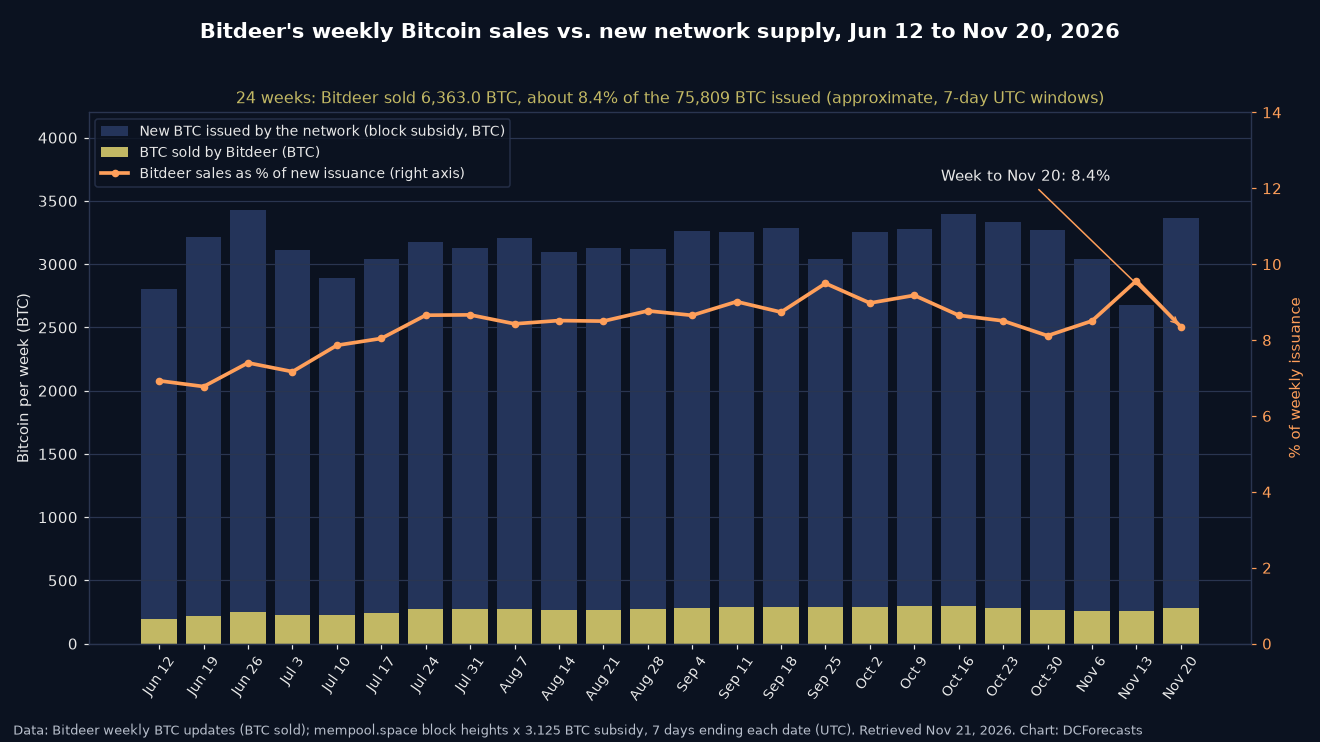
The latest week tells a second story. The network produced about 1,077 blocks in the seven days to November 20, up from 857 the week before.
That faster block pace, rather than a jump in Bitdeer’s own fleet, likely explains the 9.8% rise in its weekly output.
We believe this is the healthy way to read it. Bitdeer’s selling is large, regular and published every week, so it is a known flow rather than a surprise.
Buyers have taken every one of those coins at market prices for almost six months. That includes the weeks when Bitcoin was sliding, as covered in our look at record-low hashprice before a 9% difficulty hike.
What It Means for BTDR Stock and Its Peers
Bitdeer is not alone. Large public miners are increasingly treating bitcoin as operating income to be spent on power and computing capacity, not as a treasury asset.
The trade-off is clear. Holders of BTDR stock get less direct exposure to a Bitcoin rebound, but more exposure to contracted AI cloud revenue.
The mining engine is still growing. Bitdeer’s total proprietary hash rate reached 86.4 EH/s in the third quarter, up from 35.0 EH/s a year earlier, while miner efficiency improved to 15.4 J/TH from 20.1 J/TH.
For us, the key takeaway is that Bitcoin mining has become a cash engine that funds broader infrastructure. That is a sign of the network’s economic weight, not of weakness.
Can Bitcoin Absorb Miner Selling Through 2028?
Miner supply is the most predictable flow in the market. It is set by code, and it shrinks at every halving.
The next halving, expected in 2028, will cut the block subsidy to 1.5625 BTC. A miner selling everything then would be selling about half as many new coins for the same share of the network.
We would watch three signals: whether Bitdeer’s weekly holdings ever turn positive, how fast its AI capacity comes online, and whether network block times settle as difficulty adjusts.
Bitcoin’s long-term case does not depend on any one miner’s treasury policy. Its supply is capped at 21 million coins, and the new supply that miners like Bitdeer sell keeps shrinking.
The coming months will show whether the market keeps absorbing about 8% of new issuance from one company, and how quickly that flow fades as the next halving approaches.
DC Forecasts is a leader in many crypto news categories, striving for the highest journalistic standards and abiding by a strict set of editorial policies. If you are interested to offer your expertise or contribute to our news website, feel free to contact us at [email protected]











Discussion about this post