



Bitcoin proof-of-work is being pitched as a national cyber shield by Jason Lowery, the Space Force officer behind the Softwar thesis, in the same week Washington replaced its top cyber official.
On November 20, Lowery wrote on X that he is “ready and willing to support this country with using Bitcoin’s PoW network to counter the threat of agentic superintelligence.”
He added: “This has been the singular focus of my life since 2021.”
By the time we checked on November 22, the post had drawn more than 118,000 views, 4,171 likes and 498 reposts.
For Bitcoin holders, the interesting part is not the post itself. It is the timing, and the question of whether a security idea born in a military thesis can find a hearing while federal systems are under strain.
A Rough Week for Federal Cybersecurity
Lowery’s offer landed after several days of bad news for US government networks.
A White House official confirmed on November 19 that National Cyber Director Sean Cairncross was leaving. Pentagon chief information officer Kirsten Davies is taking over in an acting role, pending Senate confirmation.
Asked on November 20 why Cairncross had to go, President Donald Trump told reporters: “Because I didn’t think that person was good enough.”
The change followed a run of outages at airlines, banks and government services. Administration officials, including Secretary of State Marco Rubio, said they found no evidence that those outages were coordinated attacks.

Two separate incidents look different. The Agriculture Department told staff that a system used to pay farmers had been breached, according to multiple US media reports. The FBI is also reported to be investigating an apparent breach of its National Crime Information Center. The FBI had not commented publicly when we checked.
A day before those reports, the Government Accountability Office said USDA and the FDA had only partially met, or not met, five of 16 cybersecurity requirements for the food and agriculture sector. Both agencies cited a lack of staff and resources. USDA disagreed with the two recommendations aimed at it.
What Is Bitcoin Proof-of-Work Supposed to Defend?
Lowery did not explain how the Bitcoin network would be used, and no agency has responded to his offer. So the details have to come from his earlier work.
His 2023 MIT thesis, Softwar, argues that Bitcoin is more than money. It treats proof-of-work as a way to put a real-world, electricity-based cost on computer activity.
The logic is simple. Software can copy itself and run commands almost for free. That makes spam, brute-force attempts and automated attacks cheap to launch at scale.
Proof-of-work changes the maths. If every request to a critical system must carry proof that real energy was spent, flooding that system becomes expensive. In Lowery’s view, attacking it would cost more than defending it.
That is why the idea now appeals to people worried about autonomous AI agents. An agent that can try millions of actions a second is far less dangerous when each action has a physical price.
We believe that point deserves a serious look. Similar thinking has inspired anti-spam tools for decades, and the original Hashcash design is cited in the Bitcoin white paper itself.
The Network Behind the Pitch
Any proof-of-work defense would borrow from the most battle-tested computing network on Earth.
According to mempool.space mining data, Bitcoin’s seven-day average hashrate stood near 1,033 exahashes per second on November 21. Three years earlier, in late November 2023, it was about 488 EH/s.
That is more than double the computing power in three years, even after this year’s price slide. Bitcoin traded near $59,990 early on November 22.
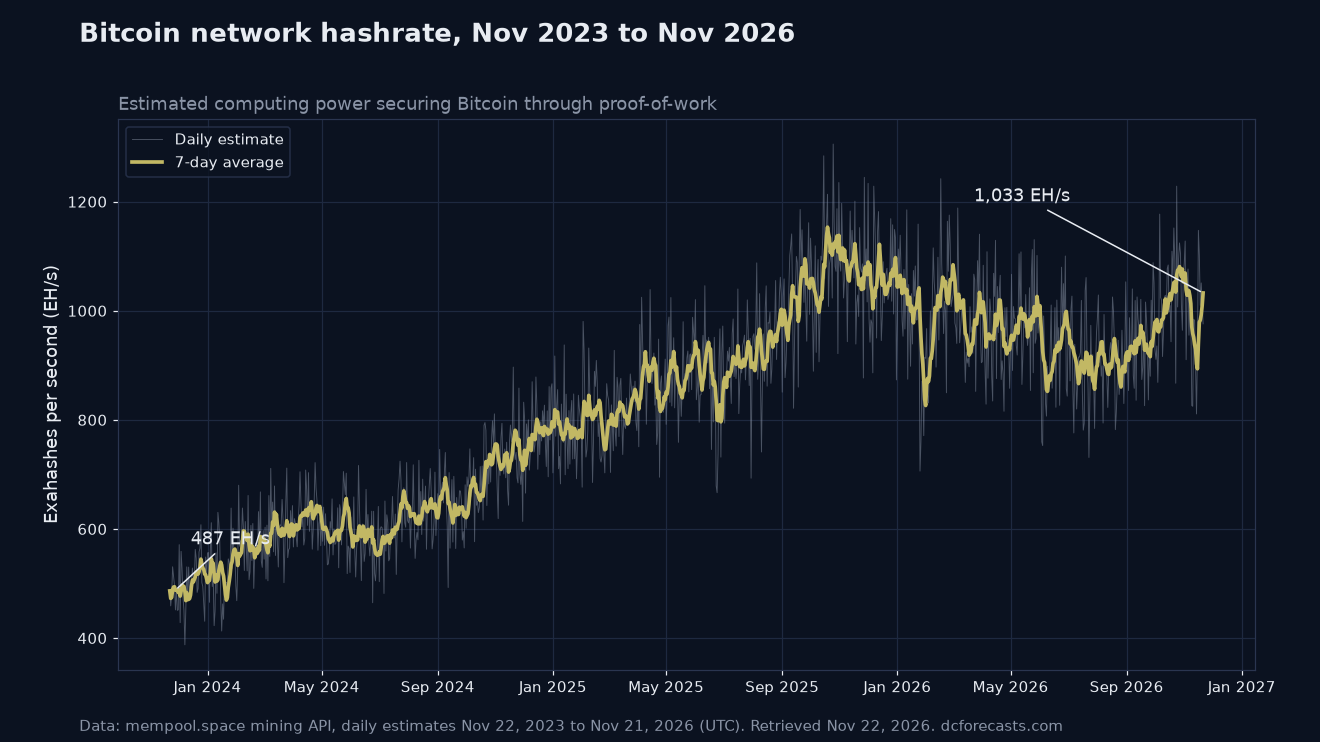
The next difficulty adjustment, due in about 800 blocks, was estimated at roughly +8.9% when we checked. After the previous adjustment’s 9.1% cut, that estimate suggests miners are switching machines back on.
We see that as the clearest evidence for Lowery’s broader claim. A network that keeps attracting hardware through a price drawdown is hard to attack and hard to ignore. As we noted when Satoshi’s BitcoinTalk anniversary came around, that security budget has grown by many orders of magnitude since the early days.
Why the Cyber Threat Numbers Keep Rising
The case for new defenses is easy to make with the government’s own data.
The FBI’s 2025 Internet Crime Report counted 1,008,597 complaints and $20.877 billion in reported losses last year. That was 26% more than in 2024, and roughly five times the $4.2 billion reported in 2020.
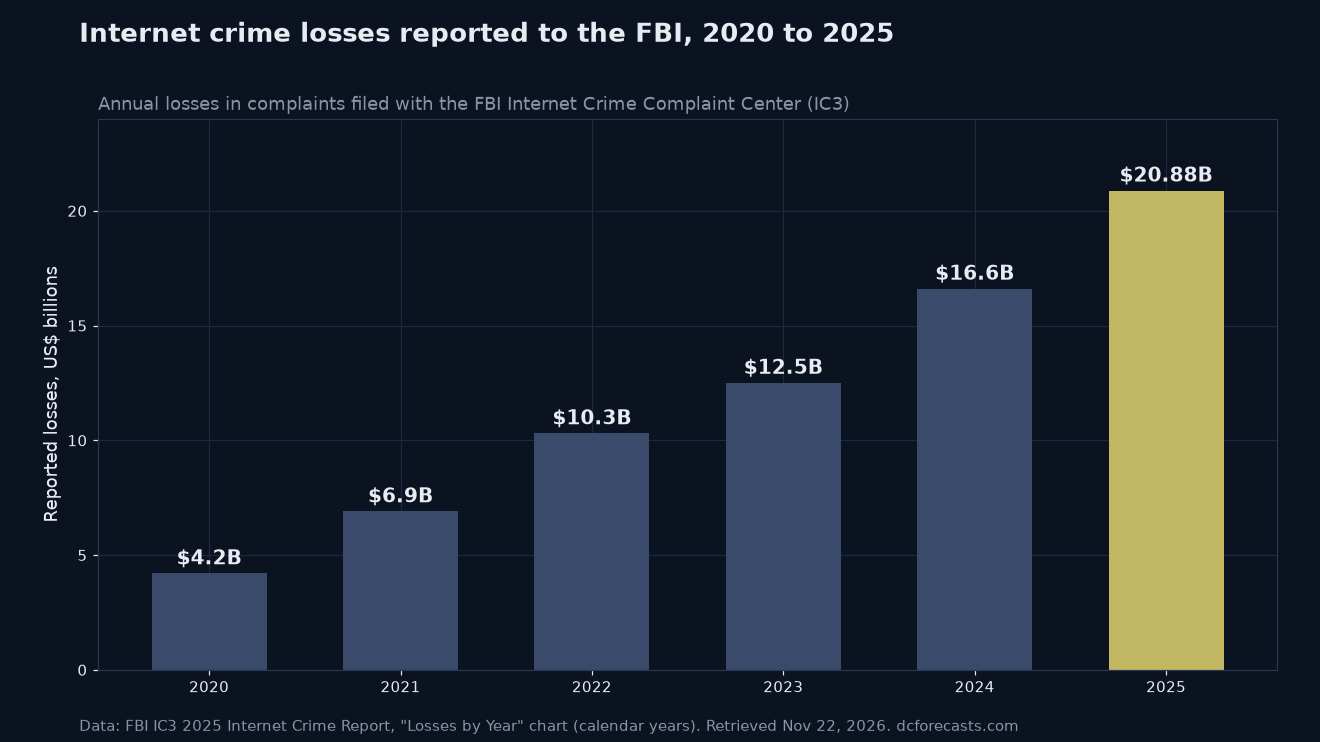
The same report logged more than 3,600 ransomware complaints in 2025. The FBI notes that its ransomware loss figures leave out downtime, lost business and recovery costs, so the true damage is higher.
AI is adding pressure on both sides. We recently covered an AI-flagged Bitcoin Core vulnerability that was fixed and publicly disclosed through Bitcoin Core’s normal review process. The open-source model handled that case in the open. Most legacy government systems do not have that level of public scrutiny.
Can a Bitcoin Idea Win a Hearing in Washington?
We would keep expectations measured. A post on X is not a policy proposal, and Lowery has given no timeline, budget or technical design.
Still, the opening is real. A new acting cyber director is taking over, Congress is asking questions about the outages, and the GAO is pointing to thin resources at key agencies.
We believe the most realistic first step would be small pilots, such as proof-of-work stamps on public-facing services that face constant automated abuse. That would test the idea without touching core systems.
For Bitcoin, the bigger takeaway is how the conversation has shifted. Proof-of-work was long criticized as wasted energy. Now the Space Force officer who wrote Softwar is offering it as a national security tool.
With a fixed supply of 21 million coins and a hashrate above 1,000 EH/s, Bitcoin brings both scarcity and raw security to that debate. The coming months will show whether Washington wants to borrow either.
DC Forecasts is a leader in many crypto news categories, striving for the highest journalistic standards and abiding by a strict set of editorial policies. If you are interested to offer your expertise or contribute to our news website, feel free to contact us at [email protected]












Discussion about this post