


Bitcoin transaction fees sat below 1 satoshi per virtual byte in the typical transaction of 81 of the network’s last 144 blocks, even as those blocks stayed almost completely full.
According to mempool.space block data, blocks 976,931 to 977,074, mined between 17:02 UTC on Nov. 21 and 16:23 UTC on Nov. 22, carried 691,023 transactions.
Together they paid just 2.21 BTC in fees. That works out to about 320 satoshis per transaction, or roughly 20 cents at Bitcoin’s spot price near $61,100 on Coinbase.
For Bitcoin users, the most striking part is the timing. This came barely a day after one of the sharpest sell-offs of the year.
The bigger question is what keeps blockspace this cheap while demand for it stays high.
What the Last 144 Blocks Show
One day of Bitcoin blocks is about 144, so this window is a clean daily snapshot.
In 81 of those blocks, the median transaction paid less than 1 sat/vB. In many recent ones it paid closer to 0.12 sat/vB, a tenth of what used to be the network’s practical floor.
The newest block in the set, 977,074, shows how far this has gone. It packed 5,862 transactions, yet its fees totaled 721,728 satoshis, or about $440 for the whole block. Its median fee rate was 0.131 sat/vB.
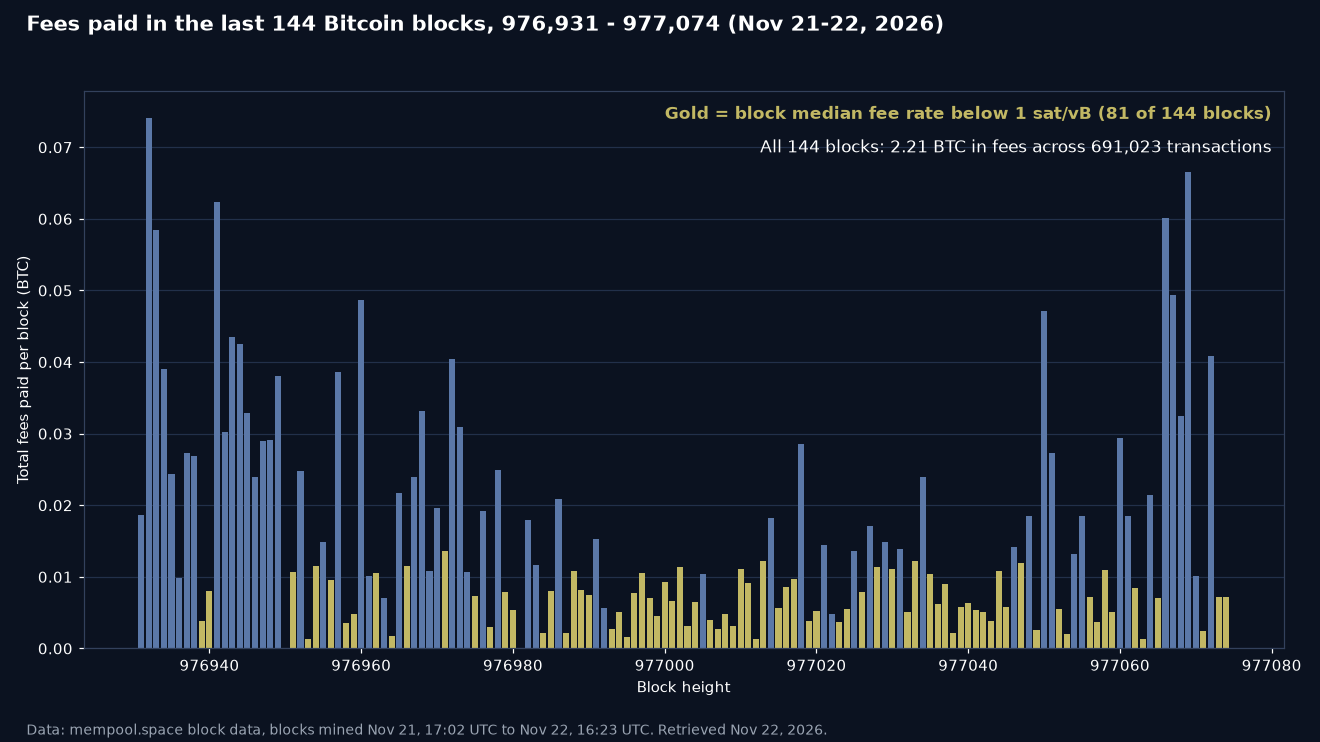
Low fees did not mean empty blocks. In 133 of the 144 blocks, weight topped 3.99 million units against the 4 million limit.

We think that combination matters. Bitcoin is moving close to 700,000 transactions a day, and users are not being priced out to do it.
Why the Sell-Off Barely Touched Bitcoin Fees
Bitcoin fell to about $55,500 on Coinbase early on Nov. 21, as we covered when hashprice hit a record low. Sharp sell-offs can send traders rushing coins to exchanges, and that rush tends to bid fees higher.
This time the bidding war stayed small. Mempool.space fee data shows the busiest stretch around the drop averaged under 0.09 BTC in fees per block. Earlier this month, on Nov. 8, one short stretch averaged about 0.39 BTC per block.
That fits other on-chain readings. As we reported, Bitcoin exchange balances barely moved while the price fell about 20% in 10 days.
We read that as a sign of calm holders. If coins are not stampeding toward exchanges, there is no surge of urgent transactions to push fees up.
Sub-1 Sat/vB Fees Have a Software Story
The other driver is a policy change inside node software.
Bitcoin Core 29.1, released on Sept. 4, 2025, cut the default minimum relay fee and incremental relay fee to 100 satoshis per kilo-virtual-byte, or 0.1 sat/vB. Before that, nodes running default settings would not relay transactions paying under 1 sat/vB.
Bitcoin Core 30.0 went further on the mining side, lowering the default minimum fee rate for block templates to 0.001 sat/vB.
The effect is visible right now. Mempool.space showed roughly 70,500 unconfirmed transactions on Sunday evening, about 31 blocks’ worth of data. Around 99% of that backlog bid less than 1 sat/vB.
Its fee estimator still listed 1 sat/vB as enough for the next block. In practice, anyone paying that rate is jumping ahead of nearly the entire queue.
How Far Have Bitcoin Transaction Fees Fallen Since 2023?
The longer trend is just as clear. Mempool.space fee statistics put the monthly average of block median fee rates near 154 sat/vB in December 2023, when inscription activity crowded blocks.
The April 2024 halving month averaged about 87 sat/vB. By November 2025 it was around 1.4 sat/vB, and November 2026 is running near 1.3 sat/vB.
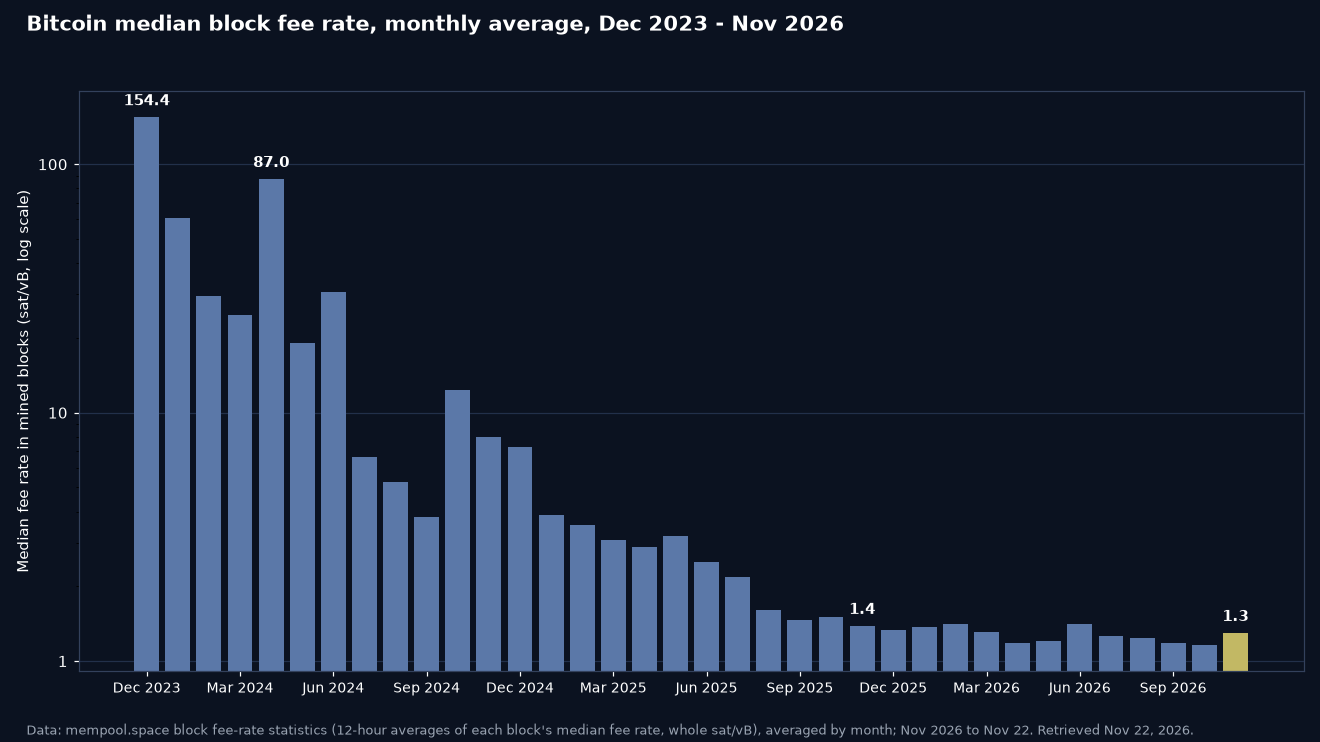
One caveat applies. Those historical figures are stored in whole sat/vB, so months full of sub-1 sat/vB blocks still show up near 1. The real median in recent months is likely lower than the chart suggests.
For a user sending a typical transaction, the change is dramatic. A simple payment that could easily cost several dollars in late 2023 now often costs well under a dollar, even with Bitcoin’s price higher than it was then.
What Cheap Blockspace Means for Users and Miners
For users, this is an unusually good window for on-chain housekeeping. Consolidating small coins, moving funds into cold storage or opening Lightning channels all cost a fraction of what they did two years ago.
We believe that matters for self-custody. When fees are this low, there is little cost reason to leave coins on an exchange.
Miners see the other side. Fees made up only about 0.49% of block rewards across the 144 blocks, with the 3.125 BTC subsidy doing almost all the work.
That is a real pressure point when hashprice is weak. Still, a network that clears close to 700,000 transactions a day for about 20 cents each is building the habit of use, and fee demand tends to return when activity spikes.
For us, the key takeaway is resilience. A sharp price drop came and went, and Bitcoin’s base layer kept settling full blocks at some of the lowest fee rates in its history.
The coming weeks will show whether that calm lasts. If it does, sub-1 sat/vB fees may become the new normal rather than a weekend curiosity.
DC Forecasts is a leader in many crypto news categories, striving for the highest journalistic standards and abiding by a strict set of editorial policies. If you are interested to offer your expertise or contribute to our news website, feel free to contact us at [email protected]












Discussion about this post