


Bitcoin Knots 29.5.1 went live on GitHub late on Nov. 21 (UTC), and it lands at a moment when far fewer Knots nodes are visible on Bitcoin’s main network than a month ago.
The point release patches a node-stall bug first fixed in Bitcoin Core, closes a command-injection hole in wallet notifications and tightens several spam filters.
Meanwhile, Bitnodes data shows reachable nodes reporting a Knots user agent fell from 4,154 on Oct. 19 to 2,088 on Nov. 22, a drop of about 50%.
For Bitcoin users, the bigger picture is how calmly the network has absorbed a public software split.
The question now is how many node operators still sit on older Knots builds, and what they plan to run next.
What Bitcoin Knots 29.5.1 Changes
The headline fix is CVE-2026-117348. According to the release notes, a peer could stall a node by repeatedly announcing an orphan transaction with many missing parents.
Knots pulled in the same patch Bitcoin Core merged, pull request #35878, titled “process unique tx INVs only.” Core developer Gregory Sanders, who wrote it, appears among the 14 contributors credited in the Knots release.
The second security fix matters for anyone using the -walletnotify option. An authenticated RPC user allowed to create wallets could run arbitrary commands by crafting a wallet name with special characters. Wallet names are now treated literally.
The rest is housekeeping and policy. Out-of-range values for options such as bytespersigop and maxscriptsize now stop the node at startup. Decoy public keys also count toward the data-carrier limit unless a signature is actually checked against them.

We like the speed here. The Core advisory for CVE-2026-117348 went public on Nov. 20, and a Knots build carrying the fix followed within about two days.
Why Knots Now Runs Separate Rules
This is not a routine maintenance branch. Version 29.5.1 builds on 29.5 and on 29.4.1, released Sept. 2, which introduced what its notes call a “backward-incompatible protocol change.”
That change swaps Bitcoin’s SHA-256 proof-of-work for BLAKE2b. It also sets a temporary 800,000 weight-unit block limit, roughly 300 kB, which the Knots project website says runs until Sept. 1, 2027.
The Knots team frames this as a defense. Its 29.4.1 notes claim that on Aug. 8 “most former miners abandoned Bitcoin en masse,” and they describe the SHA-256 chain as a new altcoin. Those are the project’s own claims, and Bitnodes data suggests most reachable node operators have not followed them.
Version 29.5 added another unusual rule. Newly mined coins from block 979,919 onward must wait 25,920 blocks, about 180 days, before they can be spent, until the temporary rules expire in September 2027.
For us, the key fact is simple. Nodes running Knots 29.4.1 or later follow different consensus rules from the SHA-256 Bitcoin network that Bitcoin Core runs and that Bitnodes crawls.
Where Did Half the Knots Nodes Go?
Bitnodes counted 6,640 reachable Knots-labelled nodes on July 26. That number eased to 4,090 by Oct. 18, then fell sharply in late October.
The timing points to the fork. On Oct. 21, Bitnodes still saw 1,259 nodes running Knots 29.4.1 or 29.4.2, the releases that carry the BLAKE2b rules. Its next complete crawl, on Oct. 27, showed none.
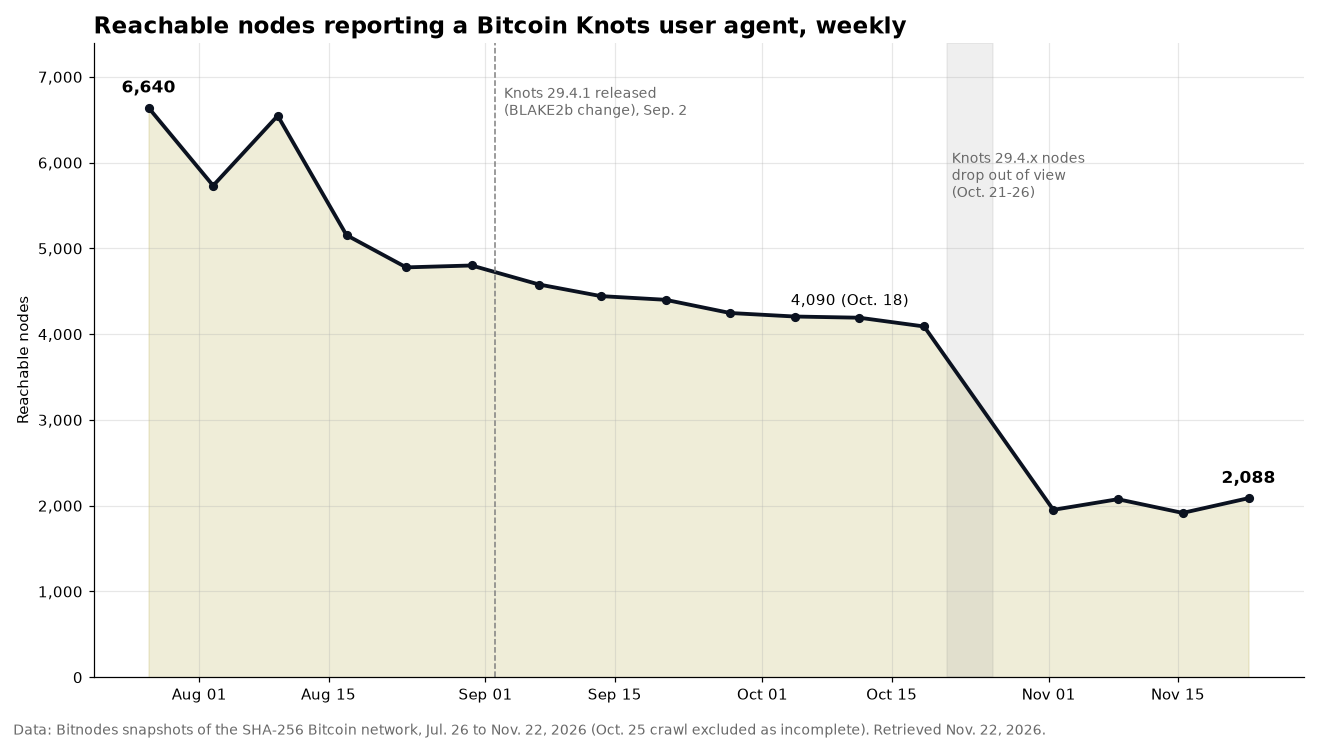
We read that as nodes following the BLAKE2b rules off the SHA-256 network, rather than shutting down. Bitnodes cannot see that other network, so it cannot confirm how many of those nodes are still running.
A few crawls around Oct. 24-26 were incomplete, so we leave the Oct. 25 reading out of the chart. The trend on either side of that gap is clear.
What Bitcoin Nodes Look Like Today
The SHA-256 network still looks deep and healthy. Bitnodes counted 21,662 reachable Bitcoin nodes on Nov. 22 at block height 977,066.
Of those, 19,511, or 90.1%, run Bitcoin Core. Another 2,015 report older Knots builds released before 29.4.1, mostly based on Core 29.3. A further 73 identify as “KnotsSHA256,” builds whose name signals they keep SHA-256 proof-of-work.
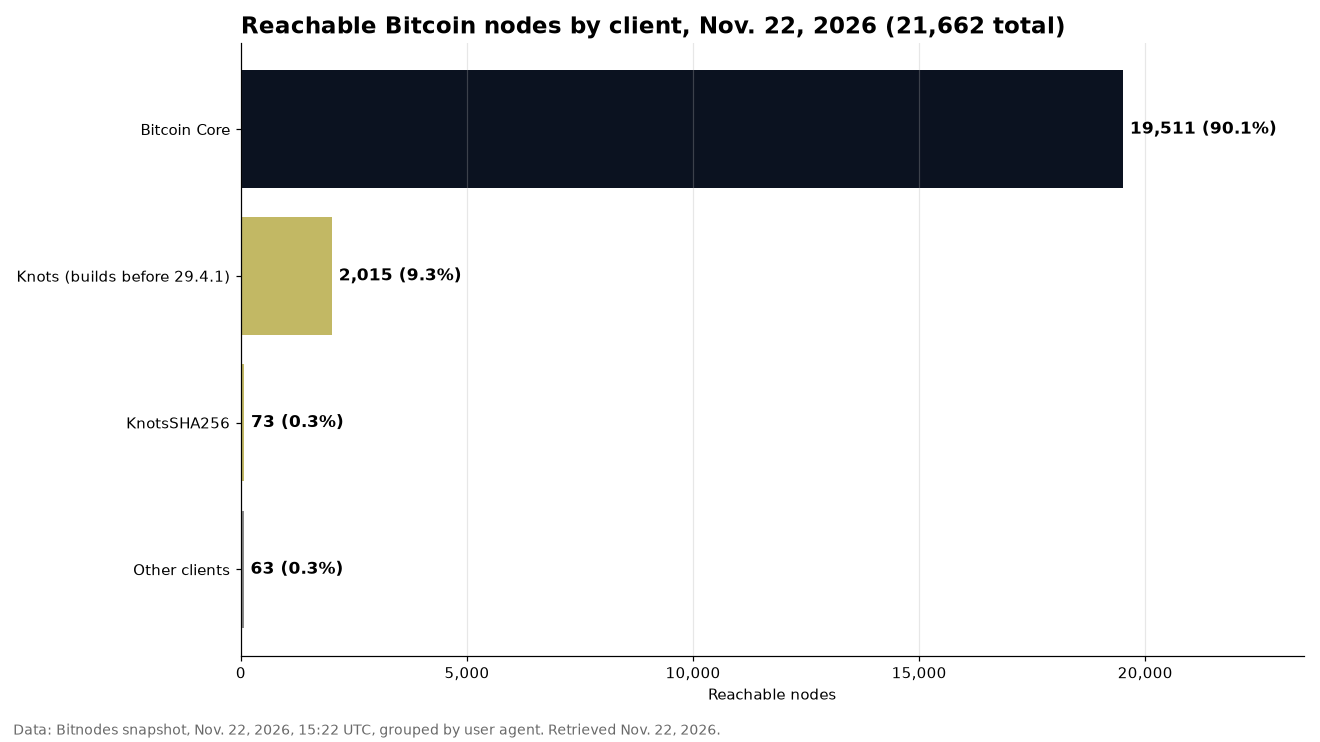
That is a real decline in total count. Bitnodes saw 25,648 reachable nodes on Oct. 19, so the network has about 16% fewer listening nodes than five weeks ago.
Context matters, though. Bitnodes only counts nodes that accept incoming connections, and many home nodes never do. A network with more than 21,000 independently run, publicly reachable nodes remains extremely hard to censor or capture.
As we noted when the AI-flagged Bitcoin Core vulnerability was patched, many Core operators also still need to upgrade. About 7,050 reachable nodes run a Core version that carries the CVE-2026-117348 fix.
What Older Knots Operators Should Weigh
The 2,015 older Knots nodes face a practical choice. Every Knots release since 29.4.1 carries the BLAKE2b rules, so installing 29.5.1 means leaving the SHA-256 network.
Staying put has its own cost. Knots 29.5.1 lists CVE-2026-117348 as newly fixed, which suggests earlier Knots 29.x code shared the flaw, though neither project’s advisory addresses those older builds directly.
Those operators can move to a patched Bitcoin Core release, run a KnotsSHA256 build, or join the BLAKE2b network. That freedom is the point of running a node. No one can force an upgrade, and every user chooses the rules they verify.
We believe this episode shows Bitcoin’s design working as intended. A disagreement over rules played out through voluntary software choices, while the main network kept producing blocks and Core developers kept shipping fixes. Decentralized block building, like the OCEAN mining pool’s DATUM rollout, continues to grow on that same network.
The coming weeks will show whether the remaining older Knots nodes stay on Bitcoin’s SHA-256 chain or follow the BLAKE2b path, and Bitnodes will keep the score in public.
DC Forecasts is a leader in many crypto news categories, striving for the highest journalistic standards and abiding by a strict set of editorial policies. If you are interested to offer your expertise or contribute to our news website, feel free to contact us at [email protected]











Discussion about this post