



The Strategy net reserve is $35 billion and none of the company’s bitcoin is pledged to a lender, Strategy said on Friday, as bitcoin traded near two-year lows.
The statement came in a short post on the company’s X account on the afternoon of Nov. 20, U.S. Eastern time. It drew more than 265,000 views by Sunday.
“During the 2022 bear market, our Net Reserve was negative. 1/3rd of our BTC was pledged as collateral. But we survived and emerged stronger,” the company wrote. “Today, our Net Reserve is $35 billion. All our BTC is unencumbered.”
For Bitcoin investors, the claim answers the question every drawdown raises about the largest corporate holder: can anyone force it to sell?
The bigger question is whether the numbers in Strategy’s own filings back that up. We checked, and they largely do.
What Strategy Said, and What It Left Out
The post did not define “Net Reserve,” give a measurement time or list the line items behind the $35 billion figure.
The unencumbered part, however, is on the record. Strategy’s quarterly report for the period ended Sept. 30 states that it held about 847,666 bitcoins at that date, and 672,500 at the end of 2025, “all of which were unencumbered as of such dates.”
Since then the stack has grown. A Form 8-K filed on Nov. 16 puts holdings at 850,849 BTC as of Nov. 15, bought for $64.20 billion at an average of $75,452 per coin.
So the Nov. 20 message is not a new balance-sheet event. It is a public restatement, delivered when it mattered most.

How the Strategy Net Reserve Adds Up
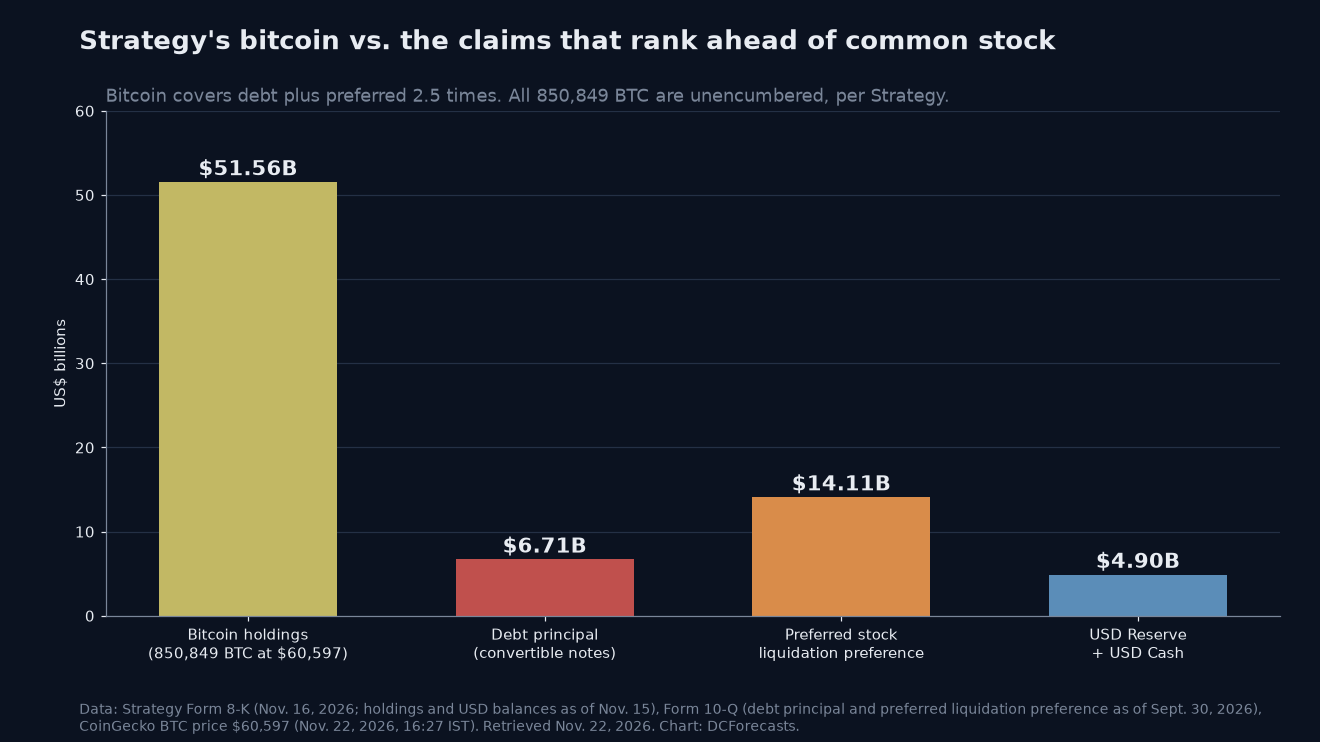
We rebuilt the figure from filed numbers. At CoinGecko’s price of $60,597 on Sunday afternoon, Strategy’s 850,849 BTC are worth about $51.56 billion.
Two claims rank ahead of common shareholders. The 10-Q shows $6.71 billion of convertible note principal and a $14.11 billion liquidation preference on preferred stock, both as of Sept. 30.
Subtract both and bitcoin alone leaves about $30.73 billion.
Add the $4.75 billion USD Reserve and $151.2 million of USD Cash reported for Nov. 15, and the total comes to roughly $35.64 billion. That lands very close to the company’s $35 billion.
One caveat: the preferred figure is seven weeks old. Strategy has been buying back its STRC preferred stock since then, including $228.1 million in the week to Nov. 15, which would trim that claim rather than grow it.
On our numbers, Strategy’s bitcoin covers its debt and preferred stock about 2.5 times over.
Why 2022 Is the Right Comparison
The 2022 comparison is not marketing spin. It comes from the company’s own annual report.
At Dec. 31, 2022, Strategy, then MicroStrategy, held about 132,500 bitcoins, of which only about 82,991 were unencumbered. That means roughly 49,500 coins, or 37%, were tied up.
Of those, 34,619 BTC sat in a collateral account backing a $205 million term loan from Silvergate Bank to its MacroStrategy subsidiary. That loan required a loan-to-value ratio below 50%.
As prices fell that year, the subsidiary deposited 15,153 additional bitcoins into that account to stay inside the limit.
That is the kind of margin-call mechanics that can force selling in a falling market. Today, none of Strategy’s coins are exposed to it.
The holding is also more than six times larger, and the company has moved its funding toward unsecured convertibles and perpetual preferred stock with no maturity date.
The Dollar Buffer Behind the Bitcoin
The USD Reserve is the other half of the story.
Under a policy its board adopted in June 2026, Strategy must keep the reserve at no less than 12 months of expected preferred dividends and interest, and may use it only for those payments.
In the week to Nov. 15, it drew $18.9 million from the reserve for preferred dividends, according to the 8-K.
We believe this structure matters more than the headline number. Dividends and interest can be paid in cash for a year without touching a single coin, and no lender holds a claim on the bitcoin itself.
The common stock still carries the volatility. Strategy’s stack is worth less than it paid, and the company keeps issuing MSTR shares to fund purchases and buybacks, as we covered when it paid $68,887 per bitcoin last week.
How Far Would Bitcoin Have to Fall?
Here is the arithmetic we find most useful. Divide the $20.82 billion of debt and preferred claims by 850,849 coins and you get about $24,474 per bitcoin.
That is the price at which Strategy’s bitcoin would merely match the claims ahead of common stock, before counting any cash. It sits about 60% below Sunday’s price.
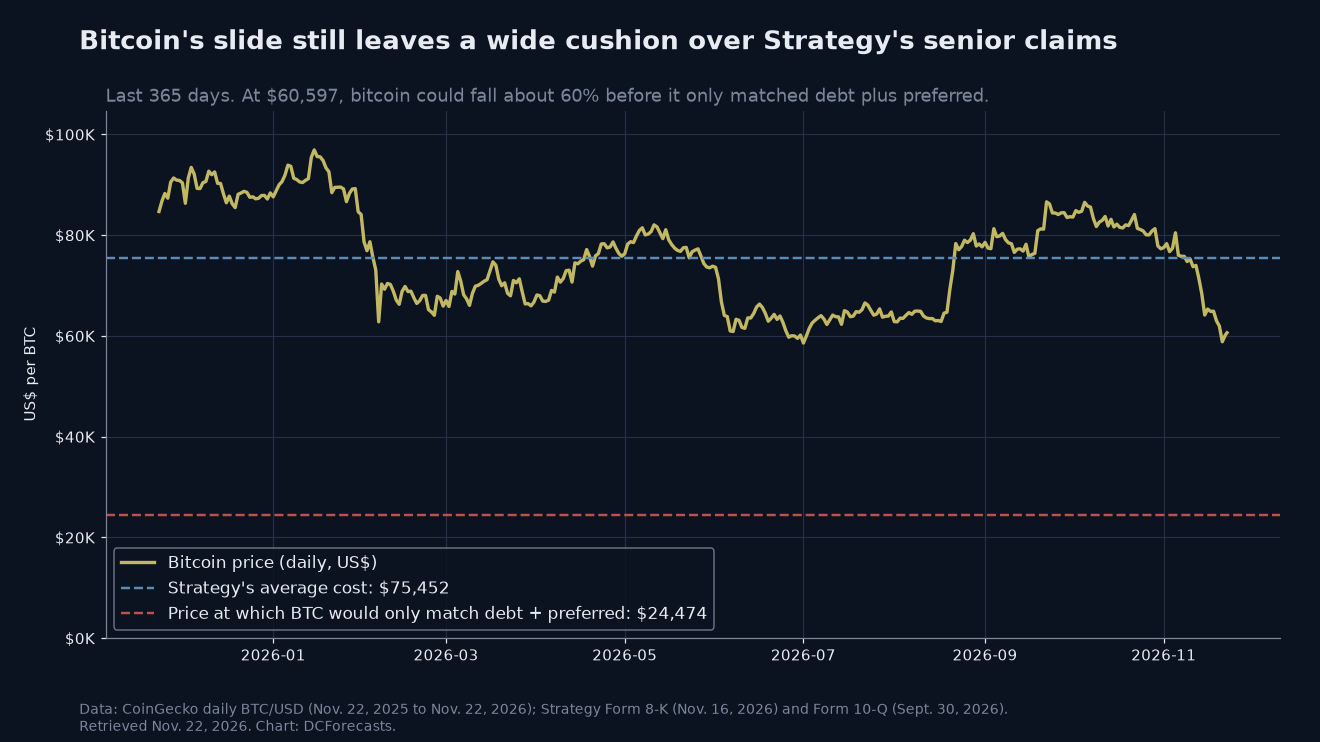
Bitcoin’s past year shows why the cushion matters. According to CoinGecko daily data, BTC peaked near $96,899 on Jan. 15 and is down about 28% from $84,676 a year ago.
Even after that slide, and after Saturday’s rebound to $60,000, the market sits far above the line where the balance sheet would come under strain.
We would watch three things next: the size of Strategy’s weekly STRC buybacks, the USD Reserve balance in each Monday 8-K, and whether purchases resume at larger scale below its $75,452 cost basis.
For us, the key takeaway is simple. The largest corporate holder of a fixed-supply asset is sitting through a 37% drop from the year’s high with no coins pledged and at least a year of dividend and interest cash set aside. That is a very different setup from 2022.
DC Forecasts is a leader in many crypto news categories, striving for the highest journalistic standards and abiding by a strict set of editorial policies. If you are interested to offer your expertise or contribute to our news website, feel free to contact us at [email protected]












Discussion about this post