


The Cardano Foundation wants 24,995,775 ADA from Cardano’s on-chain treasury to run its 2027 conference program, and the delegates voting on it are mostly saying no.
One week into the vote, 25 delegated representatives (DReps) have voted against the request and 15 in favor, according to on-chain governance data from the Koios API.
Measured by stake, the gap is wider. DReps controlling 741.7 million ADA voted no, against 140.8 million ADA voting yes.
For anyone following how blockchain treasuries get spent, this is a useful test. The request comes from the ecosystem’s best-known institution, and it renews a program that passed easily in 2025.
The bigger question is whether DReps now want hard proof of results before they fund marketing.
What the Cardano Foundation Is Asking For
The proposal, titled “Cardano Global Events 2027,” was submitted on-chain on Nov. 16.
It seeks 24,995,775 ADA, which the Foundation priced at US$4,999,155 using an assumed rate of US$0.20 per ADA.
The money would fund a single Cardano-branded presence at 12 industry conferences between January and December 2027. Each stop would include a side event, and four would be hackathons.
The budget also covers travel for Cardano builders who exhibit at those booths. The Foundation says it will not charge for its own staff time and will make no profit from the program.

It describes the plan as a renewal of the Unified Global Events Marketing Strategy that it ran with EMURGO and Rare Network from August 2025 to July 2026.
That program, the Foundation says, won treasury funding with nearly 70% DRep support, ran 20 activities across five continents and gave 79 ecosystem projects a stage. The 2027 version trims the calendar to 12 activations from 14.
At CoinGecko’s price of about $0.146 on Monday, the requested ADA is worth roughly $3.65 million. The Foundation’s assumed rate sits about 37% above that market price.
How the Cardano Governance Vote Is Breaking
The vote did not start one-sided. By the end of Nov. 17, the first full day, about 151 million ADA had voted no and about 61 million ADA yes.
The decisive move came on Nov. 20. A single DRep known on-chain as YUTA, with 482.5 million ADA delegated, cast a no vote. That one ballot accounts for about 65% of all stake voting against.
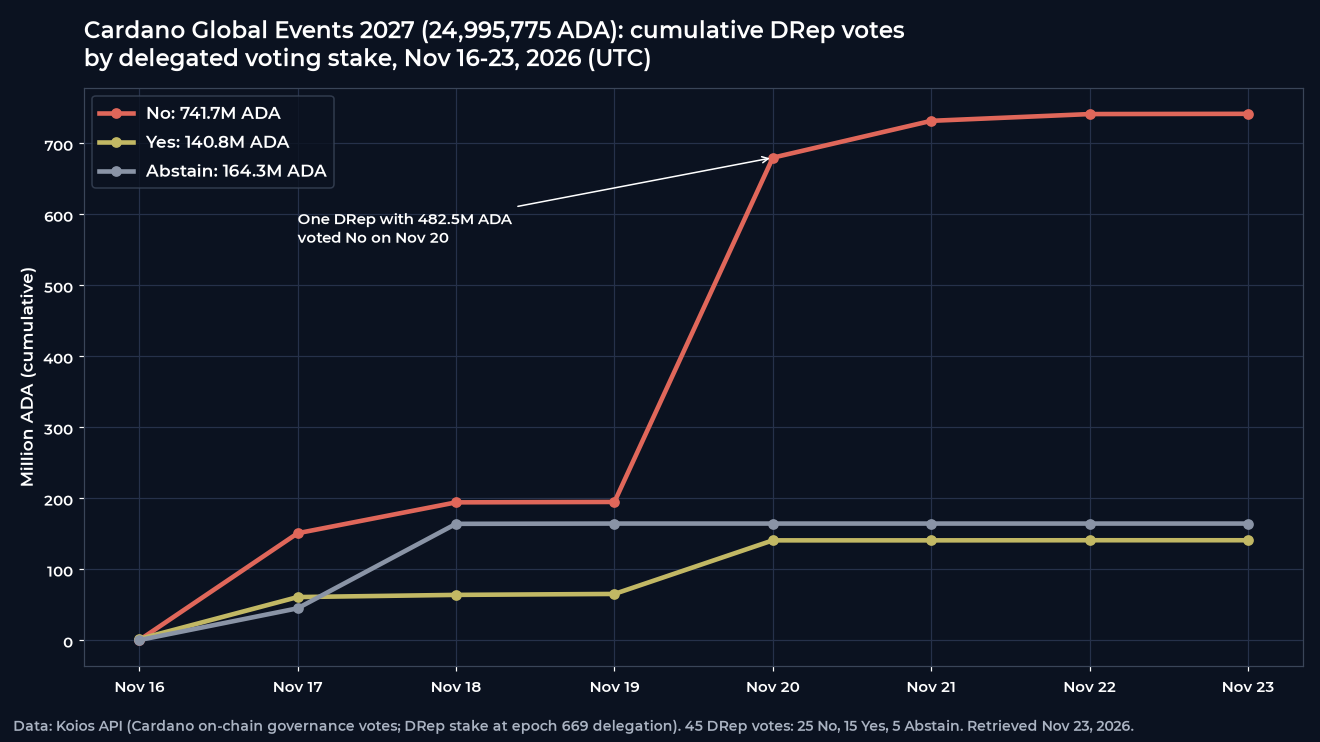
Among DReps who picked a side, about 84% of the stake is against. Another 164.3 million ADA abstained.
Under Cardano’s rules, the formal bar is much higher than a simple majority. A treasury withdrawal needs yes votes from DReps representing 67% of the active voting stake, and stake held by active DReps who stay silent counts against it.
On that formal tally, Koios puts the proposal at 3.03% yes. The constitutional committee, which must also sign off, has not voted yet.
We believe that, barring a dramatic turn, the request is on track to expire unless the Foundation rewrites it.
Why DReps Want Evidence First
The no voters are not arguing that Cardano should skip conferences. Their published rationales focus on measurement.
YUTA’s rationale sets out two tests: whether the spending would “come back to the treasury and the community,” and whether it raises trust in Cardano “in a way ada holders can see.”
To check the first, YUTA matched 13 projects that exhibited at TOKEN2049 Singapore in October 2026 to their on-chain transactions. Compared with similar projects that did not exhibit, the exhibitors did 1.02 times as well over the four weeks after the event, a 2% edge that YUTA said “cannot be told apart from normal variation.”
A second DRep, SASA_nagamaru, with 130.7 million ADA delegated, voted no on Nov. 17. That vote’s rationale says the Foundation reported contacts and wallet registrations but not how many led to production deployments.
“Before supporting a further allocation of approximately 25 million ADA, I need verifiable evidence connecting previous spending to adoption and real-world usage,” SASA_nagamaru wrote.
The yes camp includes DRep Martin Lang, whose 73.3 million ADA backed the plan on Nov. 20.
A Tougher Cardano Treasury in 2026
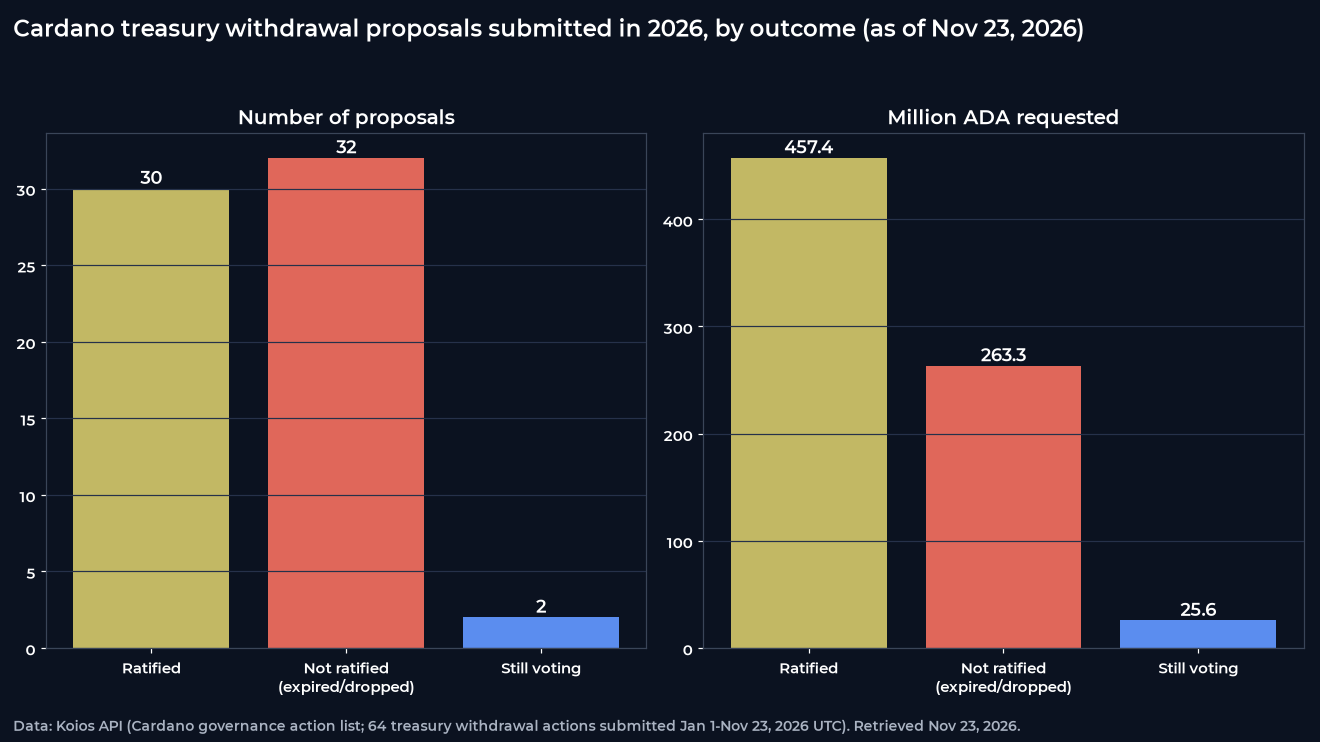
The vote fits a broader pattern. Of the 64 treasury withdrawal proposals submitted in 2026, 30 were ratified, 32 expired or were dropped, and two are still open.
Ratified requests total 457.4 million ADA. The ones that failed asked for 263.3 million ADA.
DReps have recently turned down both unusual and mainstream asks. Earlier this month, as we reported, voters sank a 22 million ADA copper reserve plan by a huge margin.
The 9.6 million ADA police evidence system that we covered on Nov. 10, which listed the Cardano Foundation as a co-author, expired with 41.6% formal support.
The treasury held about 1.43 billion ADA in the current epoch, so the events request equals about 1.75% of it. In a weaker market, each ADA buys fewer dollars of services, which raises the bar for every request.
What Comes Next for the Cardano Foundation
Governance actions on Cardano stay open for six epochs, and each epoch lasts five days. Koios lists this one as expiring in epoch 675, which leaves the vote open into late December.
The Foundation has options. It could resubmit with a smaller budget, a lower ADA price assumption, or the post-event tracking that the no voters keep asking for.
A smaller request is also on the ballot. Mesh, a developer toolkit team, wants 600,000 ADA for maintenance and stands at 14.39% formal support.
We believe the bigger signal is not the likely defeat itself. Cardano’s delegates are setting a clear standard: show measurable on-chain results, then ask for the next round.
For a treasury that holds over a billion ADA, that discipline may matter more to long-term holders than any single booth at any single conference.
DC Forecasts is a leader in many crypto news categories, striving for the highest journalistic standards and abiding by a strict set of editorial policies. If you are interested to offer your expertise or contribute to our news website, feel free to contact us at [email protected]












Discussion about this post