


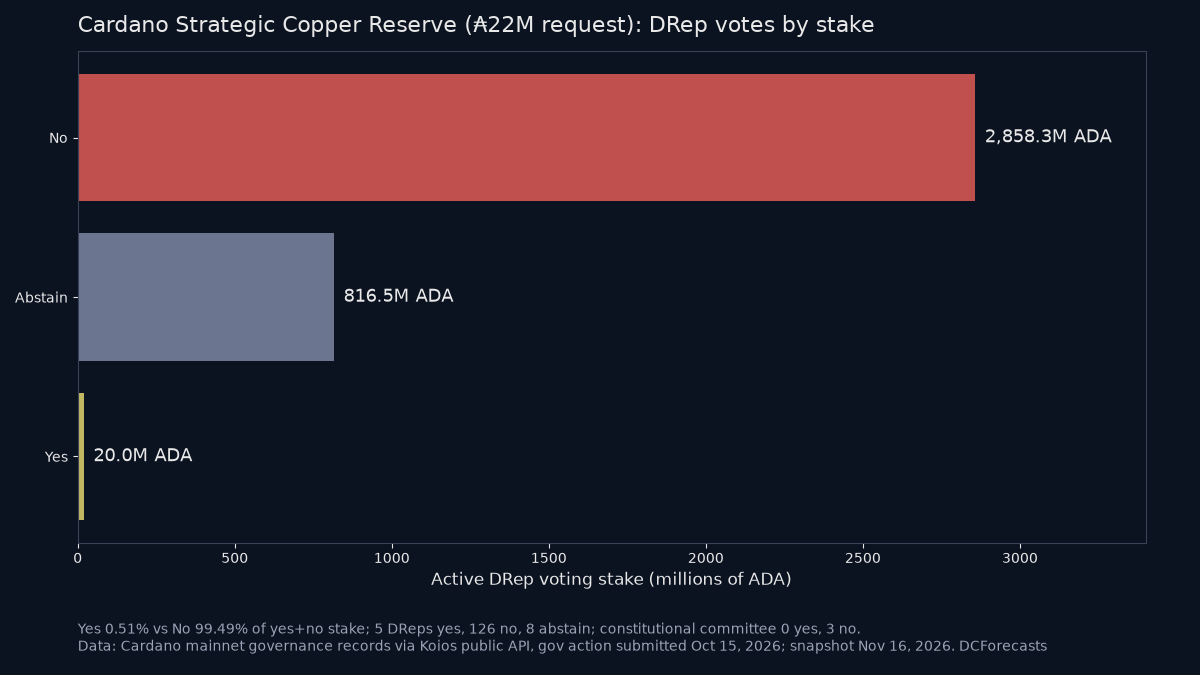
A plan to spend 22 million ADA from the Cardano treasury on a stockpile of physical copper has failed, and not narrowly. When the governance action expired at the epoch boundary late on November 15 (UTC), DReps holding 2.86 billion ADA of active voting stake had voted no, against just 20.0 million ADA in favor. Measured on yes-plus-no stake, that is 99.49% against and 0.51% for.
The constitutional committee was also unanimous: all three of its members who voted cast a no. The proposal, titled “Cardano Strategic Copper Reserve | ₳22M RWA Tokenization,” was submitted on-chain on October 15 and never came close to the bar a treasury withdrawal must clear.
What the Cardano treasury was asked to buy
According to the proposal’s on-chain metadata, Toto Finance Inc., a U.S.-based company named as both recipient and accountable administrator, asked for a one-time withdrawal of exactly 22,000,000 ADA. The plan was to buy COMEX Grade 1 copper cathodes held in a COMEX-approved U.S. warehouse and tokenize the metal as a token called CuTT, with one token representing one verified pound of copper.
The budget split was spelled out in detail. Of the 22 million ADA:
- 14,724,409 ADA (66.93%) would go to buying copper
- 2,640,000 ADA (12%) to Toto Finance technology and project management, paid on milestones
- 3,533,859 ADA to external operations and assurance
- 441,732 ADA to execution costs
- 660,000 ADA to independent administration
The proposal described an 18 to 24-month holding period, followed by a controlled sale of the copper and the return of 100% of realized net sale proceeds, plus any unused budget, to the treasury by month 36. It also stated that an independent oversight provider would be appointed, naming a U.S. PwC member firm as preferred but “not engaged,” and said Toto Finance had received no Cardano treasury funds in the previous 24 months.
At an ADA price of about $0.152 on Monday morning, the full request was worth roughly $3.35 million. It represented about 1.54% of the 1.43 billion ADA sitting in the treasury at the start of epoch 668.
How lopsided was the Cardano governance vote?
By headcount, only five DReps voted yes, while 126 voted no and eight abstained. By stake, the gap was even wider. Yes votes carried 20.02 million ADA, abstentions 816.5 million ADA and no votes 2.86 billion ADA.
Cardano’s current protocol parameters require a treasury withdrawal to win at least 67% DRep approval, in addition to constitutional committee approval. The copper proposal reached less than one percent.
The vote also reflects the nature of the request. Rather than paying for software or infrastructure, the plan asked the network to take on commodity price exposure and warehouse custody risk.

A treasury that says no far more often than yes
The copper rejection is extreme, but rejection itself is the norm. Since June 24, 2026, fifteen treasury withdrawal requests have reached mainnet. Only two have been ratified: AlphaGrowth’s 120 million ADA Cardano PRIME request, which won 80.1% DRep support, and Se7en Labs’ 1.79 million ADA plan to maintain the Daedalus wallet, which won 77.1%.
Eleven have expired or been dropped, including several that won majority backing yet fell short of the 67% threshold. A 103,000 ADA request to reimburse Ikigai’s governance action deposit reached 65.2%, and the 2.46 million ADA Scalus 2026 development plan reached 51.8%. Two requests are still open: a 9.6 million ADA action submitted on October 21 without a title in its metadata, currently at 29.9%, and the 940,000 ADA AURORA credit infrastructure request at 4.1%.
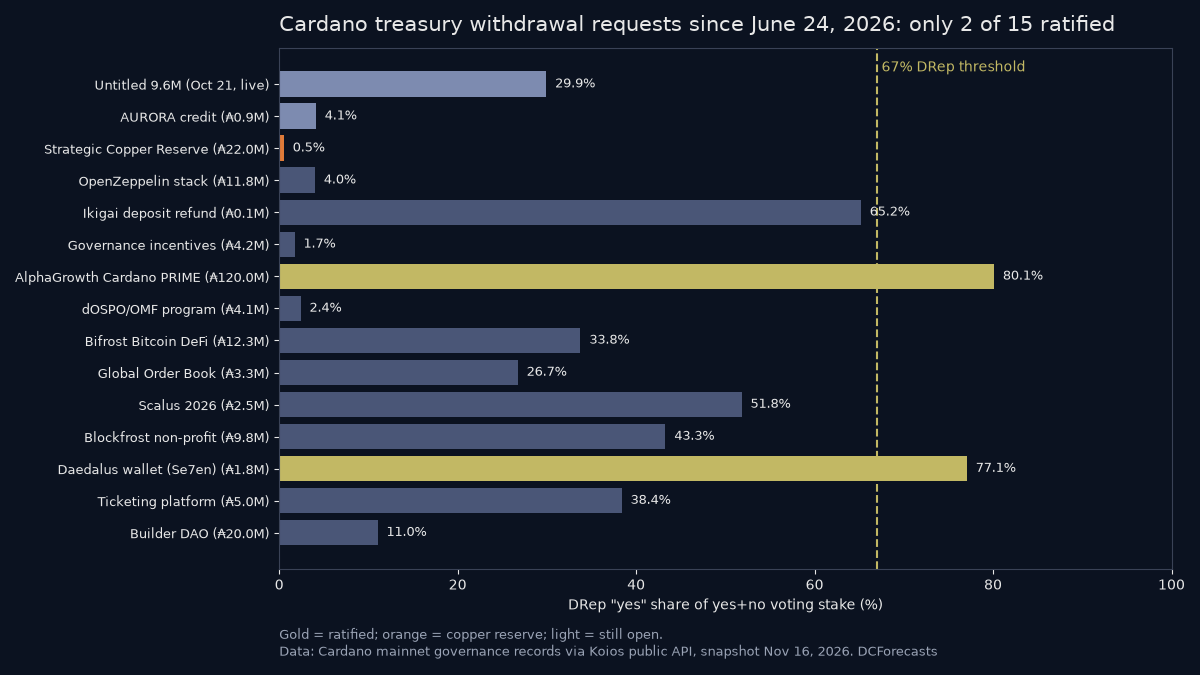
Among the failed requests was Bifrost, a 12.3 million ADA proposal pitched as “Unlocking Bitcoin DeFi on Cardano,” which drew 33.8% support. That result shows Bitcoin’s pull reaches even into rival ecosystems, where builders keep looking for ways to put BTC to work, even when a particular funding request does not succeed.
Why tokenized copper struggled to win support
Real-world asset tokenization is one of the busiest themes in crypto, and the proposal leaned into it directly, presenting copper as an essential input for power grids, data centers and electrification. The proposal itself was candid about the risks. Its rationale stated that “neither industry adoption nor original Treasury principal recovery is guaranteed,” and that no public listing, liquidity or DeFi yield was promised.
Those disclosures framed the trade-off DReps were weighing. Roughly two-thirds of the money would have bought a commodity whose price can move in either direction during the holding period, while about a third would have paid for technology, assurance and administration. A treasury that has turned down 11 of 15 requests since June was unlikely to back a commodity position with no guaranteed return of principal.
The outcome also shows on-chain governance working as designed: a proposal was submitted openly, voted on by stake and rejected, and every figure here can be checked against public chain data. DCForecasts recently covered another Cardano treasury story, an Indian police evidence project.
What the copper vote signals for the Cardano treasury
The treasury still holds about 1.43 billion ADA, and two withdrawal actions remain open. The copper result makes the bar clear for future requests: a commodity reserve or an asset-holding experiment will need much stronger safeguards, or a much smaller first step, to get close to 67%.
For Bitcoin holders, the episode is a reminder of a design choice Bitcoin made long ago. Bitcoin has no protocol treasury and no committee deciding how to spend shared funds. Its fixed 21 million supply and absence of a central budget leave capital allocation to individual holders, the simplicity that continues to set the original cryptocurrency apart.
DC Forecasts is a leader in many crypto news categories, striving for the highest journalistic standards and abiding by a strict set of editorial policies. If you are interested to offer your expertise or contribute to our news website, feel free to contact us at [email protected]












Discussion about this post