


ABTC stock holders learned on Monday that American Bitcoin Corp. now has a $150 million credit line it can tap without selling a single coin or issuing a single share.
In a Form 8-K filed with the SEC on Nov. 23, the miner said its subsidiary, American Bitcoin Operating LLC, signed a committed revolving facility with FalconX Charlie, Inc. on Nov. 18.
The loan fee is 5.95% a year, the facility runs to Nov. 18, 2028, and the only security is bitcoin held at Anchorage Digital Bank.
No money has been drawn yet. For Bitcoin investors, that may be the most telling detail: the company arranged liquidity in the week bitcoin hit a two-year low, then left it on the shelf.
The bigger question now is how much of American Bitcoin’s 8,427-coin reserve this line could tie up, and at what prices the collateral rules would start to bite.
What American Bitcoin Signed With FalconX
The filing describes a $150.0 million committed revolving facility. Borrowed dollars carry the 5.95% annual loan fee, and the company pays a commitment fee on any undrawn amount.
Those commitment fee rates are redacted in the term sheet filed as Exhibit 10.1. They are split into two tiers, one for the first $50 million of the line and one for the remaining $100 million.
American Bitcoin can prepay at any time without penalty and borrow again before maturity. FalconX may extend the term by three more years, if the borrower accepts.
The company said the money is for “general corporate purposes.”

Two protections stand out. The lender’s recourse is limited to the pledged collateral, apart from customary carve-outs for fraud and willful malfeasance. And neither FalconX nor Anchorage may lend, pledge or rehypothecate the posted bitcoin.
We believe that second clause matters most. It means the coins sit segregated with a federally chartered custodian rather than being recycled through a lender’s balance sheet.
How the 143%, 130% and 105% Triggers Work
Every draw must start with collateral worth at least 143% of the amount outstanding, measured across the whole facility.
If that ratio falls below 130%, FalconX can issue a margin call that requires enough extra bitcoin to restore 143%. Below 105%, the lender may declare a default and, after the required notices, liquidate the collateral.
The rules also work in the borrower’s favor. If the ratio stays above 163% for 30 straight days, American Bitcoin can ask for coins back until it returns to 143%.
To make the numbers concrete, we ran a simple illustration. If the full $150 million were drawn today with bitcoin near $61,307, the company would need to post about $214.5 million of collateral, or roughly 3,499 BTC.
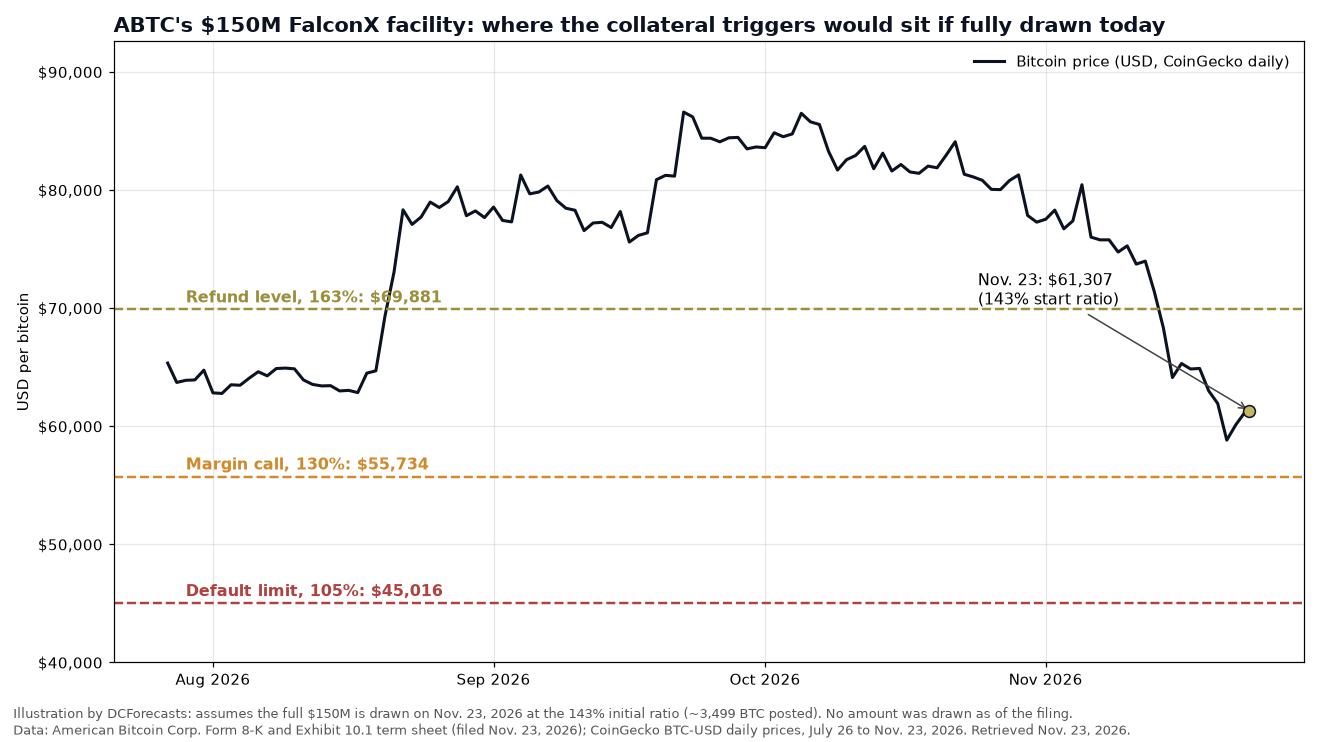
On those assumptions, a margin call would come near $55,734, about 9% below today’s price. The default limit would sit near $45,016, about 27% lower.
The refund level would be near $69,881, a 14% rally that the price has to hold for 30 days.
That margin-call line is close to recent action. Coinbase BTC-USD candles show bitcoin’s intraday low on Saturday, Nov. 21, was $55,106 before the price recovered above $61,000.
A real borrower would rarely draw everything at once or post only the minimum, so these levels are a stress test, not a forecast.
Can the ABTC Stock Reserve Carry the Load?
American Bitcoin’s third-quarter results, filed on Nov. 4, put its holdings at about 8,427 BTC on Sept. 30. That figure includes about 3,090 BTC pledged for miner purchases under agreements with Bitmain.
That leaves roughly 5,337 coins unpledged. A full draw at today’s price would need about two-thirds of them.
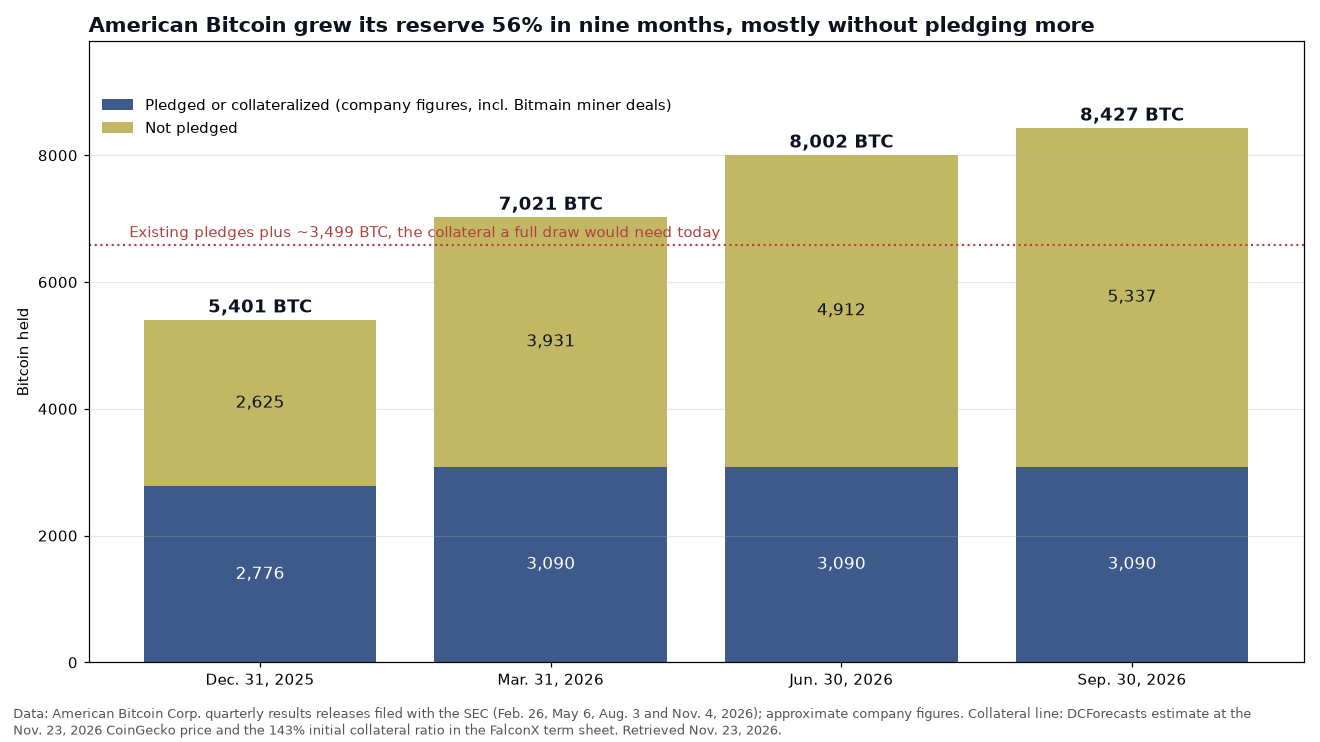
The trend in that reserve is constructive. Holdings rose from about 5,401 BTC at the end of 2025 to 8,427 BTC nine months later, a 56% gain, while the pledged slice grew by only about 314 coins.
The company said it mined about 891 BTC in the third quarter and raised satoshis per share by about 5%, without ATM share sales or bitcoin purchases.
Its cost to mine was about $42,100 per coin, against revenue of about $71,100 per bitcoin mined. American Bitcoin is majority-owned by Hut 8 Corp.
Why a Bitcoin Loan Can Beat Selling the Coins
This year, some miners have chosen the opposite route. As we reported, MARA and Riot sold 60,845 bitcoin in 2026 to fund power plants and AI campuses.
A bitcoin loan keeps the asset on the balance sheet. If the price recovers, the borrower keeps the upside and pays 5.95% a year on what it actually uses.
Collateralized borrowing can also go wrong. Our coverage of PowerCompute’s bitcoin-backed loan showed how quickly pledged coins can disappear when a lender liquidates.
For us, the difference here is structure. The line is committed, recourse is limited to the collateral, there is no rehypothecation, and nothing is drawn while bitcoin trades near $61,000.
What American Bitcoin Corp. Shareholders Should Watch
The first signal is whether, and when, management draws on the facility. That should show up in future SEC filings.
The second is the reserve itself. Further growth in unpledged coins would widen the buffer above the 130% margin-call line.
The third is the price. A move back above $69,881 would put a fully drawn line at the 163% refund level, though the 30-day test means a brief spike would not be enough.
We believe the FalconX deal shows how far bitcoin has come as collateral. A Nasdaq-listed miner can now borrow against it at a fixed annual fee, through a regulated custodian, for up to five years if the extension is used.
The coming weeks will reveal whether American Bitcoin treats the line as a safety net or as fuel to keep stacking.
DC Forecasts is a leader in many crypto news categories, striving for the highest journalistic standards and abiding by a strict set of editorial policies. If you are interested to offer your expertise or contribute to our news website, feel free to contact us at [email protected]











Discussion about this post