


Bisq has made its Java4Shell security patch mandatory, telling users of its peer-to-peer Bitcoin exchange to update now, even if they are not trading.
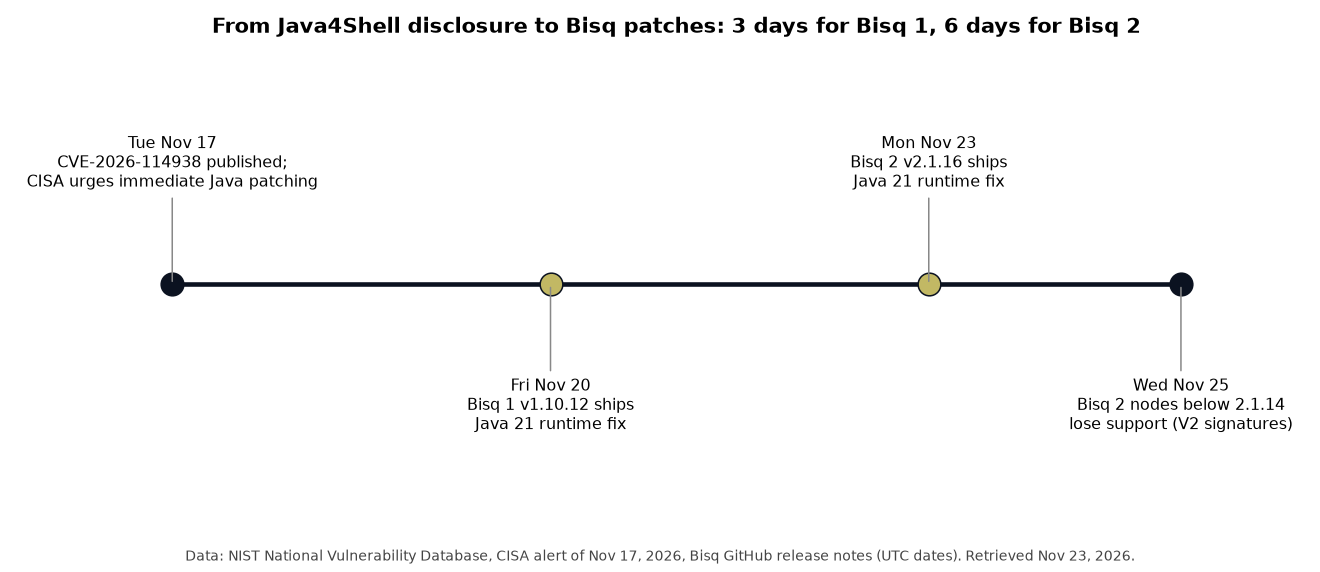
Bisq 2 version 2.1.16 went out on Monday, Nov. 23, three days after Bisq 1 version 1.10.12 shipped the same fix on Nov. 20.
Both releases swap in a patched Java 21 runtime for CVE-2026-114938, a flaw that the U.S. Cybersecurity and Infrastructure Security Agency calls critical. The release notes say updating “is required to continue trading.”
For Bitcoin users, the interesting part is how a network with no company, no server farm and no customer database handles a security emergency.
The bigger question is how quickly thousands of independent desktop nodes can move to the new version.
What Java4Shell Is and Why Bisq Had to Move
The National Vulnerability Database at NIST lists CVE-2026-114938 as a vulnerability in Oracle Java SE and GraalVM, published on Nov. 17.
The database shows a CVSS 3.1 base score of 8.1, rated high. An unauthenticated attacker with network access can exploit it, though the database classes the attack as difficult. A successful attack can result in takeover of the Java runtime.
The same day, CISA urged organizations to patch immediately.
CISA describes a memory-corruption bug in the Base64 decoder of the x86-64 HotSpot Java Virtual Machine. Specially crafted input could crash the JVM and allow remote code execution.

The agency also warned that Java runtimes “bundled with third-party applications” may not appear in software inventories. That describes Bisq exactly.
Bisq ships its own Java runtime inside the installer, so a system-wide Java update would not have protected its users. The developers had to rebuild the app itself.
Both new versions are built with Amazon Corretto 21.0.13.1 or newer, the Java build that carries the fix.
Bisq 2 Gets the Fix Two Days Before a Network Cutoff
The timing matters for Bisq 2 users.
Separately from the Java patch, the project says all Bisq 2 nodes must run version 2.1.14 or later before Nov. 25. From then on, updated nodes will require V2 storage signatures. Older clients will have connection and data problems and will no longer be supported.
Anyone still on an old build therefore has two reasons to update this week.
Bisq 2.1.16 also fixes several trade-handling bugs. Messages that arrive before a trade can process them are now stored with the trade, so it no longer stalls after a restart. Closed trades also stop showing up among open ones.
Tor, the anonymity network that carries Bisq’s peer-to-peer traffic, moves to version 0.4.9.16. A slow first peer exchange no longer aborts startup after 90 seconds.
How Fast Are Bisq Users Upgrading?
GitHub download counts give a rough read on uptake, though they are not a user count. Mirrors and repeat installs inflate them, and some users build from source.
By late Monday morning in Israel, the Bisq 1 v1.10.12 installers had been downloaded 3,770 times in about three days. Its predecessor, v1.10.11, has 20,406 installer downloads since Nov. 5.
Bisq 2 v2.1.16 had 99 installer downloads roughly nine hours after release, against 1,996 for v2.1.15.
The gap between the two apps is a reminder that Bisq 1 is still the main venue. Bisq 2’s last four full releases drew roughly 2,000 to 3,000 installer downloads each, against roughly 13,000 to 23,000 for Bisq 1’s last four.
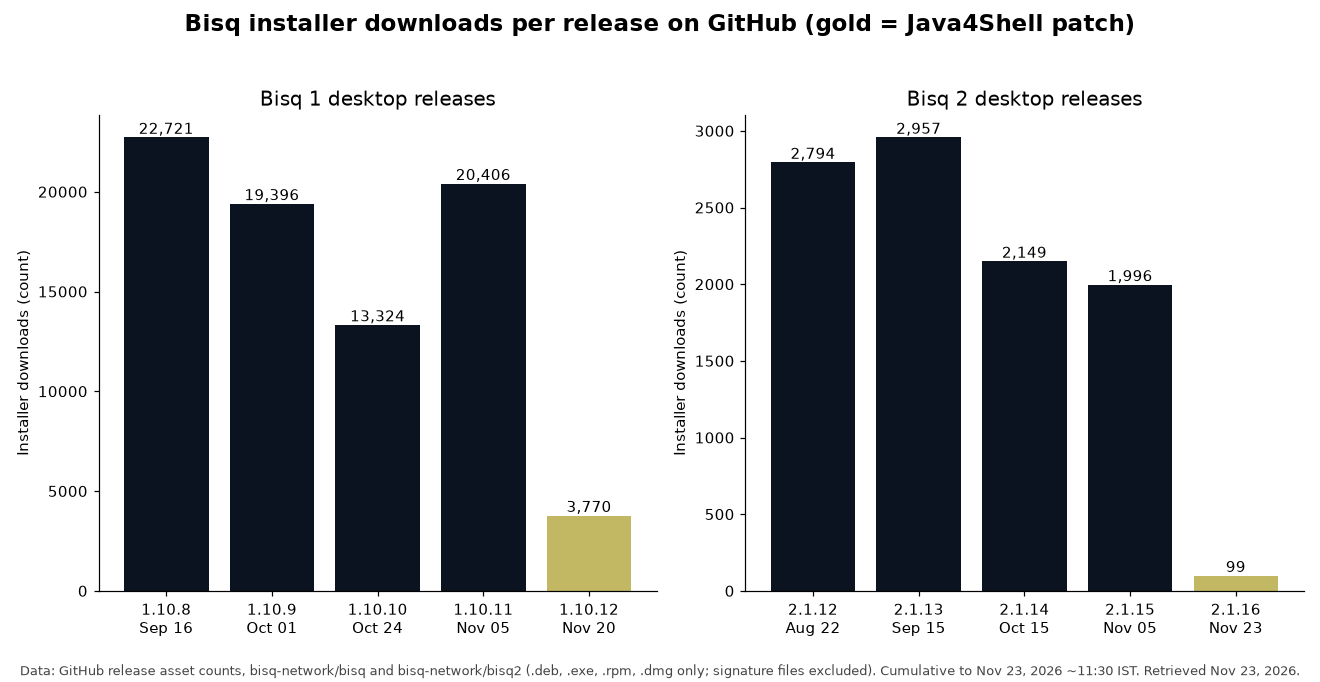
We would watch whether v1.10.12 catches up with the 20,000-plus range of recent releases over the next two weeks. Since the update is required to keep trading, it should.
Bisq 1 Adds 18 Stablecoin Payment Methods
The Bisq 1 release is more than a security patch.
It adds stablecoins as a way to pay for BTC in USD markets: USDT, USDC, USDS, USDe, DAI, RLUSD, USDG, PYUSD, U and USDF across Ethereum, Tron, BNB Smart Chain and Solana, 18 methods in all.
One coin pays one dollar, trades get a 24-hour window, and the highest trade limit applies without account age or signing.
A new custom payment method covers payment rails Bisq does not support, in every fiat currency, with a 0.01 BTC trade limit.
The release also lowers default fee rates to 5 sat/vB, with a 2 sat/vB floor. That fits a quiet mempool, as we noted when Bitcoin fees fell below 1 sat/vB in 81 of 144 blocks on Sunday.
We believe stablecoin rails could make a real difference for Bisq. Bank transfers are slow and get disputed, while a dollar token on a fast chain settles in minutes.
Why a P2P Bitcoin Exchange Patch Is Good News
A serious flaw in a widely used runtime is never welcome. Still, the response here shows what open-source Bitcoin software does well.
The fix was public, the code changes were public, and users can verify downloads against published signing keys. No exchange had to freeze withdrawals, because Bisq never holds user funds. In Bisq 1, each trade’s bitcoin sits in a 2-of-2 multisig escrow shared by the two traders.
That is the same self-custody logic that keeps Bitcoin’s base layer resilient. It’s also why we keep tracking node software, as we did when an AI-flagged Bitcoin Core vulnerability was patched while many nodes lagged.
The weak point is the same in both cases: people who don’t update. Bisq has dealt with that by making the new version a condition of trading, which pushes the network to upgrade quickly.
For anyone holding Bitcoin in a non-custodial setup, the lesson is simple. Keep wallet and trading software current, and check signatures before installing.
The next few days, with Bisq 2’s Nov. 25 cutoff, will show how fast a decentralized exchange can move its users without anyone in charge. We believe that kind of coordination is one of Bitcoin’s quiet strengths.
DC Forecasts is a leader in many crypto news categories, striving for the highest journalistic standards and abiding by a strict set of editorial policies. If you are interested to offer your expertise or contribute to our news website, feel free to contact us at [email protected]












Discussion about this post