


Grayscale’s newest Zcash ETF product doubles the daily move of an existing fund, and its own prospectus spells out what that leverage costs.
The 2x ZCSH ETF, ticker ZECX, became effective on Nov. 23 for listing on NYSE Arca, according to a post-effective amendment Grayscale Funds Trust filed with the SEC on Nov. 20. A summary prospectus dated the same day followed on Monday.
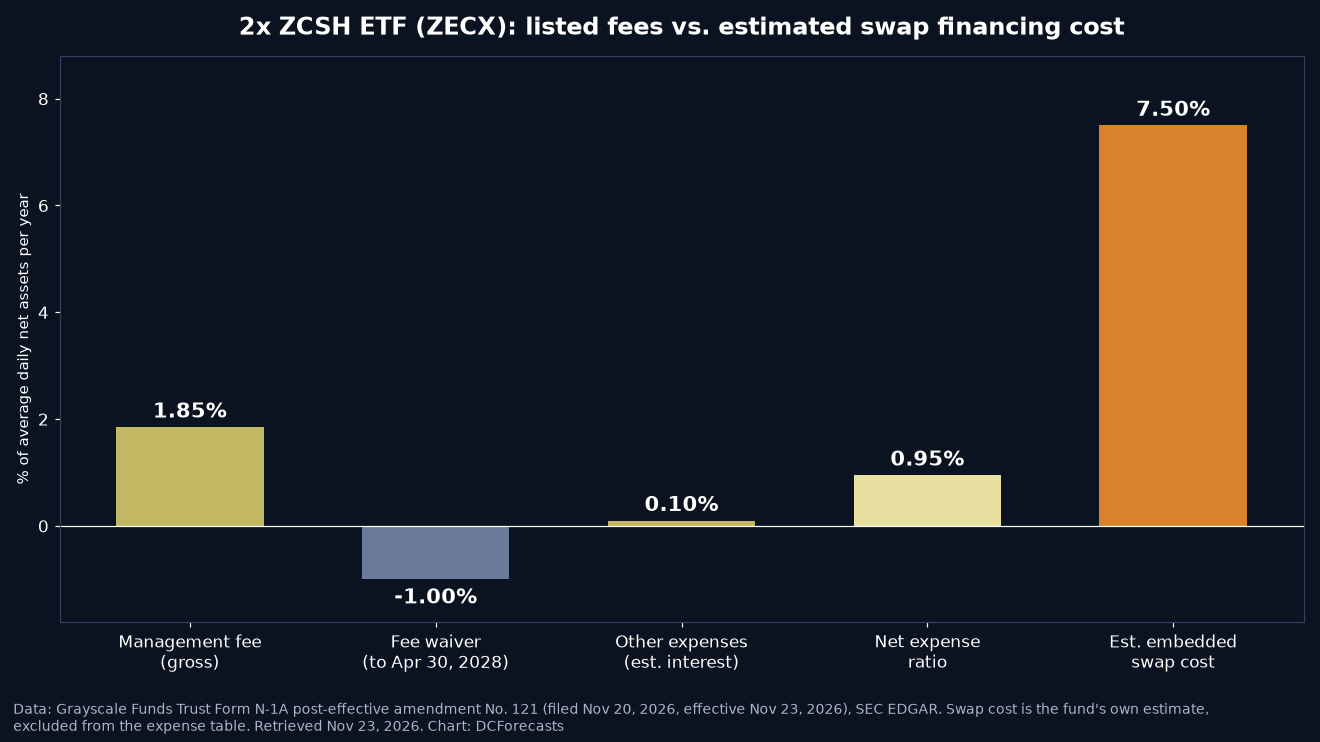
The headline expense ratio is 0.95% after a fee waiver. One footnote lower down, the fund estimates that the financing built into its swap contracts will run at about 7.50% of assets a year.
For crypto investors, that gap is the real story. It shows how quickly the cost of leverage compounds on a coin that swings as hard as Zcash.
The bigger question is who this product is really for, and what its numbers say about the difference between trading volatility and owning a scarce asset.
What Grayscale Filed for the 2x ZCSH ETF
ZECX does not hold ZEC directly. It aims for two times the daily performance of The Zcash ETF (ZCSH), Grayscale’s spot Zcash fund on NYSE Arca, measured from one 4:00 p.m. Eastern close to the next.
To get there, the fund plans to use cash-settled swaps that reference ZCSH first. It will add Zcash futures when they are available and ZCSH options if needed, all held mainly through a wholly owned Cayman Islands subsidiary.
Grayscale Advisors is the adviser. Tidal Investments is the sub-adviser.
The filing is blunt about the risk. If ZCSH falls 50% or more in a single day, the prospectus warns, investors could lose all or substantially all of their money.

It also calls ZECX a short-term trading vehicle for investors who actively monitor their positions. It is a new, non-diversified fund with no operating history.
A 0.95% Fee Next to a 7.5% Swap Estimate
On paper, the fee table looks competitive for a leveraged crypto ETF. The gross management fee is 1.85%, and Grayscale has contractually agreed to waive 1.00% of it through at least April 30, 2028.
Add 0.10% of estimated interest expense and the net figure lands at 0.95%.
The swap estimate sits outside that table. The fund says the embedded cost of its swaps is “approximately 7.50%” of average daily net assets, based on expected exposure and current counterparty financing rates and spreads.
Those costs never show up as a line item. They simply reduce the value of the swaps, and therefore investors’ returns.
There is one more layer. ZCSH itself charges a 2.50% sponsor’s fee, and the adviser has agreed to waive an equal portion of its management fee on any ZCSH shares the fund holds directly.
We believe that 7.50% number is the most useful disclosure in the whole document. Anyone comparing leveraged crypto ETF products should look past the expense ratio to the financing line.
Why Leveraged ETF Decay Hits Zcash Harder
Daily reset funds lose ground when prices chop up and down, even if the underlying ends flat. The prospectus includes its own table to show it.
With ZCSH flat over a year and volatility at 50%, the table puts ZECX at minus 22.1%. At 100% volatility, the same flat year becomes minus 63.2%.
Even a 20% gain in ZCSH at 100% volatility translates into a 47.0% loss for the 2x fund. Those figures already assume zero fees and zero borrowing costs.
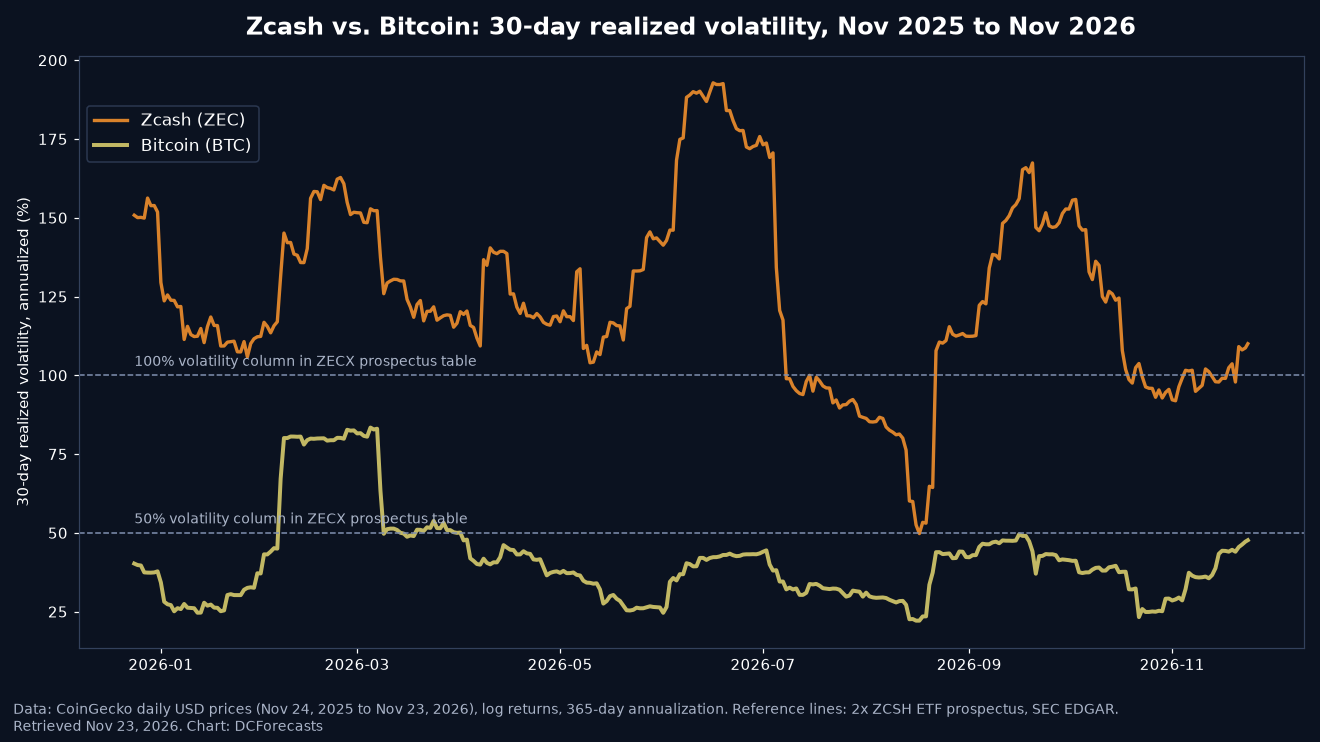
Zcash lives in that high-volatility zone. Based on CoinGecko daily prices, ZEC’s 30-day realized volatility, annualized, stayed above 100% in 267 of the last 336 rolling windows. It was about 110% on Nov. 23.
Over the full year, ZEC traded between a $197 low on March 8 and a $1,653 high on Sept. 27. It changed hands near $835 on Monday, up about 46% from a year ago.
That is exactly the setting in which leveraged ETF decay does its damage. A trader can be right on direction over a month and still lag a simple 2x expectation by a wide margin.
How Bitcoin’s Volatility Compares
The same calculation tells a calmer story for Bitcoin. BTC’s annualized volatility over the past year was about 44%, roughly a third of Zcash’s 130%.
Its 30-day volatility topped 50% in only 50 of those 336 windows, and it sat near 48% on Monday with BTC around $61,800.
That matters for anyone weighing leverage against ownership. Lower volatility means less daily-reset drag, and Bitcoin’s fixed 21 million supply rewards patient holders without any swap counterparty in the middle.
We believe that is a quiet strength of the largest crypto asset. Its maturing volatility profile and deep spot ETF market make it the natural core holding, while products like ZECX serve short-term traders at the edges.
What the Zcash ETF Lineup Says About Demand
ZECX is a sign of how far the Zcash ETF market has come in a few months. As we reported, Grayscale pledged to reinvest a year of Zcash ETF fees into the network, and Bitwise is seeking a Texas Stock Exchange listing for its own Zcash fund.
Issuers rarely build leveraged products on top of funds that nobody trades. A 2x wrapper suggests Grayscale sees an active trading audience for privacy-coin exposure.
For us, the key takeaway is about reading the whole prospectus. A 0.95% net fee, a 7.50% swap estimate and a volatility table that turns flat years into steep losses all belong in the same sentence.
Leverage can be a useful tool for disciplined traders. For long-term wealth building, we still think the strongest case belongs to Bitcoin itself: scarce, increasingly institutional and far steadier than it used to be.
The coming weeks will show whether ZECX draws real trading volume once it starts changing hands, and whether lower-cost structures follow.
DC Forecasts is a leader in many crypto news categories, striving for the highest journalistic standards and abiding by a strict set of editorial policies. If you are interested to offer your expertise or contribute to our news website, feel free to contact us at [email protected]












Discussion about this post