



A strong dollar is back: the Federal Reserve’s broad trade-weighted dollar index closed at 123.60 on Friday, Nov. 20, its highest level since April 15, 2025, according to the Fed’s H.10 release published on Monday.
The gauge gained 0.77% in a week and 1.59% since the end of October.
It now sits 5.2% above its 2026 low of 117.44, set on Jan. 29, yet still about 5% below its January 2025 record.
For Bitcoin investors, the more revealing detail sits underneath the headline number. Most of last week’s dollar strength came from emerging-market currencies, and that changed how deep Bitcoin’s slide looked depending on where its holders live.
The bigger question now is whether this run is close to fading, as it did after the last two peaks.
What Pushed the Broad Dollar Index Higher?
The broad index weighs the dollar against the currencies of major U.S. trading partners, with January 2006 set at 100.
Its emerging-market component did the heavy lifting. That sub-index rose 1.12% in the week to 132.35, its highest close since Aug. 21, 2025.
The advanced-economy component gained just 0.42%.
The Fed’s H.10 exchange-rate tables show where the dollar strength concentrated between Nov. 13 and Nov. 20:

- Brazilian real: from 5.6449 to 5.9488 per dollar, a 5.4% dollar gain.
- South African rand: from 16.93 to 17.48, a 3.2% gain.
- Mexican peso: from 18.57 to 19.04, a 2.5% gain.
- Australian dollar: from US$0.6775 to US$0.6639, a 2.0% gain.
Not every currency gave ground. The dollar slipped 0.7% against the yen and 1.7% against the Indian rupee over the same week.
We believe that mix matters. It looks like a broad risk-off move rather than a story about a single central bank.
Dollar Strength Arrived as Two-Year Yields Eased
Interest rates tell a more nuanced story.
The Treasury’s daily yield curve shows the two-year note at 4.63% on both Nov. 20 and Nov. 23, down from 4.80% on Nov. 17 and Nov. 18.
So the dollar’s late-week gains came while short-term yields were falling.
In our view, that fits a flight to safety during the equity selloff better than a fresh repricing of Fed policy. As we found when we measured Bitcoin’s 0.69 correlation with the Nasdaq, stocks have been the stronger driver of Bitcoin’s recent swings.
Rates still matter this week. The Bureau of Economic Analysis publishes October personal income and outlays, which include PCE inflation, on Wednesday, Nov. 25 at 8:30 a.m. ET.
We set out what is at stake in that release in our PCE inflation preview.
How Bitcoin Looked in Reais, Rand and Yen
Bitcoin fell from $68,237 to $58,815 between the Coinbase daily closes of Nov. 13 and Nov. 20, a 13.8% drop in dollar terms.
Priced in other currencies, using the Fed’s noon buying rates for the same dates, the decline was smaller for many holders.
Brazilian holders saw roughly a 9.2% fall in reais. In rand the drop was about 11.0%, and in pesos about 11.6%.
Japanese and Indian holders felt it more: about 14.4% in yen and 15.2% in rupees, because their currencies firmed against the dollar.
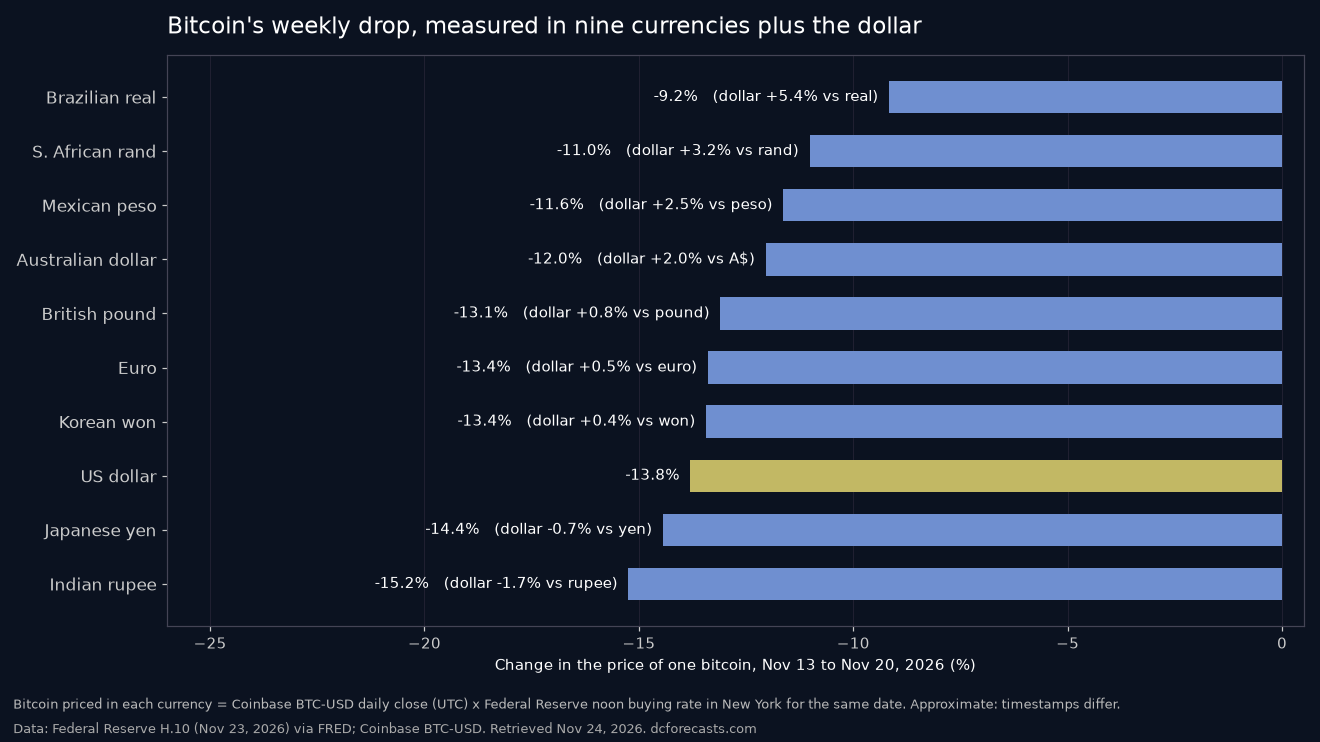
We think this is a useful reminder. Bitcoin trades in every currency at once, and for savers whose local money is weakening it can soften the blow even in a drawdown.
It did not prevent losses last week. It did cushion them where local currencies were sliding fastest.
What Happened After the Last Dollar Peaks?
Recent history offers some encouragement, with caveats.
The broad index set its record of 130.04 on Jan. 13, 2025, a day Bitcoin closed at $94,506.
By Oct. 6, 2025, the index had eased 7.5% to 120.27, and Bitcoin closed at its record of $124,720 that day.
The last time the dollar was this strong, on April 15, 2025, Bitcoin closed at $83,630. On May 22, 2025, it closed at $111,723, while the index had slipped to 122.04.
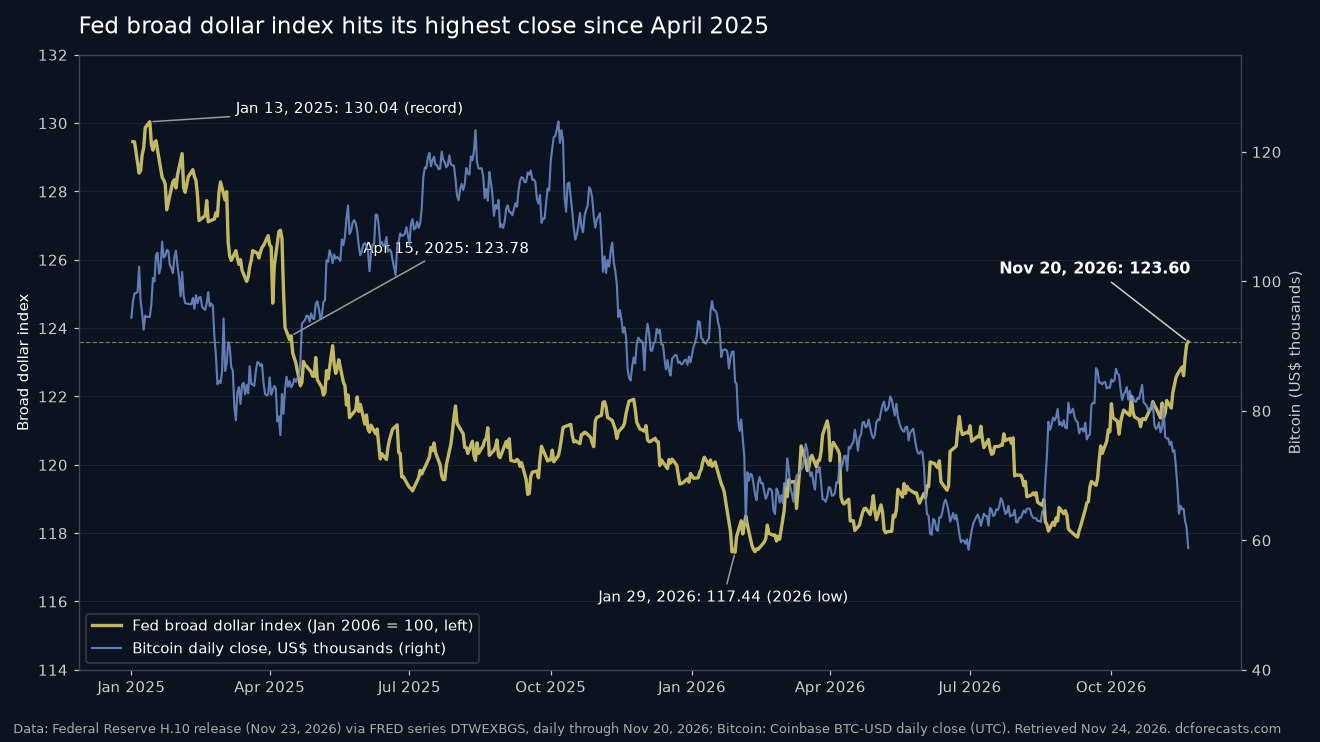
The link is loose. Between early January and late January 2026, the dollar fell to its low while Bitcoin also slipped, from $89,958 to $84,513.
A softer dollar alone guarantees nothing.
Still, in the two most recent episodes, peak dollar strength lined up with Bitcoin prices that later looked attractive to patient buyers. We believe that pattern is worth keeping in mind while the dollar index trades near its highs.
Can Bitcoin Hold $60,000 Against a Strong Dollar?
Bitcoin has steadied since the weekend. It bottomed at $55,106 on Coinbase on Saturday, Nov. 21, and closed Monday at $61,190.
That is a rebound of about 11% from the low, and Bitcoin held near $61,400 in early Asian trading on Tuesday.
Holding $60,000 keeps that recovery intact.
For the next leg, we would watch three things:
- The next H.10 readings, which show whether the broad index pushes through its April 2025 level.
- Wednesday’s PCE data and what it does to two-year yields.
- Whether the real, the rand and the peso stabilize after last week’s slide.
A pause in dollar strength would remove one of the clearer macro headwinds of the past month.
And Bitcoin’s 21 million coin cap does not move with any exchange rate. When this strong dollar eventually cools, as it did after January and April 2025, Bitcoin enters that phase with a supply schedule no central bank can adjust.
DC Forecasts is a leader in many crypto news categories, striving for the highest journalistic standards and abiding by a strict set of editorial policies. If you are interested to offer your expertise or contribute to our news website, feel free to contact us at [email protected]












Discussion about this post