


Zcash mining is a step closer to its own Nasdaq stock. HeartSciences shareholders have approved the company’s merger with Fortitude Mining, the Zcash-focused miner owned by Digital Currency Group (DCG).
At a special meeting on Nov. 19, 3,480,989 shares voted for the deal and 20,933 voted against. That is about 99.3% support among the votes cast, according to the company’s Form 8-K filed with the SEC.
The merged company is set to become Fortitude Mining Group, trading under the ticker TUDE.
The vote is the headline. The filings behind it tell a bigger story about where mining margins sit today.
The bigger question is whether a public Zcash miner can keep its cost edge once more machines chase the same coin.
What HSCS Stock Holders Approved
HeartSciences, a small medical technology company, is the vehicle for the listing. Fortitude is the business investors will actually own.
Turnout was solid. About 76.4% of the shares entitled to vote were present virtually or by proxy.
Shareholders also backed renaming the company Fortitude Mining Group, a reverse stock split of between one-for-two and one-for-five at the board’s discretion, and a new two-class share structure.
A separate Nasdaq proposal lets the combined company issue up to 35 million Class A shares in private placements within a month of closing. Total consideration is capped at $100 million, payable in cash, Zcash or debt satisfaction, at no more than a 20% discount.

DCG is expected to hold roughly 94% of the voting interests after closing, on a fully diluted basis. The companies still expect the deal to close in the fourth quarter of 2026, subject to remaining conditions.
For HSCS stock holders, that means a very small public float next to a dominant parent. We believe that structure deserves as much attention as the mining numbers.
Zcash Mining Costs $103 a Coin, Bitcoin $71,257
Fortitude’s financial discussion, filed as an exhibit to a HeartSciences Form 8-K/A on Nov. 13, breaks out the cash cost of each coin it mines.
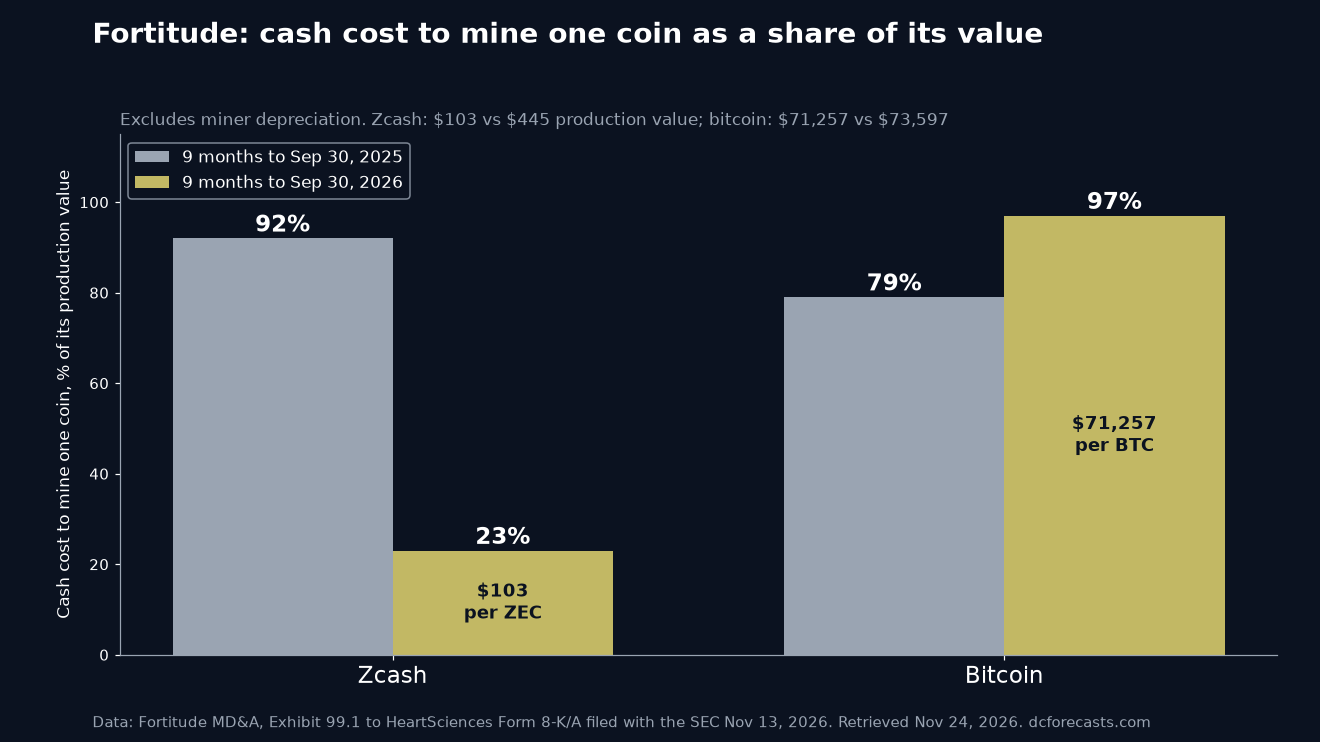
In the nine months to Sept. 30, it spent about $103 in direct cash costs for every Zcash mined, excluding miner depreciation. Each coin produced was worth $445.
That puts cost at 23% of production value, down from 92% a year earlier.
Bitcoin looked very different. The cash cost per bitcoin mined was $71,257 against a production value of $73,597, or 97%.
The swing on the Zcash side came mainly from price. Fortitude says the average Zcash price was $512 in the period, up from $42 a year earlier.
That lifted the company’s average Zcash hashprice from $0.0080 to $0.0394 per kSol/s per day, and older machines that had been switched off became worth running again.
Why the Bitcoin Fleet Shrank
Fortitude was spun out of DCG subsidiary Foundry Digital in October 2024. It has mined both Zcash and bitcoin since 2019.
In 2026 it leaned hard toward Zcash. Its average deployed bitcoin hashrate fell to 1.80 EH/s from 3.23 EH/s, and bitcoin mined dropped to 226 from 465.
The company says it powered off older bitcoin machines that became unprofitable and shifted its focus. Including depreciation, its all-in cost per bitcoin reached $114,516.
We read that as a sign of how competitive Bitcoin mining has become, not as a weakness in Bitcoin itself. Thin margins mean miners worldwide are pouring energy into securing the network, and only the most efficient fleets keep up.
That relentless competition is a big part of what makes Bitcoin’s ledger the hardest to attack, a theme we saw again when the OCEAN mining pool reached 1 in 25 Bitcoin blocks.
Zcash Miner Bets on New Machines
Fortitude is spending heavily to grow. In May it agreed to buy 9,000 Bitmain Antminer Z15 Pro units for $31.5 million, all of it already paid, adding about 7.56 GSol/s of planned capacity.
In September it signed a non-binding letter of intent for up to $100 million of Bitmain’s next-generation Zcash miners. It paid a $20 million refundable deposit, funded with borrowings from a DCG credit facility.
The Zcash miner says its deployed hashrate reached 5.4 GSol/s after Sept. 30, up from an average of 3.84 GSol/s in the first nine months.
There are clear risks. Its share of the Zcash network fell this year as rival hashrate grew faster than its own, and Zcash mined dropped to 90,582 coins from 185,154.
A July storm at its Nebraska sites also initially knocked out about 28% of its average year-to-date Zcash hashrate, and it sold more coins to fund new equipment. Only 140 Zcash were held on its balance sheet at the end of September.
Can Zcash Mining Margins Survive a Price Reset?
Zcash has been far more volatile than Bitcoin. CoinGecko data shows it rose from about $519 a year ago to roughly $739 today, up about 42%.
Along the way it peaked near $1,653 on Sept. 27, so it now trades about 55% below that high.
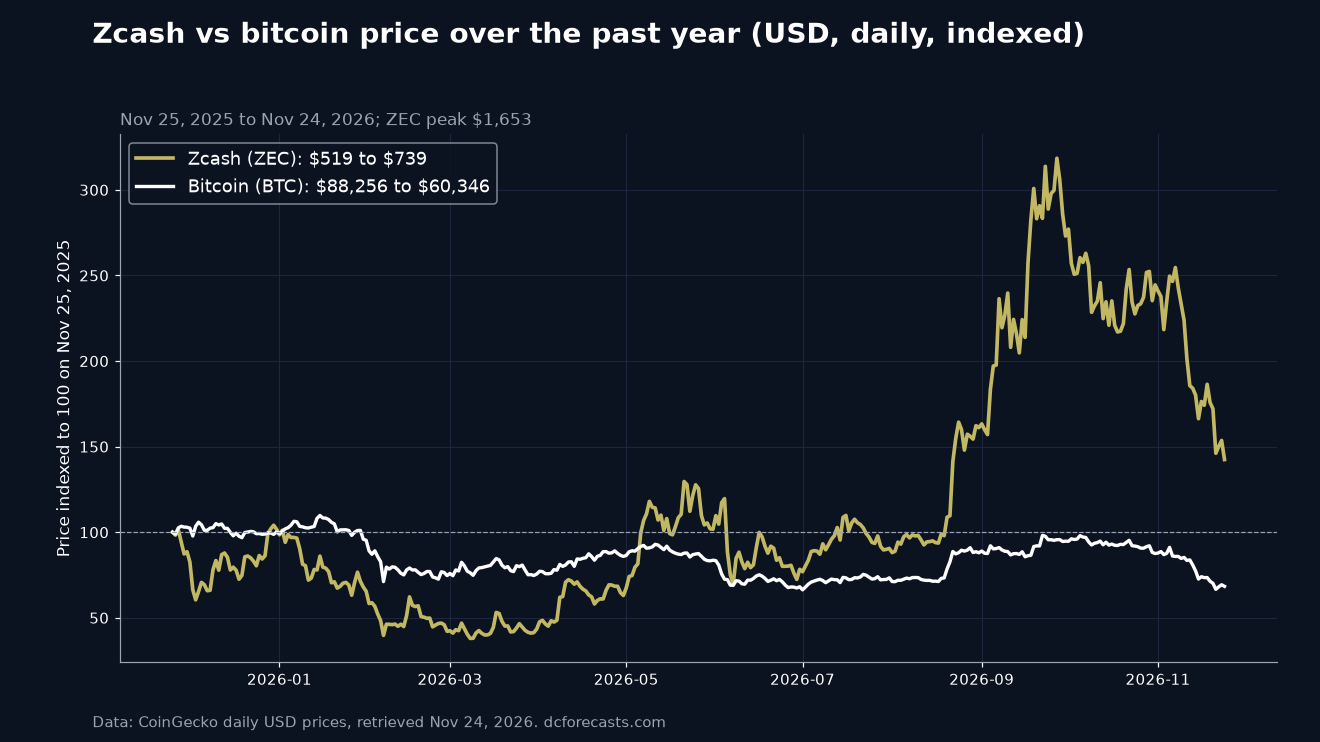
Bitcoin is about 32% lower over the same 12 months, near $60,350. Long-term holders have seen resets like this before, and we believe the steady build-out of mining infrastructure is one of the strongest signals in this market.
For Fortitude, the math is simple. Its 23% cost ratio was earned at an average price of $512, and a sharp drop or a rush of new rigs would squeeze it.
As Fortitude points out, Zcash launched in 2016 from Bitcoin’s codebase and shares its 21 million coin cap. If you want more on the asset, see our look at Grayscale’s 2x Zcash ETF and its costs.
For us, the key takeaway is that proof-of-work mining keeps drawing serious capital, and Bitcoin remains the standard every new miner is measured against. The closing of the TUDE deal will show how much public investors want to pay for that exposure.
DC Forecasts is a leader in many crypto news categories, striving for the highest journalistic standards and abiding by a strict set of editorial policies. If you are interested to offer your expertise or contribute to our news website, feel free to contact us at [email protected]











Discussion about this post