



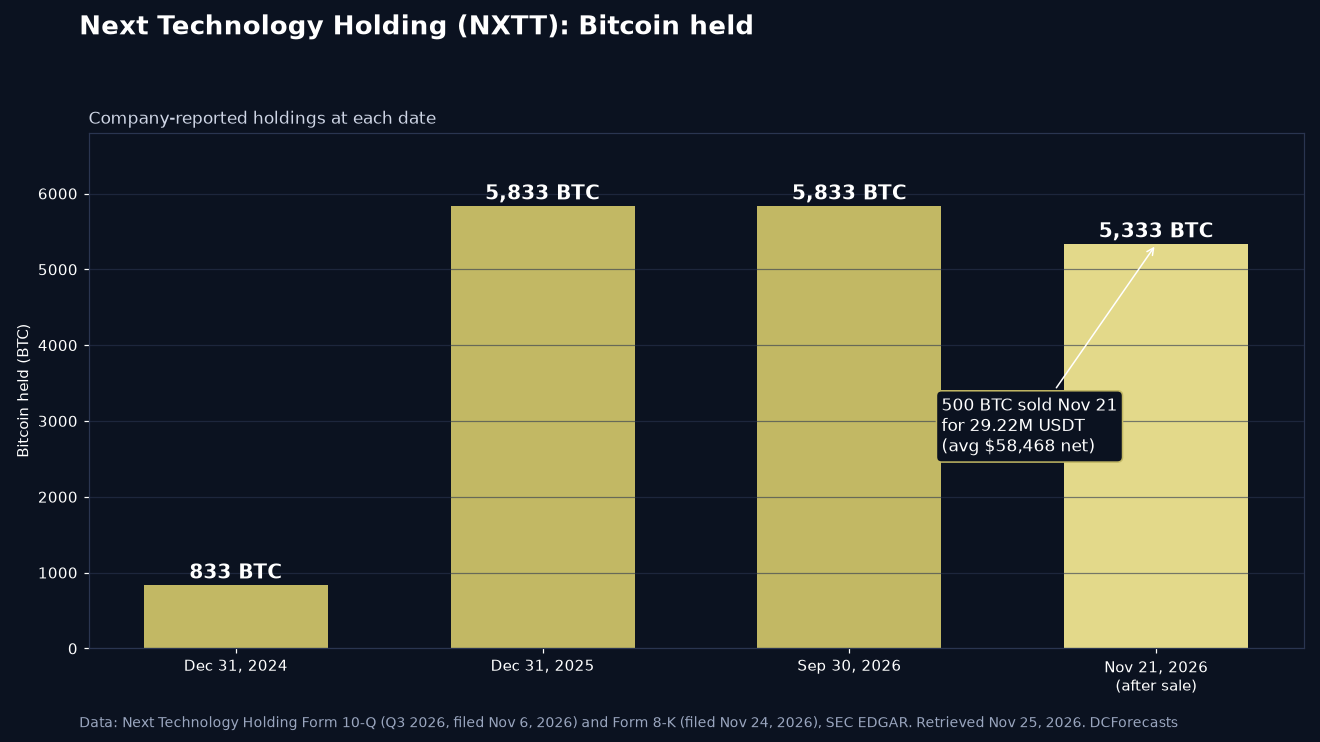
NXTT stock holders learned this week that Next Technology Holding has started cashing in part of its Bitcoin treasury, selling 500 coins on Nov. 21 for Tether’s USDT stablecoin.
The Nasdaq-listed software company disclosed the sale in a Form 8-K filed with the SEC on Nov. 24. It received 29.22 million USDT, an average of $58,468 per Bitcoin after fees.
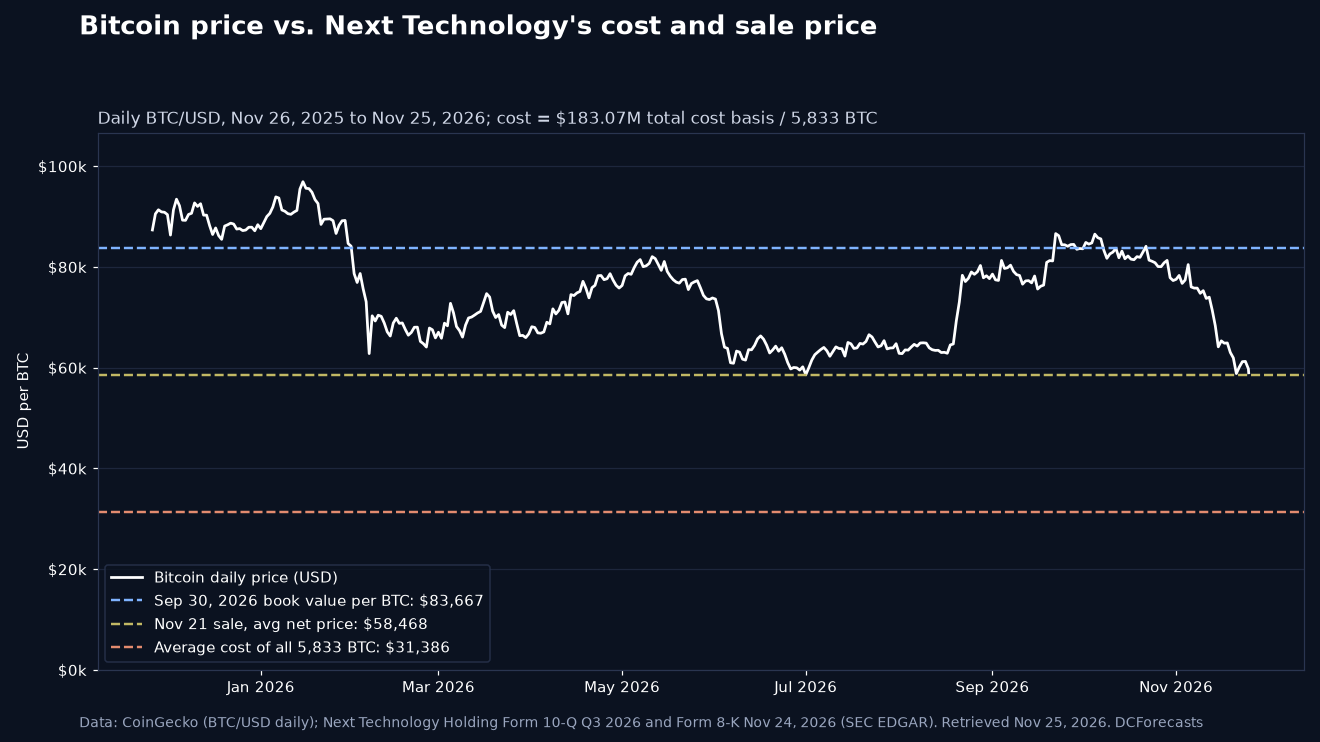
That price is roughly 86% above what the company paid, on average, for its coins.
The sale trims the treasury to 5,333 BTC, and the filing says none of those coins had been pledged as collateral as of Nov. 24.
The bigger question now is whether this is a one-off liquidity move or the start of a slow unwind by a once-aggressive buyer.
What Next Technology Disclosed on Nov. 24
According to the 8-K, the board authorized a “Bitcoin Program” on Oct. 30. It allows the company to sell or pledge Bitcoin in tranches through exchanges, block trades or financing deals.
The stated aim is “reducing risk exposure and enhancing liquidity.”
The company also confirmed that it “does not currently expect to purchase additional Bitcoin.” Proceeds from the first sale are earmarked for research and development of its AI software products and for general corporate purposes.
The program has no expiry date and no fixed size. The board can change, pause or end it at any time.

That flexibility cuts both ways. More sales may follow, but nothing in the filing commits the company to sell another coin.
A Buyer That Still Booked a Profit Near the Lows
The quarterly report filed on Nov. 6 shows how Next Technology Holding built its stack. It held 833 BTC at the end of 2024, carried at a cost of $24.99 million.
During 2025 it added 5,000 more for $158.08 million, mostly paid in newly issued shares. That took the total to 5,833 BTC with a combined cost basis of $183.07 million, or about $31,386 per coin.
We should be clear about the timing. The Nov. 21 sale landed near the bottom of Bitcoin’s one-year range. CoinGecko’s daily price points over the past 365 days bottomed at about $58,566, almost exactly the company’s average sale price.
The price was also about 30% below the $83,667 per coin at which the company carried its Bitcoin on Sept. 30.
Even so, those 500 coins cost about $15.7 million at the average basis and fetched $29.22 million. On our math, that is a gain of roughly $13.5 million on coins bought in 2024 and 2025.
We believe that is the detail worth remembering. A company that bought Bitcoin in 2025 could sell during one of the harshest drawdowns of this cycle and still nearly double its money on each coin.
What NXTT Stock Holders Now Own
For NXTT stock, the treasury is the business’s center of gravity. At Sept. 30, the company reported total assets of $654.3 million, of which $488.0 million was Bitcoin and $163.9 million was cash.
Total liabilities were $57.8 million, and $51.9 million of that was deferred tax rather than debt.
At a Bitcoin price near $59,000, the remaining 5,333 BTC is worth roughly $315 million. On paper, the new USDT adds $29.22 million to the cash pile reported at the end of September, before any spending since then.
The balance sheet also shows why the earnings line swings so hard. Bitcoin is marked at fair value, so the company booked $103.3 million of net income in the third quarter yet still shows a $32.2 million net loss for the first nine months of 2026.
The 10-Q says the coins are held mostly with Japanese institutional custodians.
Why the Bitcoin Treasury Model Isn’t Broken
One Bitcoin treasury company switching to sell-or-pledge mode will not define the sector. The models differ widely.
Some firms borrow against their coins instead of selling, as we saw when Smarter Web Company used a 6% Bitcoin loan to retire costlier preferred stock. Miners keep growing holdings per share, as CleanSpark’s fiscal 2026 results showed.
Next Technology’s choice is narrower. It is using an appreciated asset to fund an AI push, while keeping more than 91% of its coins.
We read that as Bitcoin doing exactly what a reserve asset should do: it held value through a deep drawdown and converted into $29 million of dollar-pegged stablecoins in a single day.
The flip side is real. A holder that has said it is done buying removes one source of steady demand, and any further sales add supply.
Against Bitcoin’s daily trading volume, though, a 500-coin tranche is small.
Signals Worth Watching Next
We would watch three things in the coming weeks.
- Further 8-K filings showing additional tranches, and whether they are sales or pledges.
- Any sign the company borrows against its Bitcoin instead of selling it, which the program allows.
- Whether other small-cap holders follow the same route while Bitcoin trades near its yearly low.
For long-term holders, the lesson sits in the cost column. Coins bought at about $31,000 were still worth nearly twice that at a cyclical low.
Bitcoin’s supply remains fixed at 21 million, and the market absorbed this sale without drama. If prices recover toward the $83,667 level where the company valued its coins in September, the 5,333 it kept will look like the more important decision.
DC Forecasts is a leader in many crypto news categories, striving for the highest journalistic standards and abiding by a strict set of editorial policies. If you are interested to offer your expertise or contribute to our news website, feel free to contact us at [email protected]












Discussion about this post