


The Fed discount rate became the clearest sign yet of a split inside the Federal Reserve System, after minutes released on November 24 showed eight of the 12 regional Reserve Banks had asked for a hike that Washington declined to approve.
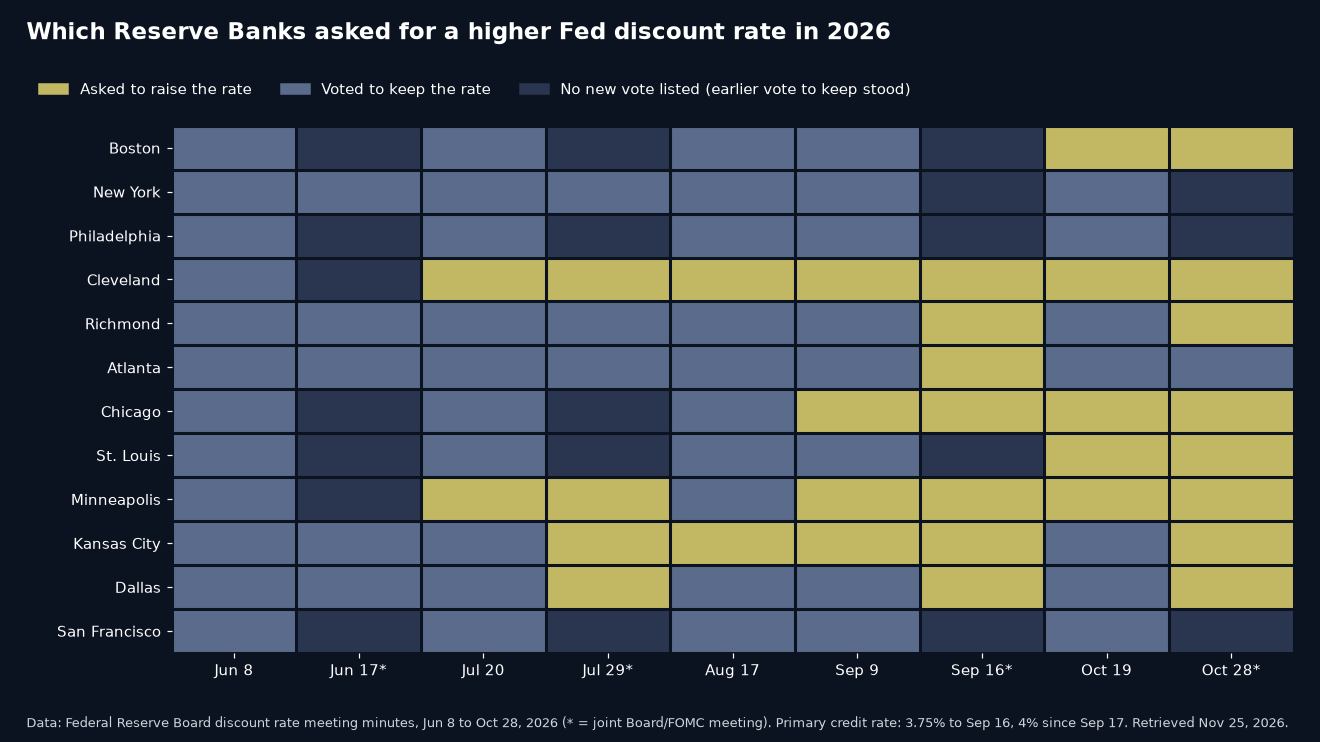
By the October 28 policy meeting, directors at Boston, Cleveland, Chicago, St. Louis, Minneapolis, Richmond, Kansas City and Dallas had all voted to lift the primary credit rate from 4% to 4.25%.
The Board of Governors kept it at 4%, and no governor expressed support for changing it.
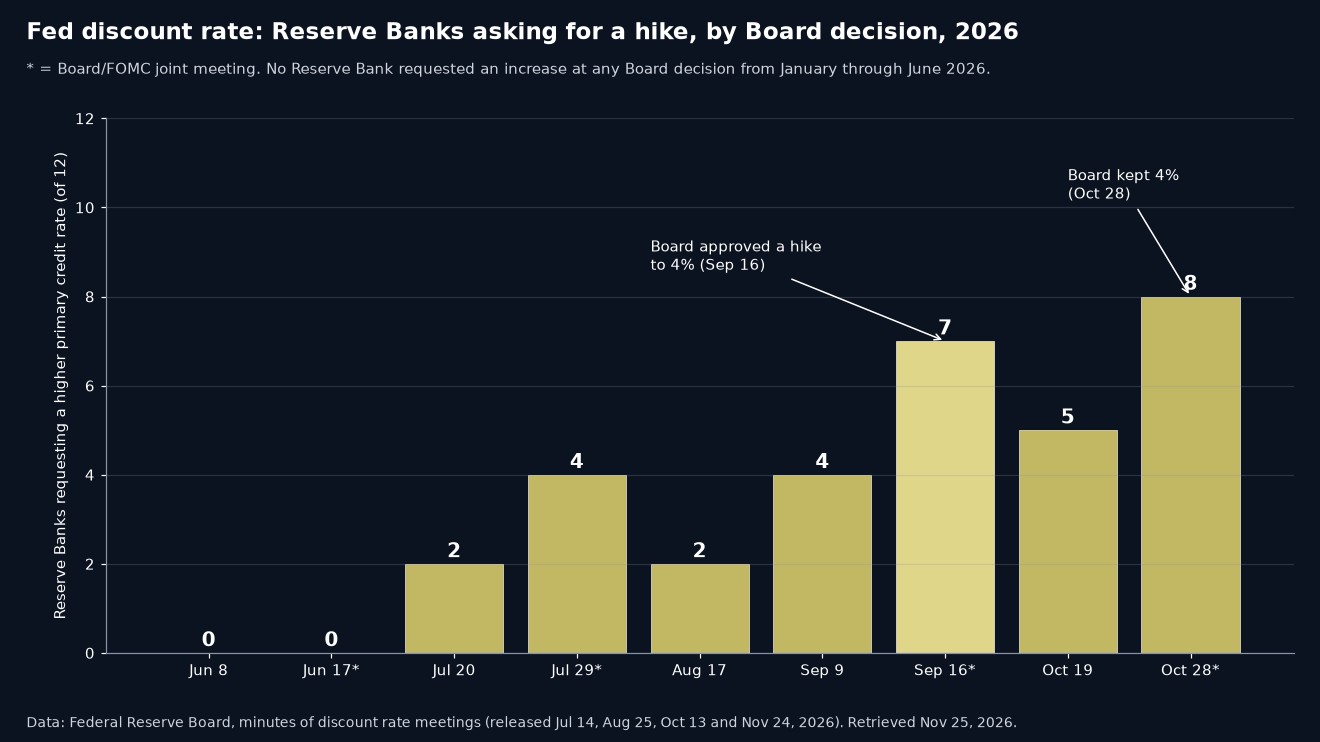
That is one more request than the seven that were on the table when the Board did hike in September.
For Bitcoin investors, the regional banks are a useful early read on how much pressure is building ahead of the December 8-9 FOMC meeting. The bigger question is whether the Board’s patience lasts.
What the Fed Discount Rate Minutes Show
The primary credit rate is what banks pay to borrow overnight from their Reserve Bank’s discount window. Each Reserve Bank’s directors vote on it, and the Board of Governors reviews and approves the result.
The Board’s minutes cover two decisions.
- October 19: five banks (Boston, Cleveland, Chicago, St. Louis and Minneapolis) had asked for 4.25%. Seven had voted to hold.
- October 28: Richmond, Kansas City and Dallas switched sides in votes on October 22, taking the count to eight. Atlanta voted the same day to stay at 4%.
Richmond, Kansas City and Dallas had all voted to hold on October 8. Two weeks later, all three wanted a hike.
New York, Philadelphia and San Francisco have not asked for an increase at any Board decision this year.

The Board’s October 28 vote to keep the rate at 4% was unanimous across all seven governors, including Lisa Cook. Yet in the separate FOMC vote that day, Cook and Cleveland Fed President Beth Hammack dissented in favor of a quarter-point hike to the federal funds range.
Under the formula the Board renewed, the secondary credit rate stays 50 basis points above primary credit, at 4.5%.
How Fed Rate Hike Pressure Built Since July
The minutes released this year tell a steady story.
From January through June, every Reserve Bank voted to keep the primary credit rate unchanged at each Board decision.
The first requests came on July 20, when Cleveland and Minneapolis asked for a move from 3.75% to 4%. By July 29 the list was four, with Kansas City and Dallas joining.
Requests dipped to two in mid-August, rose to four on September 9 and reached seven by September 16. On that day the FOMC raised the federal funds range to 3.75%-4%, and the Board lifted primary credit to 4%.
The October tally of eight is the highest of the year.
Cleveland stands out. Its directors have asked for a higher rate at every Board decision since July 20, seven in a row.
What Regional Fed Banks Are Seeing on the Ground
The October 19 minutes also summarize what Reserve Bank directors reported from their districts.
They described economic activity and labor markets as stable, though some specialized jobs remained hard to fill.
Rising costs for construction, energy, transportation and technology were still squeezing certain sectors. Several directors said inflation remained elevated, and some noted signs of price-sensitive consumer behavior.
In banking, most directors said higher rates had already dampened loan demand.
We read that mix as the core of the split. The districts see sticky costs, while the Board appears to be weighing how much tightening is already reaching borrowers.
That fits the October 27-28 FOMC minutes, which, as we covered last week, showed nearly every official expecting more hikes.
Why the Discount Window Debate Matters for Bitcoin
Bitcoin traded near $59,400 early on November 25, according to CoinGecko, down about 2.9% over 24 hours.
That is roughly 26% below its level on October 28, the day the Board held the line.
We would not pin that whole slide on the Fed. Still, a market that has fallen this far has already priced in a good deal of hawkish news.
The September hike offers some perspective. Bitcoin stood near $75,600 on September 16 and was around $82,000 by October 19, according to CoinGecko daily data, a gain of about 8.5% in the month after the Fed tightened.
History points the same way. In our review of past tightening cycles, Bitcoin was higher a year later after 16 of the last 20 Fed rate hikes.
We believe that matters more than any single meeting. Higher rates make cash more competitive in the short run, but they do not change Bitcoin’s fixed supply or the institutional rails built around it.
Can the Board Keep Saying No in December?
The next test comes at the December 8-9 FOMC meeting, which will also bring fresh economic projections.
That decision will come with its own discount rate tally, although the minutes will not be published for several weeks. The watch list is short:
- Whether the count of Reserve Banks asking for 4.25% climbs past eight.
- Whether New York, the most market-facing Reserve Bank, joins the request.
- Whether governors move from “no sentiment” for a change to open support.
- How Bitcoin and the Nasdaq trade into the decision.
Two-thirds of the regional banks want tighter money, yet the Board has twice said not yet. That is a real tension, and it will not last forever.
For long-term holders, we think the more important point is what does not change. Bitcoin’s supply schedule is fixed regardless of where the discount window is set, and the coming weeks will show how much of the Fed’s next step the market has already absorbed.
DC Forecasts is a leader in many crypto news categories, striving for the highest journalistic standards and abiding by a strict set of editorial policies. If you are interested to offer your expertise or contribute to our news website, feel free to contact us at [email protected]











Discussion about this post