



The Ukraine crypto tax and legalization law passed parliament on November 25, giving the country a full rulebook for virtual assets after years of drafting.
The Verkhovna Rada adopted bill No. 10225-d in second reading and as a whole with 271 votes, according to Yaroslav Zhelezniak, first deputy chair of the finance, tax and customs committee. A law needs 226 votes in the 450-seat chamber.
The official bill card now lists the law as being prepared for signature.
For Bitcoin holders, the most interesting detail is a two-year tax window built for people who bought before the law existed.
The bigger question is whether that window, and the licensing regime behind it, can pull Ukraine’s large informal crypto market into the open.
What Ukraine’s Parliament Passed on Wednesday
The law amends the Tax Code and other acts to regulate the circulation of virtual assets. It includes a new edition of a law on virtual asset markets, with rules for exchanges, custodians, token issuers and public offers.
“Hooray! Three years of my work in endless working groups,” Zhelezniak wrote on Telegram shortly after the vote. “Finally we did what was not possible for 35 years.”
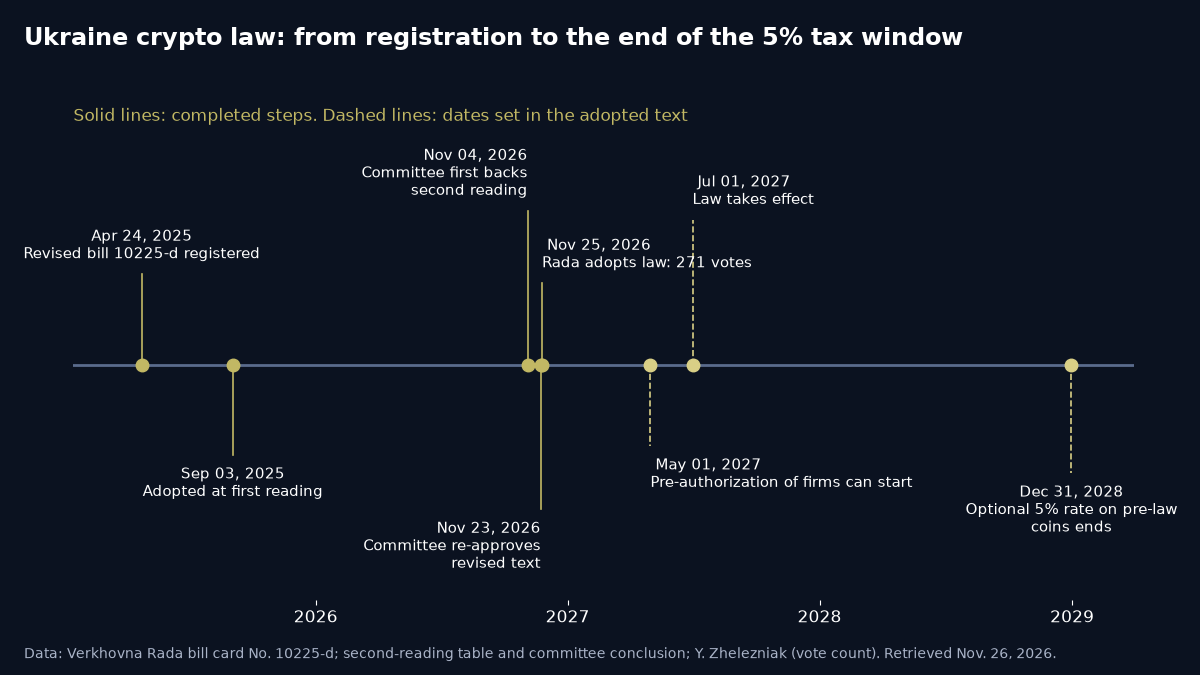
The road was long. The revised bill was registered on April 24, 2025 and adopted at first reading on September 3, 2025.
As we reported when the Ukraine crypto bill cleared committee on November 23, the last obstacle was a dispute between the central bank and the securities regulator. Two days later, the floor vote followed.

We believe the speed of the final stretch matters as much as the delay before it. Once the regulators aligned, the chamber moved within 48 hours.
How the Ukraine Crypto Tax Will Work
The core rule is simple. Profit from virtual asset operations, meaning the positive overall result for a calendar year, will be added to a person’s general taxable income.
That income is taxed at 18%, the rate in Article 167.1 of the Tax Code. Zhelezniak puts the full burden at “18%+5%”, with the 5% military levy on top.
Several things stay outside the tax net under the adopted text:
- Swaps of one virtual asset for another, unless cash is added to the trade.
- Annual crypto profit that does not exceed one minimum monthly wage.
- Assets received through issuance or free of charge, under the conditions set in the law.
Holders will report the result in their annual property and income declaration. Businesses that buy from individuals will not withhold the tax, but will report the payments.
We believe the crypto-to-crypto exemption is the most investor-friendly line in the package. Moving between assets is not treated as cashing out.
The 5% Window for Coins Bought Before the Law
The transition rules are where long-term Bitcoin holders should focus.
Under the new point 38 of the Tax Code’s transitional provisions, income from selling pre-law virtual assets for money, received from the law’s start date until December 31, 2028, can be declared separately for 2027 or 2028.
That income is then taxed at the 5% rate in Article 167.2. Importantly, the base is the full amount of money received, not the profit. Zhelezniak describes it as “5%+5% of the whole volume”, including the military levy.
The text also says that, for the 2027 result under the general rules, only income and purchase costs arising after the law takes effect are counted. We read that as a strong nudge toward the 5% route for anyone who bought years ago.
Here is the arithmetic. A coin bought for $20,000 and sold for $60,000 would carry $6,000 at a combined 10% of proceeds. The same $40,000 gain at 23% would cost $9,200.
For holders with large paper gains, that is a meaningful saving. For recent buyers with small gains, the general regime may work out cheaper, so the choice deserves careful advice.
A Licence Cap Is Gone, and 2,143 Amendments Were Rejected
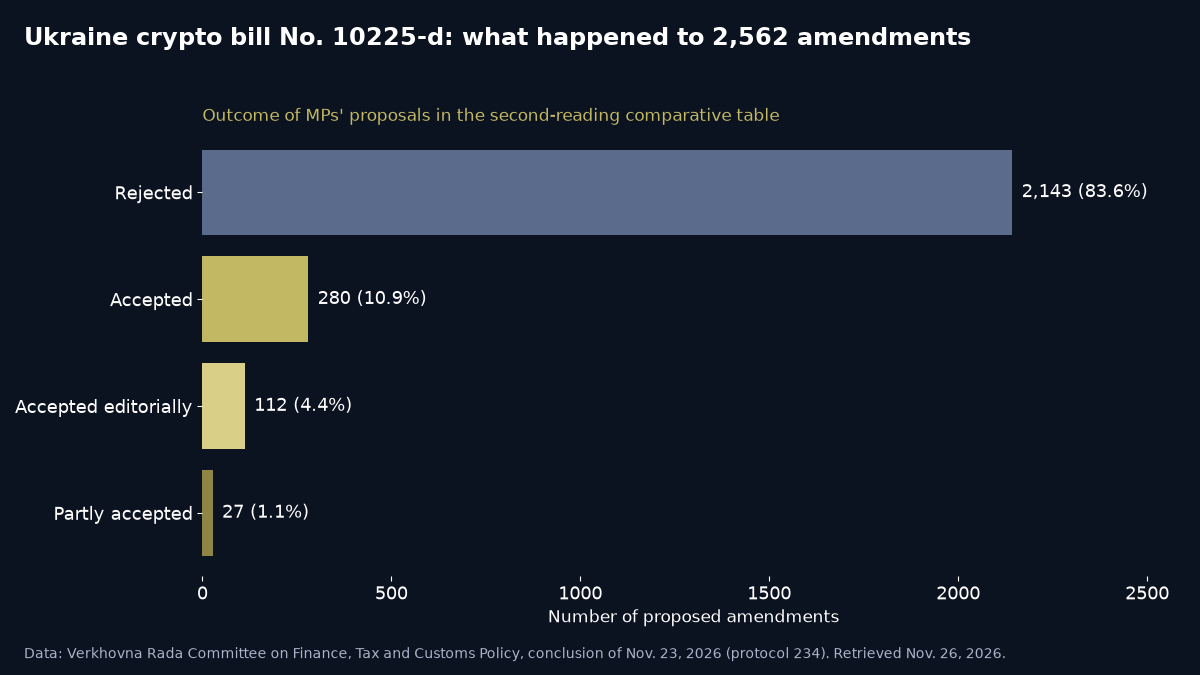
Lawmakers filed 2,562 amendments. According to the committee’s November 23 conclusion, 280 were accepted, 27 partly accepted, 112 accepted editorially and 2,143 rejected.
One change stands out. The committee deleted a clause that would have let the securities regulator decide, for five years, how many trading platform and clearing operators could work in the market, and pick them by competition.
Without that clause, Ukraine avoids a closed club of a few licensed exchanges. We believe that open door is good news for competition, fees and user choice.
The committee also refined Article 66 on decentralized activity, the DeFi rules, and set May 1, 2027 as the date when preliminary authorization of crypto firms can begin.
The central bank’s added safeguards target monetary sovereignty, payment system stability and anti-money laundering, with a clearer split of duties between the two regulators.
What Comes Next for Ukraine Crypto Regulation
The law takes effect on July 1, 2027, with some provisions starting on January 1, 2028 and a few the day after publication. It still needs the Speaker’s and the President’s signatures.
Zhelezniak said he hopes to see 15 billion hryvnias in additional budget revenue. At the National Bank of Ukraine’s official rate of 45.3541 per dollar on November 25, that is roughly $331 million.
That figure is a lawmaker’s hope, not a forecast, and actual revenue will depend on how many holders come forward.
Still, the direction is clear. A country that spent years in a legal grey zone now has a tax rate, a licensing path and a start date.
We believe clear rules like these tend to widen access to Bitcoin rather than restrict it, because banks and payment firms finally know where the lines are. The months before July 2027 will show how quickly Ukraine’s exchanges and holders step into that new legal space.
DC Forecasts is a leader in many crypto news categories, striving for the highest journalistic standards and abiding by a strict set of editorial policies. If you are interested to offer your expertise or contribute to our news website, feel free to contact us at [email protected]












Discussion about this post