



X creator revenue sharing payments to a cluster of Bitcoin-themed accounts have now cost two of their operators a court case they never turned up to defend.
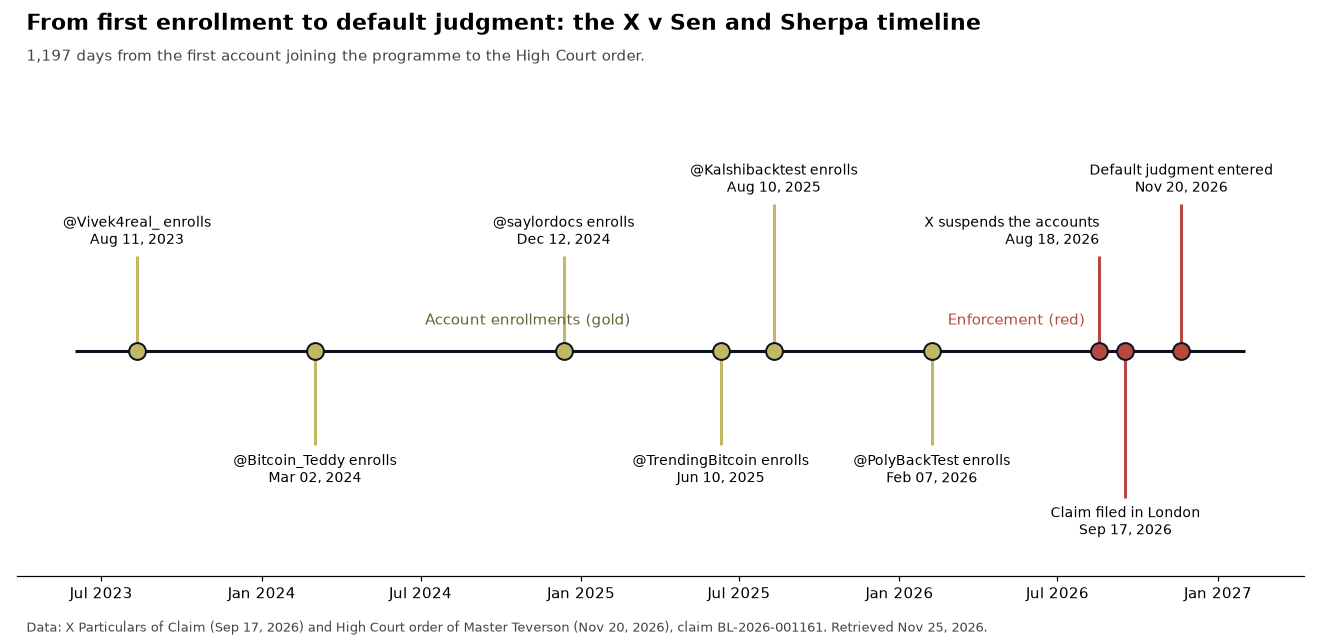
On November 20, Master Teverson of the High Court in London entered judgment in default for X Internet Unlimited Company and X Corp. against Vivek Kumar Sen and Zamyang Sherpa.
X says the pair ran a coordinated network that drew at least £207,384, roughly $277,000, from its former Creator Revenue Sharing Programme.
For Bitcoin readers, the case is a reminder of how cheaply online hype can be manufactured, and why verifiable data matters more than likes.
The open question now is how much the court will order the two defendants to pay.
What the High Court Order Actually Says
The order, which X has published on its Transparency Center, is short and procedural.
It records that the claim documents went to both defendants by first class post and email on September 21, 2026, and were deemed served on September 23.
Certificates of service followed on September 28. Neither defendant filed an acknowledgement of service or a defence, and X applied for default judgment on October 21.
The court granted it, with “the amount of damages and interest to be decided by the Court” at a separate Disposal Hearing.

That hearing has a one-hour time estimate and no date yet. Costs are reserved until then, and any party may apply to vary or set aside the order within seven days of being served with it.
We believe the distinction matters. A default judgment settles liability because nobody contested it. It is not a trial verdict on every allegation.
How X Says the Engagement Farming Worked
X’s Particulars of Claim, dated September 17, lay out what is essentially an engagement farming operation built around Bitcoin content.
Six accounts joined the programme between August 11, 2023 and February 7, 2026: @Vivek4real_, @Bitcoin_Teddy, @saylordocs, @TrendingBitcoin, @Kalshibacktest and @PolyBackTest.
According to X, they posted identical or near-identical material, sometimes within seconds of each other, and liked, replied to and reposted one another to inflate the engagement figures that drove payouts.
The filing says three more handles, @BTC_Vibes, @MrSuperBitcoin and @Laserlump, repeatedly boosted the main accounts.
One example in the claim is a February 5 post reading “LIKE, IF YOU ARE NOT SELLING BITCOIN” that showed 3,959 likes. Another shows two accounts posting the same Michael Saylor clip on April 20.
X also alleges the accounts shared devices and software clients, and that one Stripe payment account was registered to a “Stefan Mann” while linked to banking and email details tied to Sen.
X suspended the accounts on August 18, 2026, about a month before it filed the claim.
Where the £207,384 Went
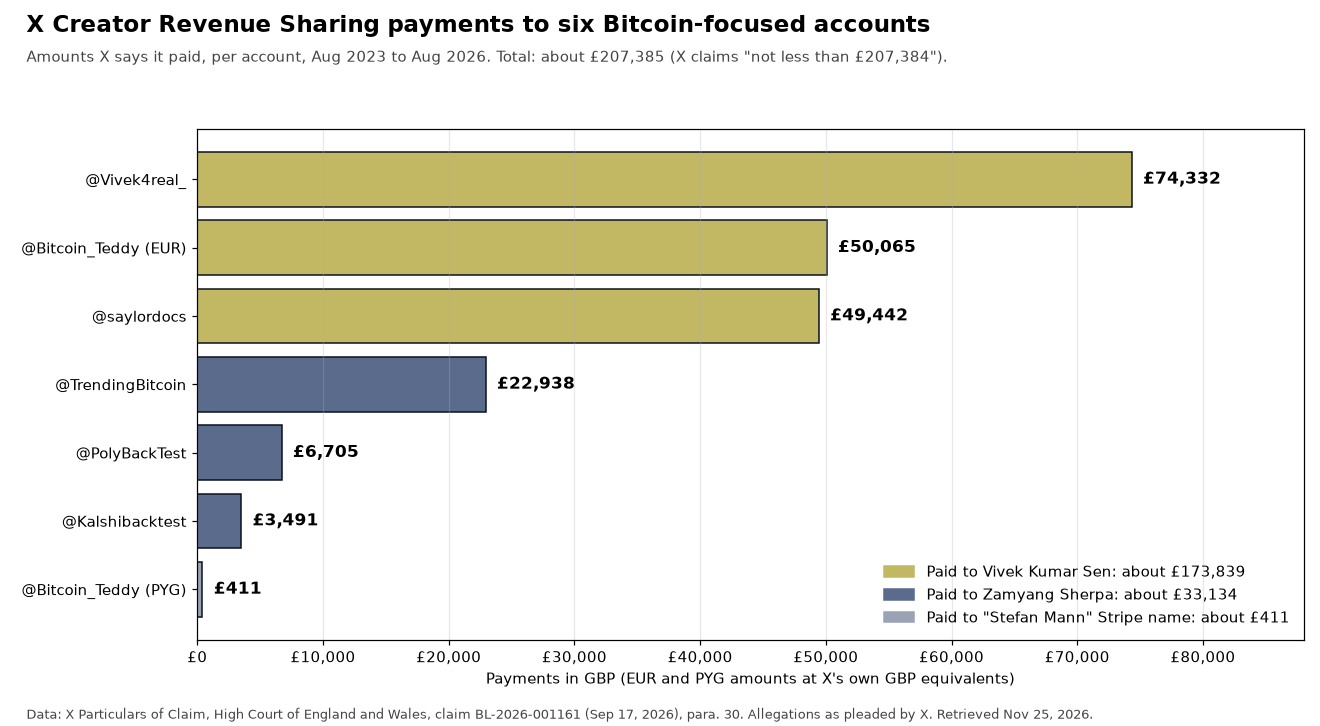
The claim breaks the payments down by account, and the split is lopsided.
Accounts linked to Sen account for about £173,839: £74,332.44 through @Vivek4real_, €58,257.48 (about £50,065) through @Bitcoin_Teddy and £49,441.91 through @saylordocs.
The Sherpa-linked accounts are far smaller, at £22,938.35, £6,705.25 and £3,490.71, or about £33,134 combined.
A further ₲3,916,908 in Paraguayan guaranís, about £411, went to the “Stefan Mann” Stripe account.
On top of the payouts, X puts its investigation and remediation costs at not less than £75,000, taking its pleaded loss to at least £282,384 before interest and legal costs.
Why Fake Engagement Is a Bitcoin Problem Too
These were not obscure accounts posting about nothing. Their handles and content leaned on Bitcoin, Michael Saylor and prediction markets, the topics that reliably draw clicks.
Fake engagement does more than drain a platform’s payout pool. It distorts the signals investors use to judge sentiment, making a talking point look more popular than it really is.
We believe that is exactly where Bitcoin’s design offers a useful contrast. Likes and reposts can be manufactured by a handful of coordinated bot accounts. Blocks, transactions and coins held on-chain can be checked by anyone running a node.
As we noted when the DOJ unveiled its 800-defendant scam sweep, enforcement is catching up with fraud that hides behind crypto branding. This case extends that pressure to the attention economy around Bitcoin.
For readers, the practical lesson is simple: weigh a post by its evidence, not its engagement count.
What Comes Next for X Creator Revenue Sharing Claims
The next step is the Disposal Hearing. X must file witness evidence on damages 14 days before it, and the defendants have until seven days before to reply.
If they file nothing, they cannot rely on evidence at that hearing without the court’s permission.
The judgment covers Sen and Sherpa only. The “persons unknown” behind the other accounts remain named in the claim but are not part of this order.
The programme itself has been replaced by X’s Original Content Rewards scheme, which the claim describes as its successor.
For X, the order turns a pleaded claim over payout manipulation into a High Court judgment it can point to.
We believe that is a healthy development for crypto media. As platforms squeeze out fake engagement, the voices that rise should be the ones backed by real data, and Bitcoin’s open ledger remains the best data set of all.
The coming months will show what figure the court puts on the damage, and whether others running similar networks take the hint.
DC Forecasts is a leader in many crypto news categories, striving for the highest journalistic standards and abiding by a strict set of editorial policies. If you are interested to offer your expertise or contribute to our news website, feel free to contact us at [email protected]











Discussion about this post