



Illegal streaming services that sell cheap pirate TV subscriptions for crypto have just learned how visible a blockchain payment trail can be.
In a five-day operation in Seville, Spain, from November 16 to 20, investigators from 11 countries traced more than €26 million in cryptocurrency transactions linked to illegal IPTV services, according to Europol.
At the European Central Bank’s November 24 reference rate of $1.0963 per euro, that is about $28.5 million, and Europol says further analysis is still ongoing.
The same week’s work disrupted 57 illegal IPTV services and identified 321 websites offering copyrighted content without permission.
For crypto investors, the most interesting part is who sat at the table: Binance, Coinbase and the blockchain analytics firm Chainalysis worked alongside police.
The bigger question is whether following the money, rather than chasing websites, can finally dent a piracy market that keeps regrowing after every takedown.
What Europol Found in Five Days in Seville
The operation was hosted at the Spanish National Police headquarters in Seville and brought together around 40 participants.
About 30 of them were law enforcement officers from Belgium, Bulgaria, Croatia, Greece, Ireland, Italy, the Netherlands, Portugal, Romania, Spain and the United States.
Europol ran it through its Intellectual Property Crime Coordinated Coalition, known as IPC3, providing analysis, real-time intelligence cross-checks and secure information exchange.

The 321 websites flagged during the week had combined annual traffic of more than 7.3 million visits, Europol said.
No arrests were announced. The agency said the information gathered will now feed national investigations aimed at identifying suspects, disrupting services and tracing assets.
That matters for how we read the €26 million. It is money traced, not money seized, and the cases are still at an early stage.
Why Illegal Streaming Turned to Crypto Payments
Pirate IPTV services sell access to thousands of TV channels, live sports and films for a few euros a month, without paying the rights holders.
Europol said these operators often collect subscriptions in cryptocurrency because it lets them receive and move funds across borders quickly.
The scale is large. Europol, citing figures from the Audio-visual Anti-Piracy Alliance (AAPA), says an estimated 60 million people in Europe use unauthorised IPTV services.
AAPA puts the yearly losses for legitimate providers at €4.83 billion, with governments losing another €1.08 billion in unpaid taxes.
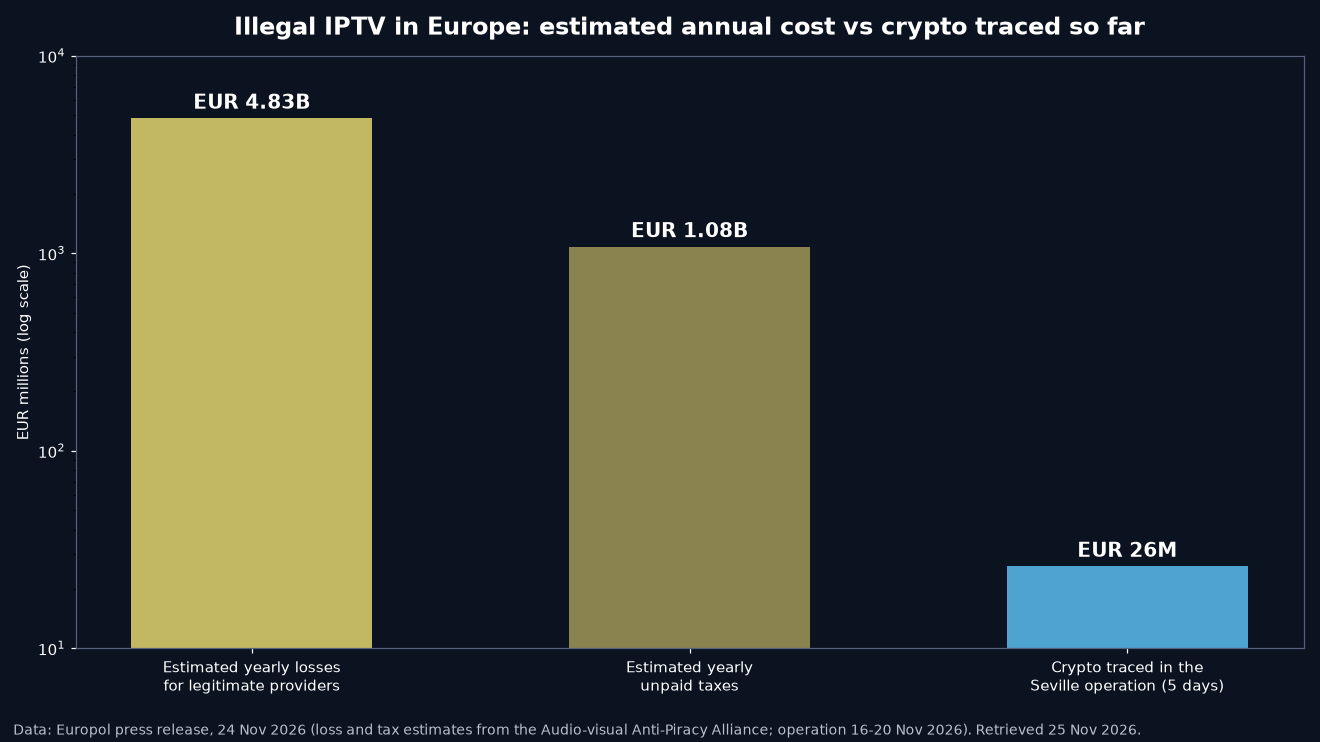
Against those estimates, €26 million is a small slice. But it came from one coordinated week, and Europol describes it as a starting figure rather than a final count.
Crypto Tracing Shows the Ledger Works Against Criminals
Europol’s own wording is the strongest line in the release: the use of cryptocurrency “does not make criminals invisible.”
Investigators followed suspicious transactions across blockchain networks, linking illegal IPTV services to wallets and to the people controlling them.
We believe this is the part of the story the market often misses. Bitcoin and most major blockchains are public ledgers, so every payment leaves a permanent, auditable record that can be matched to identified customers once it touches a regulated exchange.
That is why the presence of Binance and Coinbase matters. Exchanges are the on- and off-ramps where pirate operators eventually need to turn crypto into spendable money.
Europol called the approach a shift in the fight against digital piracy: instead of only closing services, investigators are going after the financial infrastructure behind them.
As we reported when Operation TorNado seized $234 million from dark web drug sellers, the same pattern keeps repeating across very different crimes.
How Illegal IPTV Crackdowns Have Changed Since 2024
Comparing Europol’s releases shows how the focus has shifted toward money.
In November 2024, a Europol-backed takedown targeted a network of 102 suspects that served pirated content to more than 22 million users. Eleven people were arrested, and around €1.6 million in cryptocurrency was seized along with €40,000 in cash.
Operation KRATOS 2, announced in June 2026 and coordinated by Bulgaria with Europol’s support, led to 29 arrests, dismantled nine organised crime groups and removed 27,332 illegal streaming URLs.
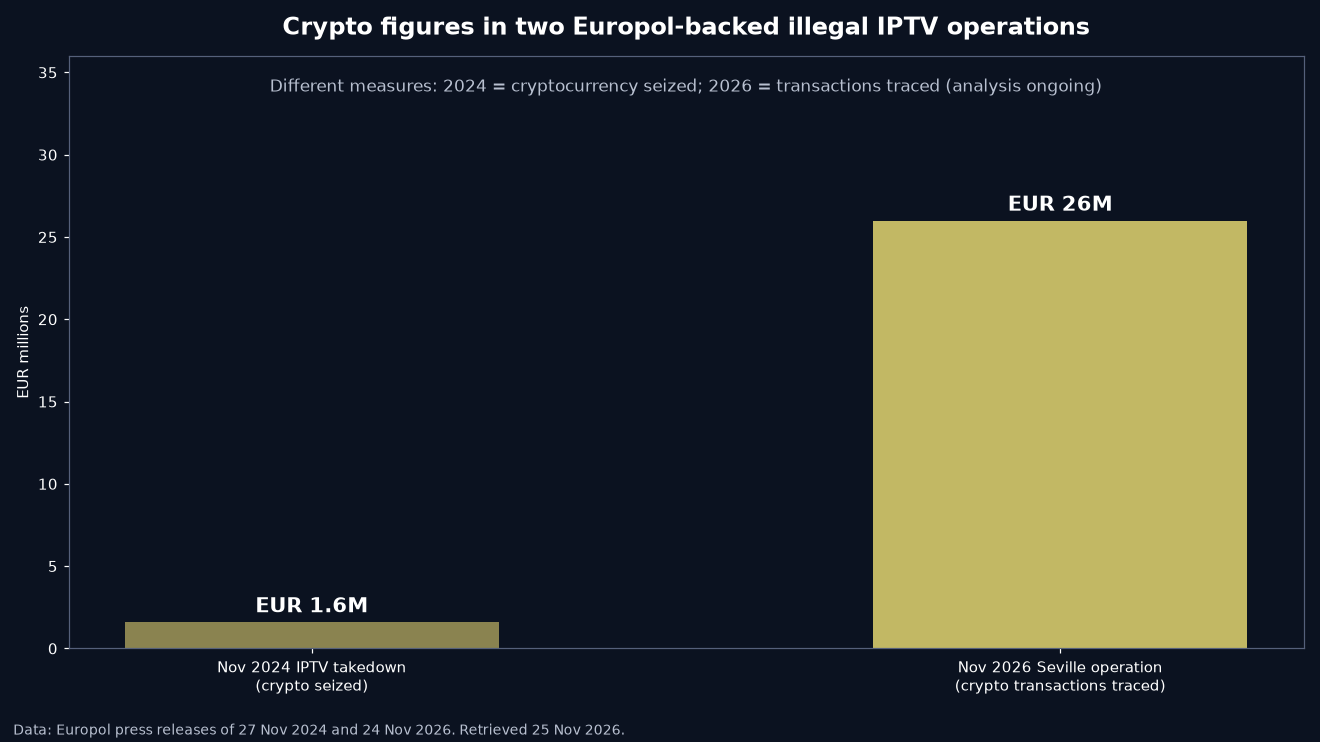
The two numbers measure different things, so they should not be read as a like-for-like jump. Still, the direction is clear: crypto is now a lead for investigators, not a dead end.
Courts are following the money too. We covered how a Leipzig judge asked a Movie2K suspect for 40,000 BTC in one of Germany’s long-running piracy cases.
What Investors Should Take From the IPTV Piracy Case
For Bitcoin holders, there are three practical points.
- Transparency is a feature. Public ledgers let police trace illegal streaming money after the fact, something that is much harder with cash.
- Exchange compliance keeps maturing. Large platforms working directly with Europol shows the regulated side of crypto choosing to cooperate with law enforcement.
- Results take time. Traced funds still have to be tied to suspects, frozen and forfeited through national courts, and Europol has not announced seizures from this operation.
We would watch for national follow-ups in the 11 participating countries, especially any asset freezes or charges that name the networks behind the 57 disrupted services.
Our view is simple. Every case like this weakens the old claim that Bitcoin is a tool built for criminals.
The reality is closer to the opposite. A fixed-supply asset on a public ledger, with regulated exchanges at the edges, is a poor hiding place for pirate TV profits and a strong foundation for honest users.
The coming months will show how much of the IPTV piracy money trail turns into seizures, and how quickly the next pirate service rethinks its payment methods.
DC Forecasts is a leader in many crypto news categories, striving for the highest journalistic standards and abiding by a strict set of editorial policies. If you are interested to offer your expertise or contribute to our news website, feel free to contact us at [email protected]












Discussion about this post