



The Binance withdrawal suspension is officially over. In a notice dated Nov. 26, the exchange said its “withdrawal recovery work is completed” and that the freeze triggered by its October security incident “has been fully lifted.”
That closes a roughly 28-day stretch that began around 20:05 UTC on Oct. 29, when attackers drained roughly $6.3 billion in token assets from Binance hot wallets.
Binance says it covered the losses with its own money, more than $6.34 billion, and that users did not absorb the hit.
For Bitcoin holders, the timeline carries a quieter message. BTC was among the first assets declared fully backed and among the first networks to reopen.
The bigger question now is whether the way Binance handled the recovery becomes the template for every large custodian that gets hit next.
What Binance Said on Nov. 26
The announcement is short. Binance says recovery work is done and the hack-related suspension has been lifted in full.
A few networks are still paused, but the company draws a clear line. It says those pauses are for maintenance or planned upgrades, affect “a very small percentage of regular traffic,” and are separate from the incident.
The exchange also repeated that “all assets remain fully backed and accounted for,” and pointed users to its Proof of Reserves site to check their own balances at a minimum 1:1 ratio.
It added a phishing warning worth repeating. Binance says it will never contact users to “speed up withdrawals” or move funds into a “Binance vault.”

How the Binance Withdrawal Suspension Unwound
The recovery ran in two tracks: refilling the stolen assets and reopening withdrawals. Binance’s own updates let us rebuild both.
On Oct. 30, it said about $3 billion of the stolen funds had been frozen on-chain and that it had already covered about 80% of the impacted amount, including $5 billion held in the exact tokens taken.
By Oct. 31, coverage reached 90%. Binance said BTC, ETH, USDT, BNB, SOL, USDC, XRP, USD1, RLUSD and ZEC were fully backed at 100%.
The money came from three places, according to the exchange: a partial deployment of its Secure Asset Fund for Users (SAFU), part of its futures insurance fund, and its corporate treasury.
Coverage hit roughly 95% on Nov. 1, about 98% on Nov. 4, and was declared complete on Nov. 12. The last few percent took longest because, as Binance explained, those smaller tokens were less liquid and harder to buy in size.
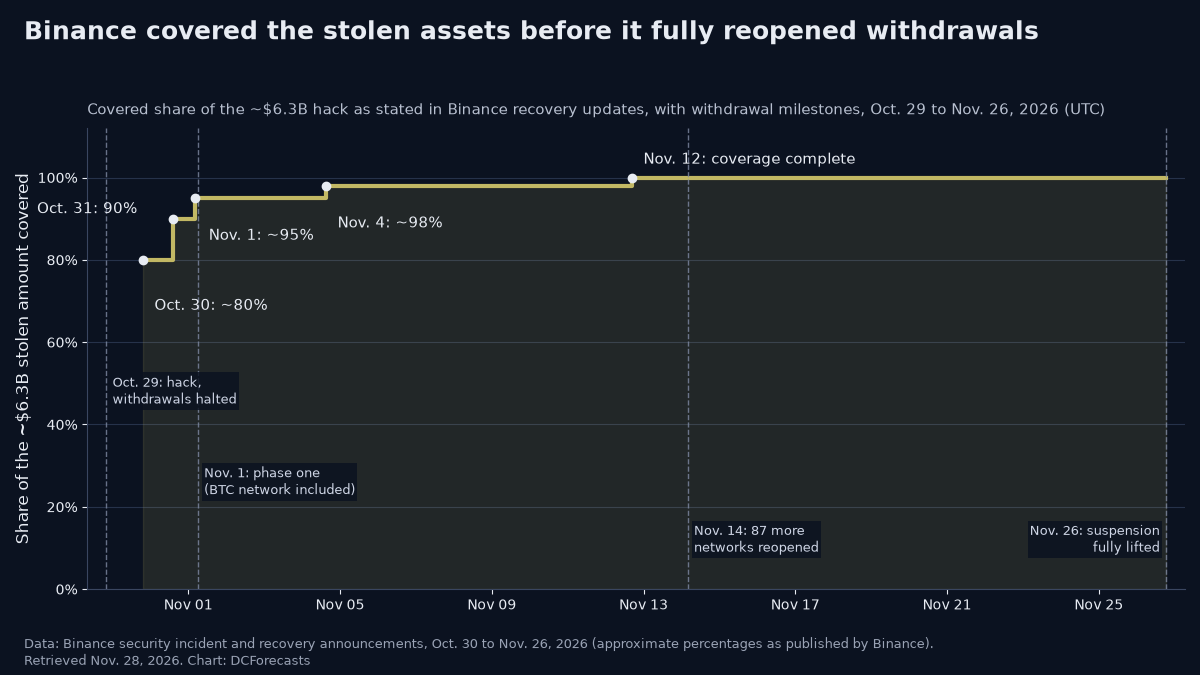
Withdrawals followed a phased rollout. Phase one opened on Nov. 1 between 06:00 and 09:00 UTC, with the Bitcoin network on the list alongside Ethereum, BNB Smart Chain, Solana, XRP and ten other networks.
More batches followed on Nov. 3, Nov. 5 and Nov. 6. In the week to Nov. 14, Binance reopened withdrawals on 87 more networks.
At that point it aimed to restore all remaining networks by the end of the following week. The full lift came on Nov. 26, a few days past that goal.
Proof of Reserves Went From 10 Tokens to 198
We believe the most useful part of the recovery was not the money itself, but the verification that came with it.
Binance took a fresh Proof of Reserves snapshot on Oct. 31 covering 10 tokens. A zero-knowledge proof for that snapshot was finished by Nov. 2, letting holders of those tokens confirm their balances were backed.
The Nov. 4 snapshot covered 44 tokens. The Nov. 12 snapshot covered 198, with its proof generated on Nov. 14.
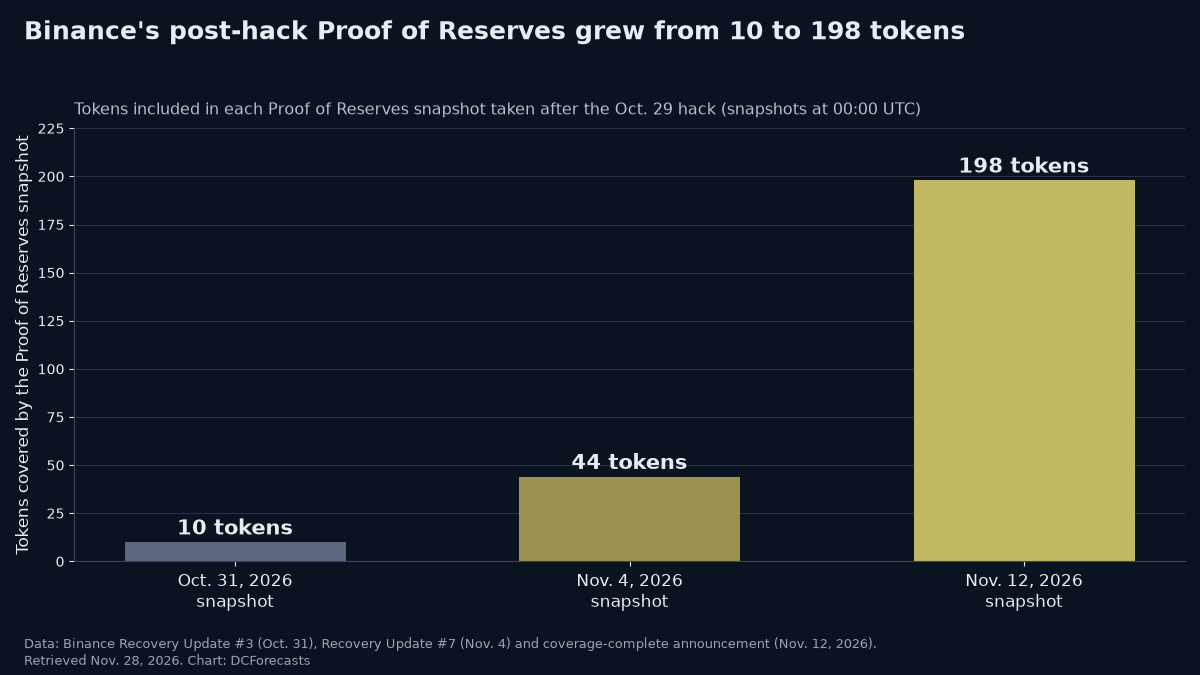
That matters because a promise to cover losses is only as strong as the evidence behind it. A user-checkable proof turns “trust us” into something closer to “check us.”
Binance has also said it will refill SAFU to roughly $1 billion, so the emergency fund it tapped is not left depleted.
Why This Crypto Exchange Hack Still Points Back to Self-Custody
None of this changes what happened. At roughly $6.3 billion, this ranks among the largest crypto exchange hacks ever disclosed, and for days many users could not move their coins.
The weak point was a custodian’s hot wallets, not Bitcoin’s protocol. Binance’s first update pointed to a compromised DevOps engineer’s laptop, later updates described additional points of breach, and the exchange said it found no evidence that wallet private keys had leaked.
The Bitcoin network kept producing blocks the entire time. Users holding their own keys never needed anyone’s permission to move their coins.
Binance said it prioritized networks by user demand when reopening. Bitcoin making the first batch suggests how many customers wanted their BTC available, or simply wanted it back in their own wallets.
The security story is not finished. As we covered when Binance brought in three outside firms to review its security, the scope and timing of their findings are still unknown. The trail of the stolen coins is also active, as our report on launderers mixing 2,310 BTC showed.
What We Will Watch After the Binance Withdrawal Restart
First, the networks still paused. Binance calls them routine, and we would expect that list to shrink quickly if it is.
Second, SAFU. The promised return to about $1 billion is checkable, and we would like to see it confirmed.
Third, the outside security reviews. If they are published, they will tell us more than any recovery update could.
For us, the key takeaway is simple. A Binance withdrawal is how a customer turns an exchange balance into Bitcoin they truly own, and that door is open again.
We believe the episode strengthens the long-term case for Bitcoin itself: a fixed-supply asset on a network that never paused, with self-custody available to anyone who wants it.
DC Forecasts is a leader in many crypto news categories, striving for the highest journalistic standards and abiding by a strict set of editorial policies. If you are interested to offer your expertise or contribute to our news website, feel free to contact us at [email protected]












Discussion about this post