


Binance.US has put its plan for Bitcoin perpetual futures in front of US regulators, and the public rulebook shows contracts sized at just one-hundredth of a coin.
On November 19, the exchange said the Commodity Futures Trading Commission had deemed its applications to become a designated contract market (DCM) and a derivatives clearing organization (DCO) “materially complete.”
That is not an approval. It means the CFTC has what it needs to start a substantive review.
For Bitcoin investors, the interesting part is the fine print. At Bitcoin’s price of about $59,200 on Sunday morning, one contract would be worth roughly $592.
The bigger question now is whether the perpetual contract, a staple of crypto trading, is finally on track to become a mainstream US product.
What Binance.US Actually Filed With the CFTC
The exchange applicant is BAM Derivatives LLC, a Chicago-based affiliate of Binance.US. Its DCM application appeared on the CFTC’s public filings register on November 19 with a status of “Pending.”
The clearing side, BAM Clearing LLC, has been listed on the CFTC’s clearinghouse register since September 21 as “Pending Registration.”
Binance.US was careful about what this step means. “It is not an approval of the application,” the company wrote, adding that it “does not yet offer derivatives products” and won’t until the CFTC grants the registrations.
CEO Stephen Gregory framed the filing as a long-term bet on clear rules. “Our customers have asked for access to regulated crypto derivatives, including perps, on a platform they already trust,” he said.

We believe that tone matters. The firm is pursuing a slow, rule-bound path rather than trying to rush onshore.
Inside the Bitcoin Perpetual Futures Rulebook
The 70-page exchange rulebook (Exhibit M-1) lists only two products: a Bitcoin perpetual contract and an Ether perpetual contract.
- Contract size: 1/100 of a Bitcoin, and 1/10 of an Ether.
- Tick size: one cent.
- Funding: calculated over eight-hour windows ending at 12:00 a.m., 8:00 a.m. and 4:00 p.m. Central Time.
- Settlement: at least once each business day at 5 p.m. New York time.
- Position limit: 2,000,000 contracts, with a reportable level of 25 contracts.
Two million Bitcoin contracts work out to 20,000 BTC. Twenty-five contracts, the reporting threshold, equal just a quarter of a coin.
The rulebook also defines a “Maximum Funding Magnitude,” a cap on the funding rate in any single interval. It gives ±2% as an example and says the clamp is meant to limit payment spikes and possible manipulation in thin or volatile markets.
That detail is worth watching. As we showed when we looked at why Bitcoin funding rates stayed positive through a 34% slide, funding is where trader sentiment shows up first.
How Long Could the CFTC Review Take?
Under the CFTC’s own rule for new exchanges, 17 CFR 38.3, the Commission reviews a DCM application under the 180-day timeframe in the Commodity Exchange Act. It can approve, deny, or designate the applicant subject to conditions.
Counting from the November 19 listing date, 180 days would run to about May 18, 2027.
BAM Clearing’s own summary of its plans (Exhibit A-3) says it “currently anticipates launching clearing services in March 2027,” while stressing that the date depends on regulatory approval and operational readiness.
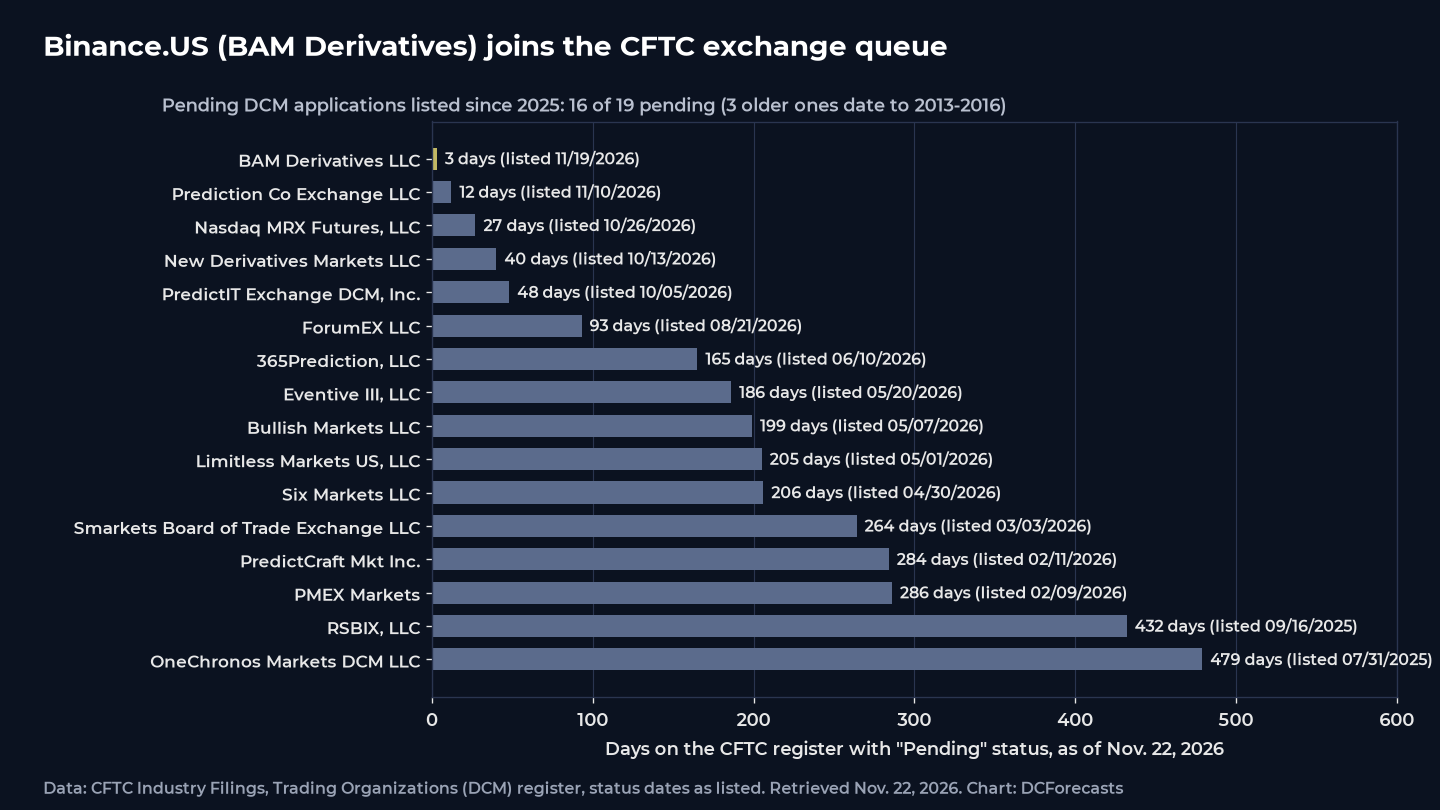
The register suggests caution on timing. Several applications listed in 2025 and early 2026 are still marked “Pending,” and one has sat there for 479 days.
So we would treat March 2027 as the company’s target, not a promise.
Why 2026 Became the Year of New US Exchanges
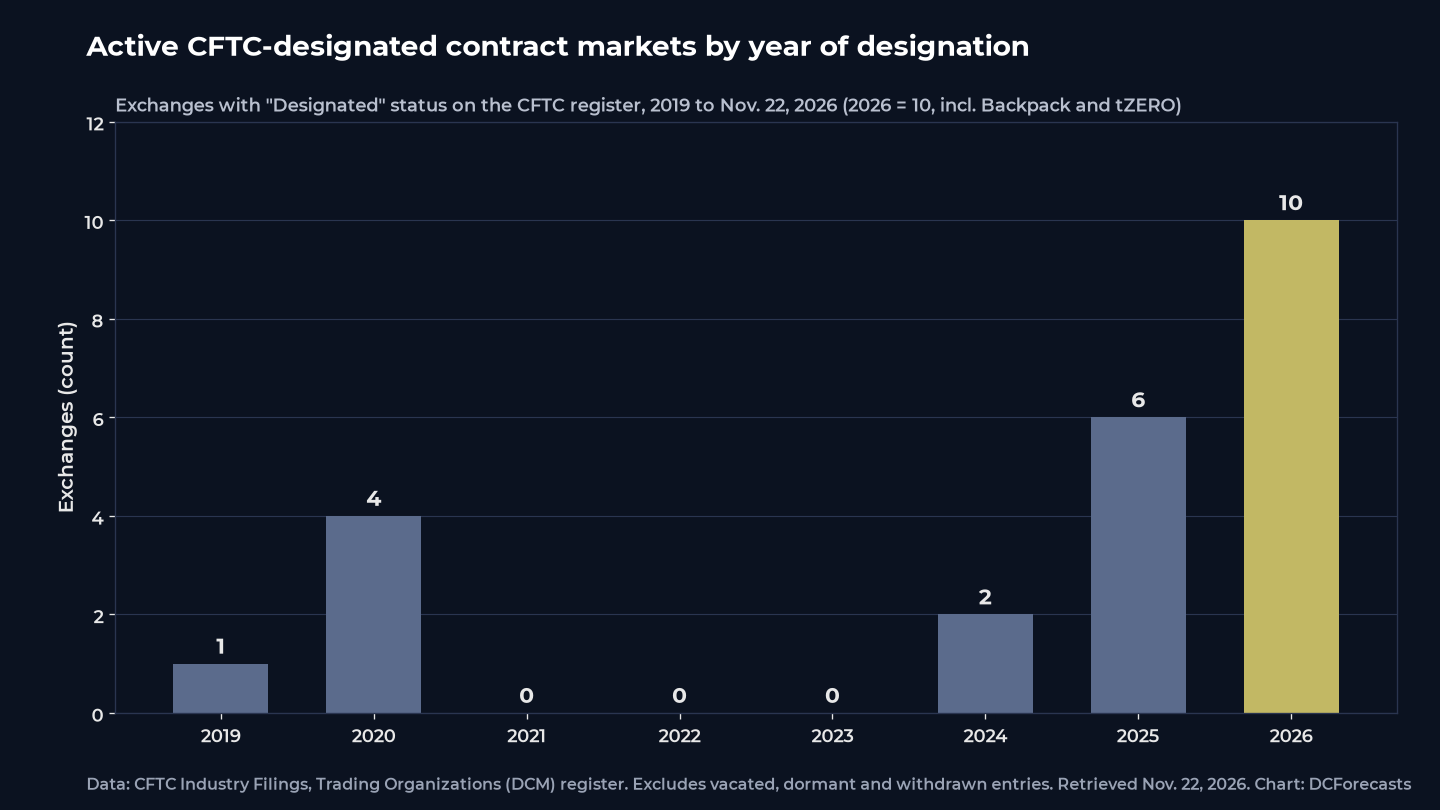
Binance.US is entering a busier lane. Ten of the exchanges that currently hold “Designated” status on the CFTC register received that status in 2026, compared with six in 2025 and two in 2024.
None of today’s active DCMs were designated in 2021, 2022 or 2023.
The two most relevant newcomers are crypto-native. tZERO’s exchange was designated on November 10, and Backpack’s TLD Markets followed on November 16.
As we covered when the CFTC cleared Backpack’s exchange for US perpetual futures, its clearing arm, TLD Clearing, was registered on November 13. The register notes it may clear margined futures as well as fully collateralized products.
BAM Clearing’s filing points to a similar model. It says it will initially clear only contracts listed on BAM Derivatives, and only through approved clearing members registered as futures commission merchants. Customers would not get direct access to the clearinghouse.
What a Regulated Perp Market Could Mean for Bitcoin
Perpetual futures have long been one of the main ways traders take Bitcoin exposure, but mostly on venues outside US oversight.
A growing list of CFTC-supervised options would bring that activity under US rules, with central clearing, position limits and reporting thresholds.
We believe that is constructive for Bitcoin’s market structure. Small contract sizes lower the entry point, while US clearing and surveillance could make price discovery more transparent.
It also arrives at a telling moment. Bitcoin is trading near $59,200 after testing a two-year low, yet regulated firms are still investing in Bitcoin-first products with a launch horizon measured in months.
The evidence so far is a filing, not a launch. The CFTC can still request changes, delay the process or deny it.
But the direction is clear. Bitcoin’s fixed supply, deepening institutional plumbing and a widening set of regulated venues all point the same way. The coming months will show whether Binance.US can join Backpack and tZERO before its own March 2027 target.
DC Forecasts is a leader in many crypto news categories, striving for the highest journalistic standards and abiding by a strict set of editorial policies. If you are interested to offer your expertise or contribute to our news website, feel free to contact us at [email protected]











Discussion about this post