


Tokenized securities are getting a fresh public review in Washington, just over two months after the SEC opened the door to onchain stock trading.
The SEC’s Investor Advisory Committee will meet virtually on Dec. 3 at 9:30 a.m. ET, and its opening panel is devoted to the agency’s “Innovation Exemption.”
The official agenda says the panel will weigh the exemption’s risks and benefits, and “whether reforms could better achieve its intended goals.”
For crypto investors, the timing matters. Five would-be venues have already told the SEC they plan to operate, and the newest one filed only on Nov. 23.
The bigger question is whether the strict volume caps written into the order survive this review, or get loosened as the market proves itself.
What the SEC Advisers Will Debate on Dec. 3
The SEC announced the meeting on Nov. 25. The tokenization panel runs from 10:00 to 11:30 a.m. ET, after opening remarks from Chairman Paul Atkins.
The lineup mixes builders and skeptics. It includes Andree Goldsmith, deputy general counsel of OKX, and Brett Redfearn, president of Securitize and a former director of the SEC’s trading and markets division.
They sit alongside Amanda Fischer of Better Markets and Timothy Massad, a former CFTC chairman who now runs a digital assets policy project at the Harvard Kennedy School.
The committee does not write rules. Congress created it to advise the Commission, and it can send formal findings and recommendations.

That still carries weight. The same committee already discussed draft recommendations on the tokenization of equity securities at its March 12 meeting, so this is a continuing file, not a one-off.
How the Innovation Exemption Caps Tokenized Securities Trading
The order, Exchange Act Release 34-106402, was issued on Sept. 17 and runs for five years, to Sept. 17, 2031.
It lets “tokenized securities venues,” or TSVs, run automated market maker pools for tokenized U.S. stocks without registering as exchanges. Liquidity providers get a matching exemption from dealer registration.
The guardrails are tight. For Tier 1 stocks, which covers the S&P 500, the Russell 1000 and larger exchange-traded products, a venue may list at most 75 symbols and trade no more than 0.25% of the prior month’s average daily share volume.
For smaller Tier 2 stocks, the limits rise to 250 symbols and 2.5% of volume. After a first breach, each further breach forces the venue to pause that stock for three months.
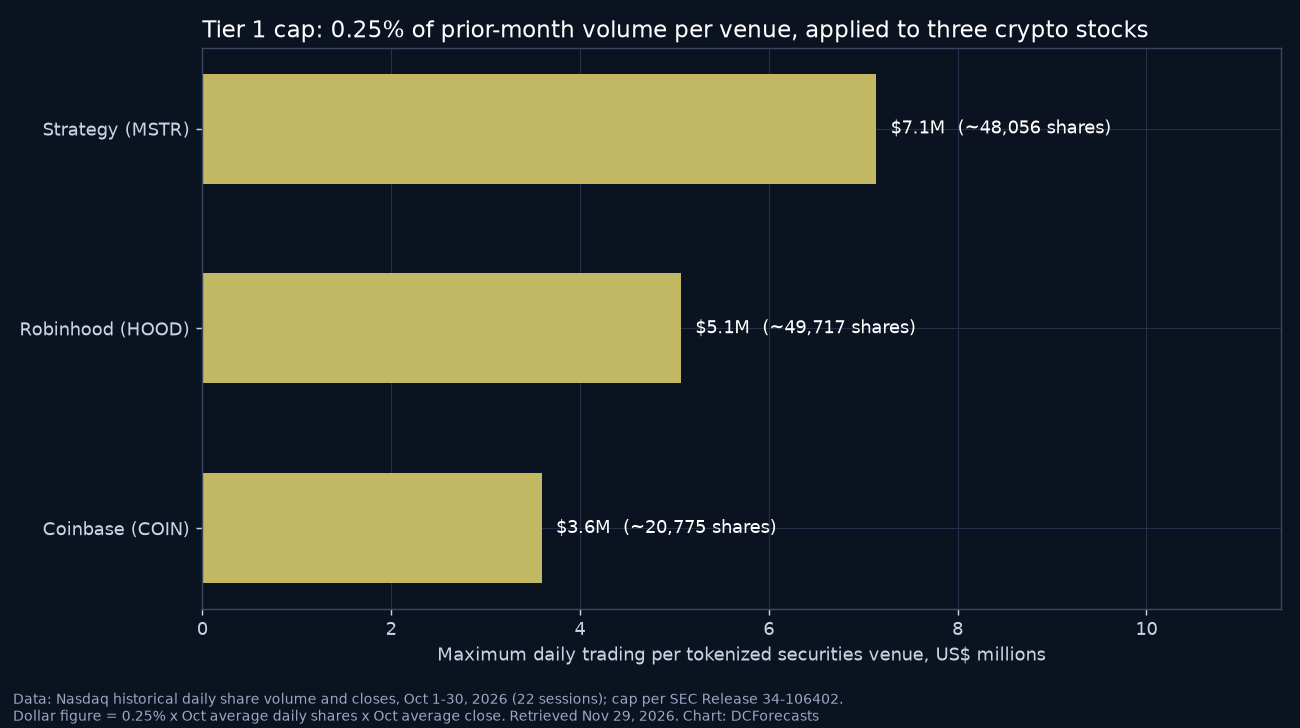
We ran the numbers on three crypto-linked Tier 1 names using Nasdaq data for October’s 22 sessions.
Coinbase averaged 8.31 million shares a day, so one venue could trade about 20,775 shares daily, roughly $3.6 million. Strategy, the largest corporate Bitcoin holder, works out to about 48,056 shares, or $7.1 million. Robinhood comes to about 49,717 shares, or $5.1 million.
Against Coinbase’s average of about $1.4 billion in daily dollar volume in October, that is a sliver.
Why Smaller Stocks Get More Room Than Giants
A footnote in the order exposes a quirk. SEC staff found that in 2025 the average Tier 1 stock traded 3,022,668 shares a day, while the average Tier 2 stock traded 1,207,978 shares.
Apply the caps and the average Tier 1 stock allows about 7,557 shares per venue per day. The average Tier 2 stock allows about 30,199 shares, four times more.
The SEC’s stated aim is to avoid disrupting the main market for the most liquid names during the trial. We believe that is a reasonable starting point.
Still, the most traded companies are exactly the ones retail investors most want on 24/7 rails. Expect that tension to come up on Dec. 3.
Five Venues Are Already Lined Up
The SEC keeps a public list of firms that have filed notices to operate under the exemption.
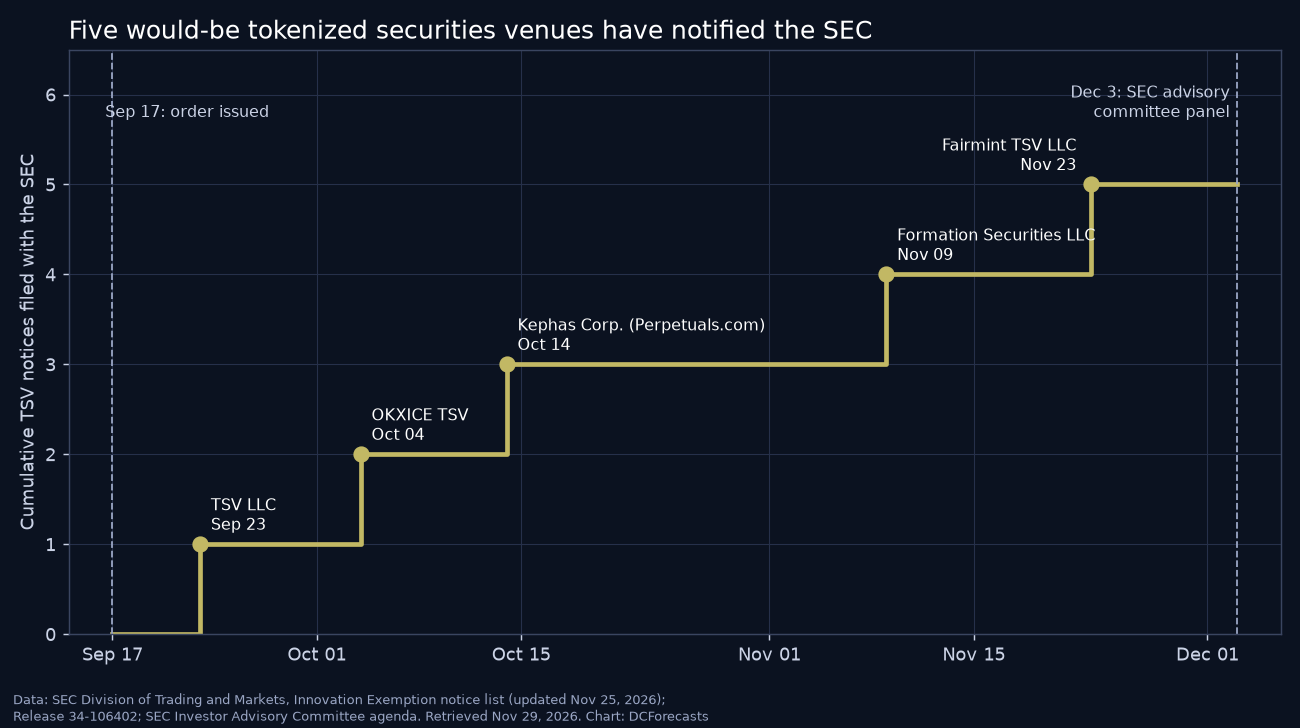
TSV LLC went first on Sept. 23. OKXICE TSV followed on Oct. 4, Kephas Corporation, doing business as Perpetuals.com, on Oct. 14, and Formation Securities on Nov. 9.
Fairmint TSV LLC is the newest name, added on Nov. 23. The SEC notes that being on the list does not mean a firm meets the order’s conditions.
OKXICE has already opened for trading. As we reported, it launched with six crypto-linked stocks, a sign that companies close to digital assets are the first to say yes.
What This Means for Crypto Markets
The order describes what these venues can offer: investor self-custody, around-the-clock trading, fractional shares and near-instant settlement.
It also lets tokenized stocks trade against payment stablecoins issued under the GENIUS Act and against tokenized money market funds.
That is the same toolkit crypto traders already use every day. For us, the key takeaway is that Wall Street’s plumbing is moving toward the always-on model Bitcoin has run on since 2009.
It fits a wider shift. Nasdaq is also stretching its hours, as we covered when it set overnight trading from Dec. 6.
The risks are real, and the skeptics on the panel will press them. Smart contracts must be public and auditable, and issuers can still object to third-party tokens of their shares.
The order also invites public comment under File No. 4-927, so the caps are not set in stone.
We would watch two things on Dec. 3: whether the committee signals support for higher Tier 1 limits, and whether more issuers opt in rather than object.
If both move the right way, tokenized securities could grow from a few million dollars a day per stock into a real second market, built on the same 24/7 logic that made Bitcoin the benchmark for open, global trading.
DC Forecasts is a leader in many crypto news categories, striving for the highest journalistic standards and abiding by a strict set of editorial policies. If you are interested to offer your expertise or contribute to our news website, feel free to contact us at [email protected]








Discussion about this post