



Gelephu Mindfulness City has given Binance a conditional green light, and the regulator behind it was handed central bank powers only four weeks ago.
Binance announced on Nov. 28 that it had received in-principle approval from the Gelephu Central Bank to set up regulated digital-asset operations in the Bhutanese special administrative region.
The exchange and the city also signed a cooperation agreement that names Gelephu as a planned Asia hub for Binance users.
For Bitcoin investors, the interesting part is where this is happening: a small Himalayan kingdom that has mined bitcoin with hydropower for years and still holds some on its national balance sheet.
The bigger question now is whether a brand-new financial zone can turn a first approval into a working, fully licensed hub.
What Binance Actually Received in Gelephu
The approval is a first step, not a licence. Binance said so plainly in its announcement.
The exchange must satisfy the conditions set by the Gelephu Central Bank and complete the remaining regulatory requirements before any regulated activity can start.
The deal was marked at Binance Blockchain Week 2026. Under the cooperation agreement, the two sides plan to build local skills in digital assets, compliance and operations, and to explore making Gelephu a regional centre of excellence for Binance’s Asian business.
Binance describes itself as serving more than 300 million users in over 100 countries. It has worked in Bhutan since launching a national crypto-powered tourism payment system there in 2025.

Jigdrel Singay, a board director of Gelephu Mindfulness City, said the city wants firms that “build real operations, create meaningful jobs, develop talent and transfer capabilities that remain in the country over the long term.”
SB Seker, Binance’s head of Asia-Pacific, called the approval “an important validation of GMC’s approach to digital asset regulation, one that protects users while enabling innovation.”
A Regulator Handed Central Bank Powers in November
The timing is notable. On Nov. 1, 2026, King Jigme Khesar Namgyel Wangchuck signed a Royal Decree that gave the Gelephu Financial Services Office a full central banking mandate, turning it into the Gelephu Central Bank.
Gelephu Mindfulness City announced the decree on Nov. 2. The new bank’s mandate covers monetary policy, foreign reserves, liquidity support and payment systems.
Licensing and supervision did not stop. According to that announcement, the office’s existing work continues inside the central bank’s Financial Supervision division.
Binance announced its approval 27 days after the decree was signed. We believe that is an early signal the new institution intends to keep its digital-asset pipeline moving rather than pause for a reorganisation.
How the Gelephu Mindfulness City Licence Path Works
The regulator’s own licensing FAQ explains what comes next, and it is a demanding list.
Gelephu regulates traditional finance and virtual assets under one law, the Financial Services Act 2025, and its rulebooks. Crypto firms face the same core regime as other financial firms, plus extra virtual-asset rules and guidance.
The FAQ says successful applicants typically receive an in-principle approval six to eight months after submitting an application. That approval does not allow a firm to start business.
Before the full Financial Services Licence is issued, a firm must generally:
- incorporate a company in Gelephu through the city’s corporate registry;
- open a local bank account and inject the required regulatory capital;
- secure office space and hire key personnel.
For us, that list is the real story. It points to staff, capital and offices on the ground, not a mailbox registration.
It also fits Binance’s broader push to show regulators stronger controls, after the $6.34 billion theft that led to a four-week withdrawal suspension, as we covered when Binance’s withdrawal suspension ended.
Bhutan Bitcoin Holdings Punch Above the Kingdom’s Size
Bhutan’s link to Bitcoin predates this deal. The state investment arm, Druk Holding and Investments, began mining bitcoin in 2019 using the country’s hydroelectric power.
BitcoinTreasuries.NET lists Bhutan with 518 BTC as of Sept. 15, 2026, ninth on its table of government holders. That is about $30.8 million at the CoinGecko price of $59,540 on Nov. 28.
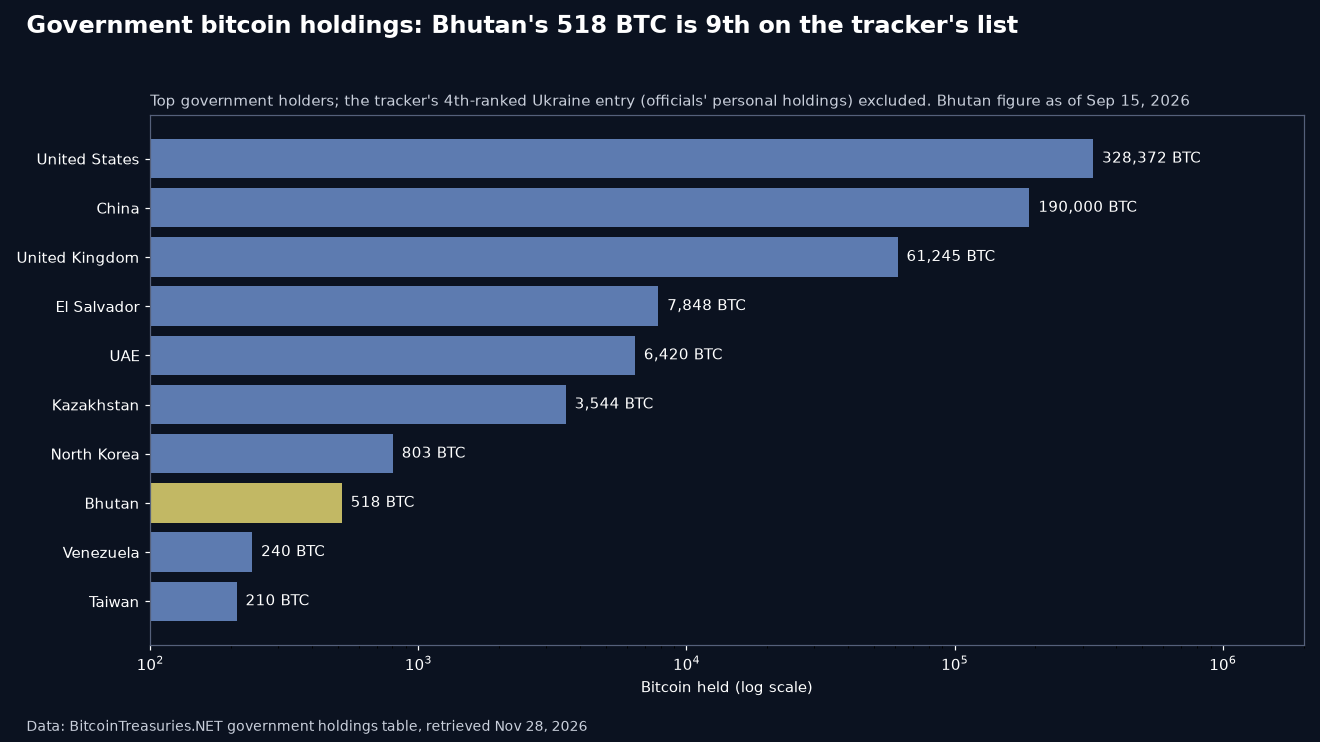
The raw number looks small next to the United States at 328,372 BTC or China at 190,000 BTC. Scale changes the picture.
Against World Bank GDP data for 2025, Bhutan’s bitcoin equals about 0.86% of its $3.58 billion economy.
Among the governments we compared, only El Salvador ranks higher, at about 1.27%. The United Kingdom, the United States and China each sit below 0.1%.
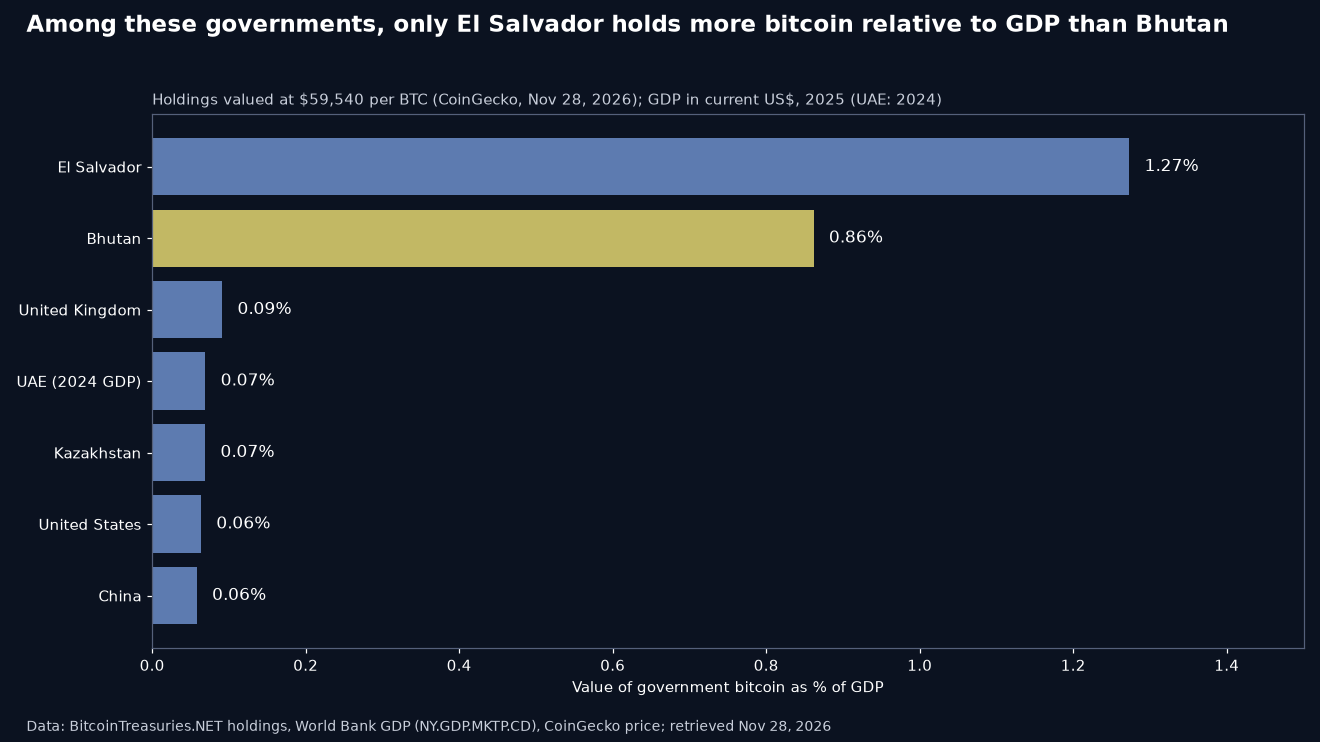
We would not read too much into one ratio, since holdings move and the Bhutan figure is two months old. But it shows a country that treats Bitcoin as a national asset rather than a side experiment.
Why Binance Bhutan Matters for Bitcoin’s Next Phase
Bitcoin is trading near $59,540, well below its 2025 record, and sentiment has been fragile through November.
Rule-writing has kept moving through the slide. A small state is now building a full licensing and central banking framework, and one of the world’s largest exchanges is choosing to work inside it.
We believe that matters more over time than any single month’s price. Clear local rules make it easier for exchanges to hire, hold reserves and serve users openly.
Bhutan also offers something few hubs can: renewable energy, state-level Bitcoin experience and a regulator that wants real operations on the ground.
The next test is the full licence. If Binance clears the conditions and Gelephu Mindfulness City issues it, the Himalayas may become one of Asia’s more unusual gateways to Bitcoin, and the coming months will show how quickly that happens.
DC Forecasts is a leader in many crypto news categories, striving for the highest journalistic standards and abiding by a strict set of editorial policies. If you are interested to offer your expertise or contribute to our news website, feel free to contact us at [email protected]












Discussion about this post