



A deposit worth less than half a hundredth of an ether was enough to empty Ankr’s Ethereum bridge. On November 9, an attacker reused one small, already-settled transfer from Optimism to unlock five withdrawals and take every token the bridge contract held.
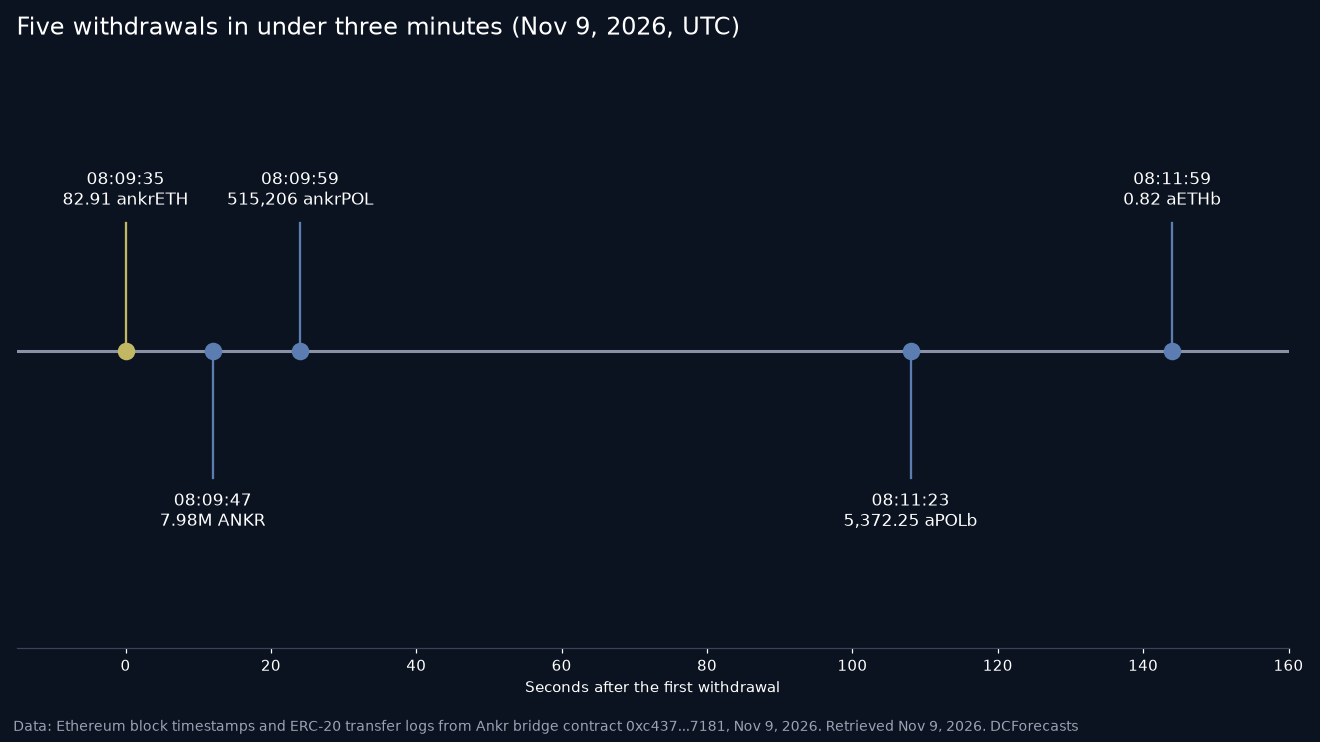
Security firm SlowMist put the loss at about $304,500. Ethereum transfer logs reviewed by DCForecasts show the tokens leaving the contract in five transactions between 08:09:35 and 08:11:59 UTC, all to the same wallet.
How a Reused Receipt Fooled the Bridge
Ankr’s cross-chain bridge lets users move its liquid staking tokens between networks. A user deposits on one chain, Ankr’s backend confirms the deposit, and a trusted signer approves the matching release on the other chain.
The attacker started from a genuine deposit made on Optimism on November 3. It moved just 0.0044024803 ankrETH and had already been redeemed on Ethereum that same day. On November 9 the attacker built five new receipts that pointed to that same deposit, but changed the recipient, the token and the amount in each one.
According to SlowMist, all five receipts carried valid signatures from the bridge’s trusted consensus signer. The contract’s withdraw function accepted those signatures without checking the receipts against what had actually happened on Optimism, so it released the funds. SlowMist said the origin of the unauthorized signatures is still under investigation and that a signer compromise has not been confirmed.
What the Attacker Took
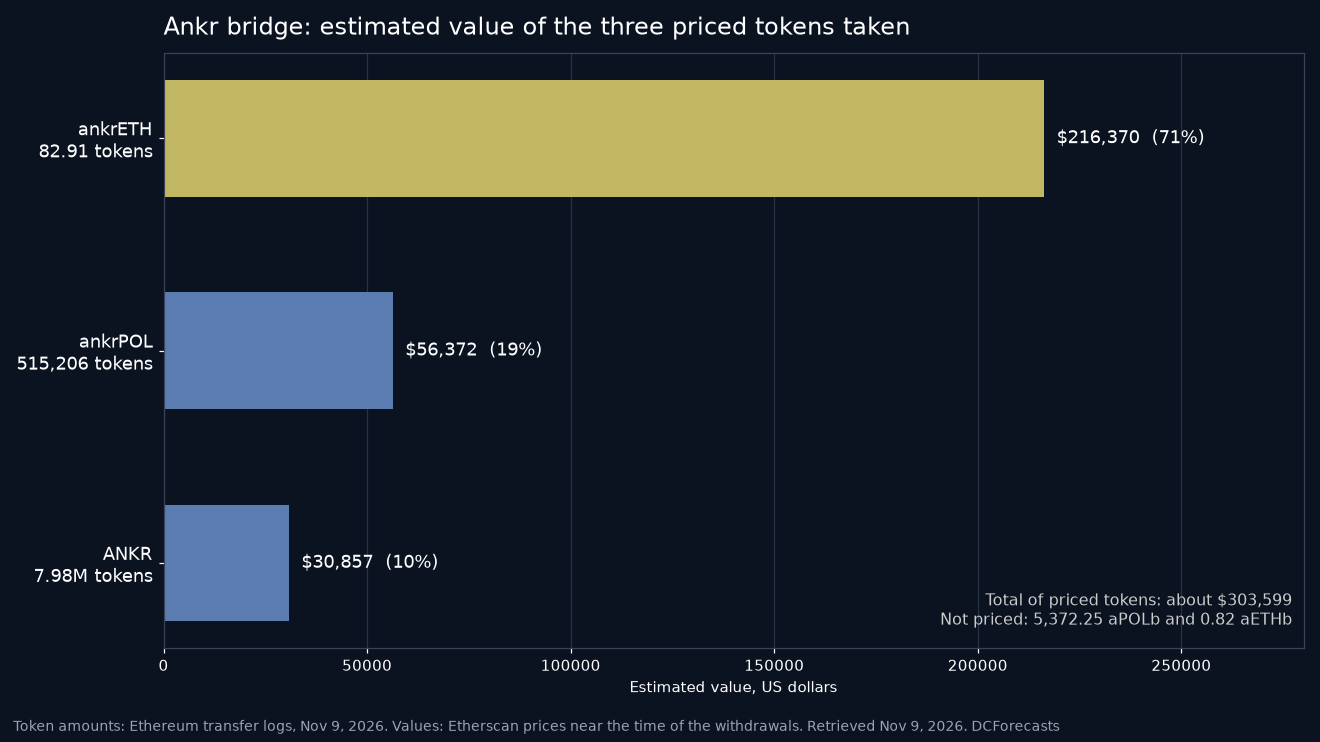
The transfer logs show the full list. The largest withdrawal was 82.91 ankrETH, Ankr’s staked ether token, followed by 7.98 million ANKR, the project’s own token, and 515,206 ankrPOL, its staked Polygon token. Two older staking tokens also left: 5,372.25 aPOLb, which is still widely listed under its earlier name aMATICb, and 0.82 aETHb.
Using Etherscan prices near the time of the withdrawals, the three priced tokens were worth about $303,600. ankrETH made up roughly 71% of that figure, ankrPOL 19% and ANKR 10%. The two older tokens had no reliable quote, which is why estimates range from about $292,000 in the first alert to SlowMist’s later $304,500.
Hours of Preparation, Minutes of Execution
Blockchain security firm Blockaid raised the first public alarm at 08:42 UTC, describing an ongoing exploit in which five withdraw calls had unlocked the bridge’s locked inventory. Its follow-up analysis said the attacker had spent the early hours of the day, from about 02:08 to 04:06 UTC, draining five Ankr operator wallets on Ethereum, Arbitrum and Linea, then using those funds to pay for the relayer that submitted the bridge transactions.
The withdrawals themselves took less than two and a half minutes. Three of them landed within 24 seconds.

The Bridge Is Now Paused and Empty
For several hours after the attack, the contract’s public pause flag still read false, which raised questions about whether more funds were at risk. When DCForecasts queried the contract at about 15:20 UTC, the flag read true, meaning withdrawals are now halted. The contract’s balance in all five affected tokens was zero.
The funds have already started to move. As of the same check, the recipient wallet still held the ankrPOL, aPOLb and aETHb, but only 5 of the 82.91 ankrETH and none of the 7.98 million ANKR remained.
Ankr had not published a statement on the cause, affected users or any recovery plan at the time of writing. The company runs liquid staking products and widely used remote procedure call (RPC) infrastructure, so the community will want to know whether any of those systems share signing keys or backend services with the bridge.
Why This Kind of Crypto Hack Keeps Happening
Cross-chain bridges hold pooled assets and rely on someone to vouch for events on another network. When that vouching is done by a small set of signers, a bad signature, or a backend that signs whatever it is shown, can unlock everything at once. This case appears to fit that pattern: the deposit was real, but the receipts built on top of it were not.
The loss is small by bridge standards, yet it lands in a busy week for security incidents, after the Gnosis Pay card breach and the sentencing of the Holograph insider who minted 1 billion HLG tokens.
A Contrast With Bitcoin’s Simpler Design
Holders of native Bitcoin don’t depend on a bridge operator’s signer to prove what happened on another chain. Every transaction is checked by each full node against the same ledger, secured by a hashrate near 980 EH/s, as our latest network report shows. That simplicity is a big part of why Bitcoin’s base layer has kept its security record.
For users of liquid staking tokens, the practical lesson is to know how a bridge verifies deposits before moving assets through it, and to follow Ankr’s official channels for its post-incident report.
DC Forecasts is a leader in many crypto news categories, striving for the highest journalistic standards and abiding by a strict set of editorial policies. If you are interested to offer your expertise or contribute to our news website, feel free to contact us at [email protected]












Discussion about this post