


Tokenized securities trading is coming to Solana. Formation Securities said on November 9 that it has notified the U.S. Securities and Exchange Commission that it intends to run a tokenized securities venue on the blockchain, with trading expected to start in early 2027.
Three listed companies are lined up for launch: Galaxy Digital, Exodus Movement and Forward Industries. That makes Formation the fourth firm to go public with plans under the SEC’s new innovation exemption, and the first to build on Solana. It also arrives with something the earlier entrants have struggled to show: issuers that want to be there.
What Formation Is Building
Formation Securities licenses its trading technology from Orca, the Solana-based exchange protocol that recently merged with lending platform Loopscale to form a company called Formation. The venue will use automated market maker liquidity pools rather than a traditional order book, which is the model the SEC’s exemption was written for.
According to the company’s announcement, verified investors will hold tokenized shares in their own digital wallets and trade them around the clock against stablecoins and other eligible assets. Each trade is set to settle atomically onchain, so the cash and the shares change hands in the same step.
The tokens are meant to carry the same voting and dividend rights as ordinary shares, while each company’s transfer agent keeps the official shareholder record. Superstate and Securitize are expected to supply tokenized shares. Access is planned through Formation’s own platform, brokers such as Alpaca, custodians including Anchorage Digital and BitGo, and Solana wallets.
“Formation Securities is designed to give issuers and investors a new, transparent market, with trading beyond traditional market hours and faster settlement onchain, while preserving the key rights shareholders enjoy in the traditional financial space,” said Christopher Montagano, the firm’s president.
How the SEC Innovation Exemption Works
The SEC issued the exemption on September 17, 2026. It frees qualifying venues, called TSVs, from being treated as an “exchange” under the Securities Exchange Act, and it frees certain liquidity providers from being treated as dealers. The relief runs for five years.
Smart contracts must be public, auditable and deployed on a public, permissionless blockchain. A venue must halt a tokenized stock whenever the underlying stock stops trading on its main exchange, and it must publish details of its operations and trading. Commissioner Hester Peirce joked in her statement on the order that its “limited nature may cause you to yawn.”
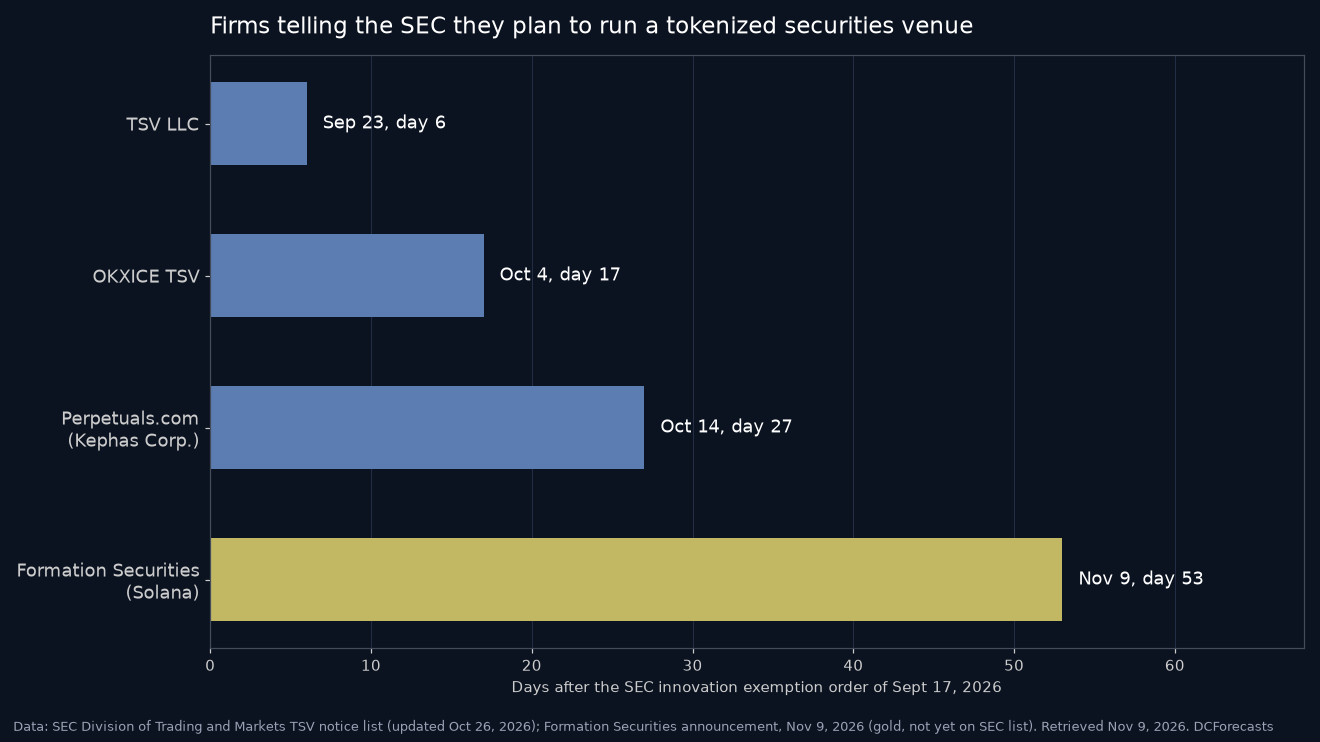
A venue must post its public notice at least 30 calendar days before it starts operating, then tell the SEC within one business day. The agency keeps a public list of firms that have done so. When it was last updated on October 26, it showed three names: TSV LLC on September 23, OKXICE TSV on October 4 and Perpetuals.com operator Kephas Corporation on October 14. Formation’s notice came 53 days after the order.

Why Issuer Consent Is the Real Test
The order gives listed companies a veto over third-party tokens of their stock. A venue that wants to trade shares tokenized by an unaffiliated firm must first notify the issuer, and it can’t start until 30 calendar days after the issuer receives that notice. If the company objects in time, those tokens stay off the venue.
Large companies have already pushed back on plans to list their tokenized stocks without permission, which makes the 30-day window a real hurdle for any venue that picks its roster first.
Formation went the other way. Galaxy and Forward Industries already have tokenized shares through Superstate’s platform, and Exodus was one of the first companies to issue tokenized shares through Securitize. Starting with issuers that already back tokenization makes the objection process far less of a risk to its launch.
Caps Keep the Experiment Small
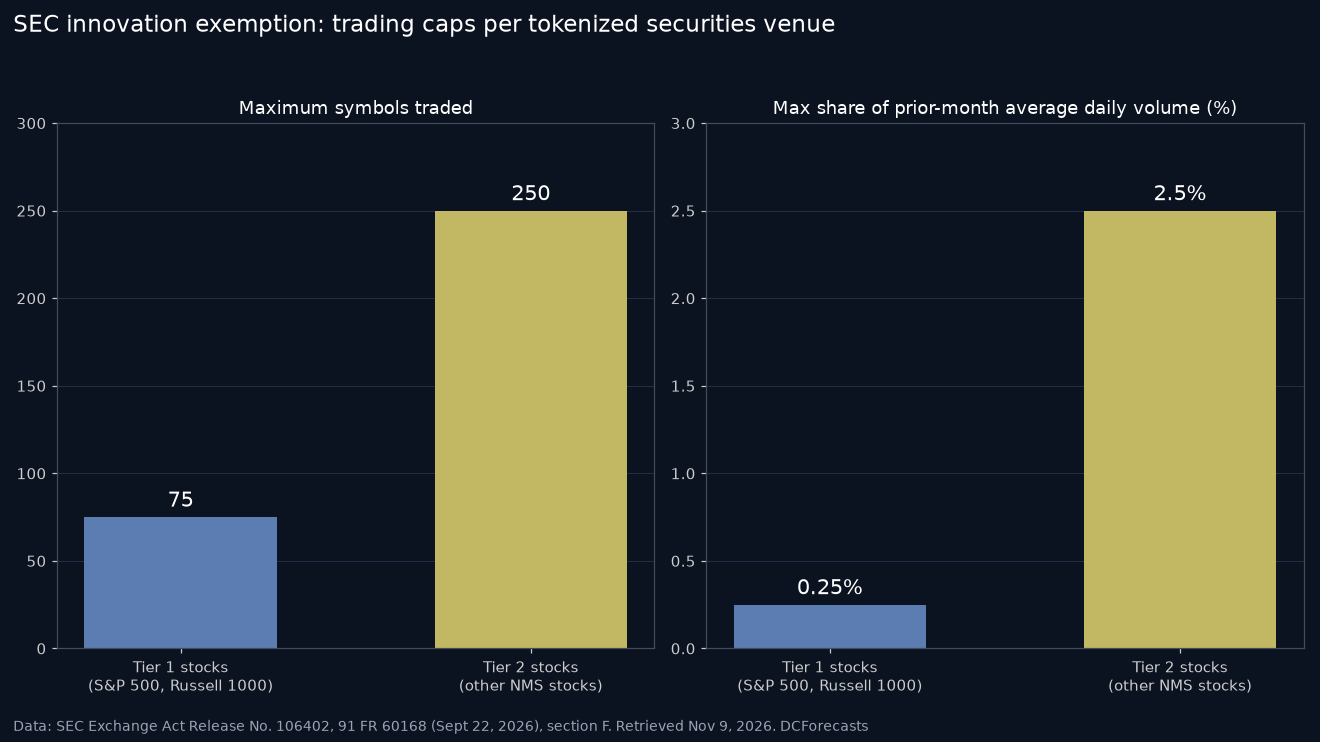
Even with willing issuers, the scale stays limited at first. Under section F of the order, stocks are split into two tiers. Tier 1 covers S&P 500 and Russell 1000 names plus some heavily traded exchange-traded products. A venue can trade no more than 75 Tier 1 symbols, and no more than 0.25% of each stock’s average daily volume from the prior month.
Tier 2, which covers other listed stocks, allows up to 250 symbols and 2.5% of average daily volume. Volume and symbol counts must be added up across affiliated venues, so a company can’t split itself into several TSVs to get around the limits.
Why This Matters for Crypto Markets
We believe the bigger story is the direction of travel for tokenized equities. A U.S. regulator is now letting listed stocks trade on public blockchains, settled against stablecoins, at any hour. That’s the same open infrastructure crypto users have relied on for years, now being adapted for mainstream capital markets.
It fits a wider pattern of U.S. regulators making room for crypto inside existing market structure, from the Texas Stock Exchange’s fast-track path for Bitcoin trusts to Coinbase’s derivatives clearer settling through trust companies. Each step makes public blockchains more ordinary for regulated finance, and Bitcoin, as the largest and most established network, stands to gain from that familiarity.
What to Watch Before Launch
Formation’s name should appear on the SEC’s notice list, and the company says it will spend the coming months approaching more public companies to join the roster. The 30-day issuer notice clock will apply to any third-party tokens it adds.
The SEC is also still accepting comments on the order under file number 4-927, so the rules could be adjusted. For now, four firms have shown they want to try onchain stock trading, and Formation is the first to arrive with its issuers already on board.
DC Forecasts is a leader in many crypto news categories, striving for the highest journalistic standards and abiding by a strict set of editorial policies. If you are interested to offer your expertise or contribute to our news website, feel free to contact us at [email protected]






Discussion about this post