



Schwab Crypto just got bigger. Charles Schwab said on November 9 that clients can now buy and sell Solana, Avalanche and Chainlink through the platform, joining Bitcoin and Ethereum.
That brings the lineup to five cryptocurrencies, traded as SOL/USD, AVAX/USD and LINK/USD pairs alongside the original two. It is the first expansion since the brokerage opened direct crypto trading to all eligible retail clients in October.
“We continue to expand Schwab Crypto to give clients greater choice and flexibility in how they invest in digital assets alongside their broader investments,” said Joe Vietri, Schwab’s Head of Digital Assets, in the announcement.
From Two Coins to Five in Six Months
The rollout has moved in clear steps. Schwab Crypto opened to clients through early access in May 2026, offering only Bitcoin and Ethereum. On August 27, Schwab said the three new tokens would arrive “in the coming months.” In October the service became available to every eligible retail client, and Monday’s addition delivered on the August promise.
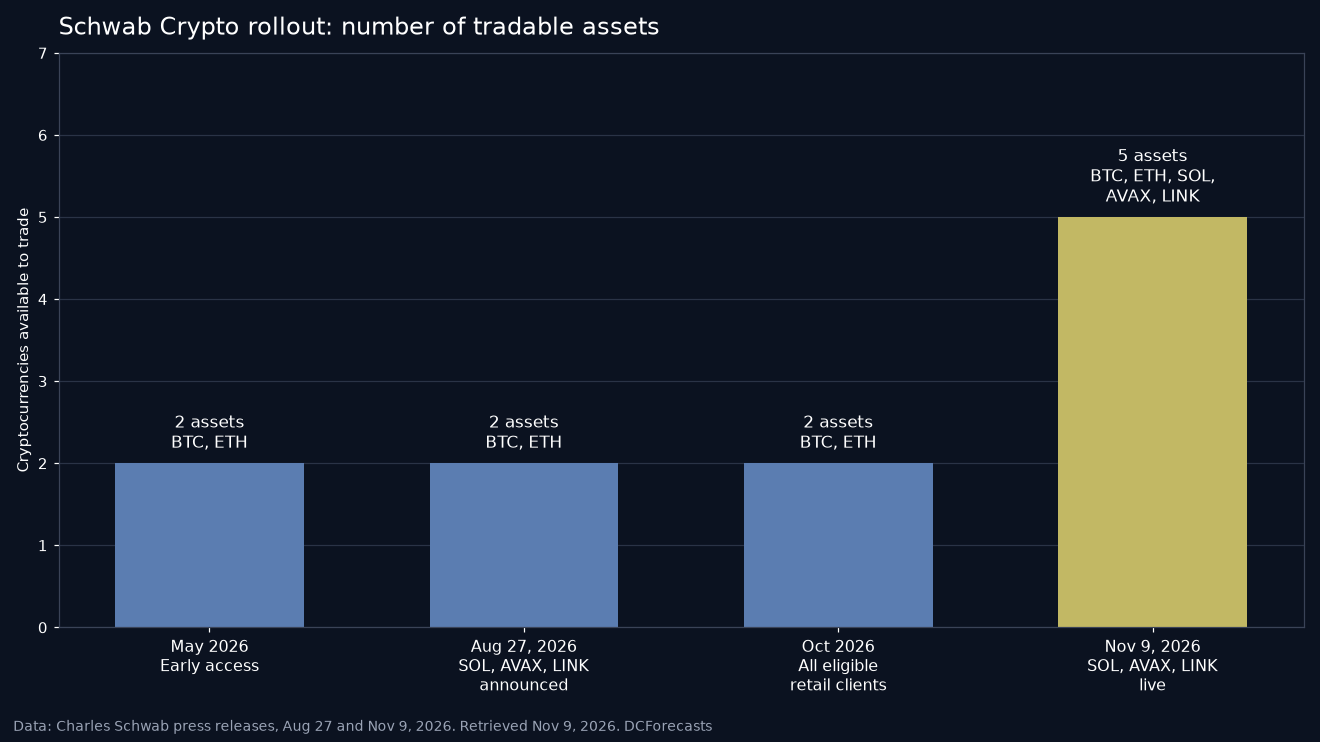
Schwab described the new tokens as established cryptocurrencies that match client demand, and said it plans to add more cryptocurrencies and other digital assets over time. It did not name the next candidates or give a schedule. The pattern so far, an announcement followed by delivery a little over two months later, gives investors a rough sense of how the next additions could be handled.
How Schwab Crypto Works
The account sits beside a regular Schwab brokerage account, so clients see crypto and traditional holdings side by side on Schwab.com, Schwab Mobile and the thinkorswim trading platform. Anyone who is not already a Schwab client has to open a brokerage account first.
The crypto accounts are offered through Charles Schwab Premier Bank, SSB, a bank subsidiary of the group, with the affiliated brokerage handling some operations. They are available in every US state except New York and Louisiana, and not in US territories or outside the country.
Schwab’s disclosures say crypto holdings are not bank deposits and are not covered by FDIC or SIPC protection. The company also reserves the right to delay, change or withdraw support for an individual token for regulatory, market or operational reasons.
What Schwab Crypto Costs
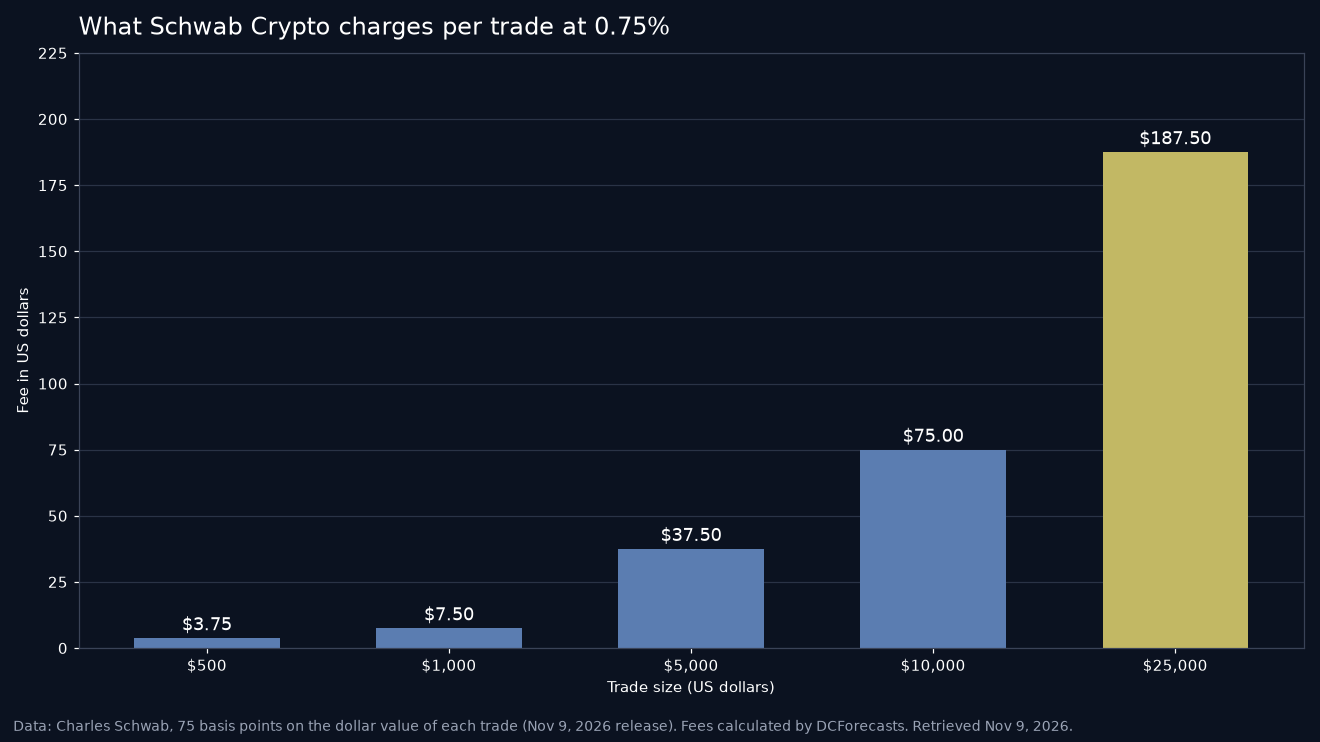
Pricing is a flat 75 basis points, or 0.75% of the dollar value of each trade, with no separate spread according to Schwab’s product page. The company calls that among the lowest in the industry.

In practice, a $1,000 purchase costs $7.50 and a $10,000 purchase costs $75. Because the fee is a percentage, it scales in a straight line with trade size, so larger orders pay proportionally more. The charge applies on each side, so buying $1,000 of a token and later selling the same $1,000 would cost $15 in total.
Orders can be entered either in coins or in dollars, according to Schwab’s product page. That makes it simple to buy a fixed dollar amount of a higher-priced asset such as Bitcoin without working out fractions by hand.
Clients also get access to Schwab’s research and education on digital assets and round-the-clock phone and chat support from crypto specialists, which the firm leans on as a selling point against standalone exchanges.
Why the Altcoin Picks Matter
Each new token brings a different use case to Schwab clients. Solana is a high-throughput smart contract network that has become a base for trading and tokenized assets, a trend we covered in our report on Formation’s tokenized securities venue on Solana. Avalanche is another smart contract network built around customizable subnets, and Chainlink supplies price feeds and data that many onchain applications rely on.
For many long-time Schwab customers, this will be the first time they can hold any of these tokens without opening an account at a separate crypto exchange. That convenience is the core of Schwab’s pitch.
Bitcoin Still Anchors the Shelf
Bitcoin was one of the two coins Schwab launched with, and it remains the asset most investors meet first. The brokerage’s move adds another mainstream doorway alongside the spot ETFs that keep drawing institutional money, from BlackRock’s record 801,033 BTC position to Fidelity’s FBTC adding 8,784 BTC in the third quarter.
Wider access through household-name brokers tends to support long-term demand for Bitcoin, because investors who start with one coin inside a familiar account often stay. Exchange infrastructure is following too, as our report on the Texas Stock Exchange’s fast-track approval for Bitcoin trusts showed.
What Comes Next for Schwab Crypto
The open questions are which assets come next, and whether Schwab will extend the service to New York and Louisiana. Schwab has kept its language cautious, describing a “thoughtful” expansion tied to client demand.
For now, the message to clients is simple. Five major crypto networks can be bought in the same account that holds their stocks and funds, at a published 0.75% fee.
DC Forecasts is a leader in many crypto news categories, striving for the highest journalistic standards and abiding by a strict set of editorial policies. If you are interested to offer your expertise or contribute to our news website, feel free to contact us at [email protected]












Discussion about this post