



ARK Investment Management has withdrawn two crypto index fund registrations with the SEC, including one designed to strip Bitcoin out of a 20-coin basket.
Both requests were filed on November 20, 2026, exactly 301 days after the original Form S-1 documents went in on January 23.
Neither fund ever traded. According to the withdrawal letters, neither registration statement was declared effective and no shares were sold.
For Bitcoin investors, the more interesting detail is the second product. It planned to short CME Bitcoin futures to remove Bitcoin from its returns.
The bigger question is whether demand for broad crypto baskets, and especially for crypto without Bitcoin, was ever as deep as the filings assumed.
What ARK Filed, and What It Withdrew
The two filings described sister products, both planned for NYSE Arca.
The first would track a benchmark of the 20 largest crypto assets by market capitalization, excluding stablecoins and memecoins, with quarterly rebalancing.
It would not hold coins directly. Instead, the S-1 describes a commodity pool taking long positions in index futures listed on ICE Futures U.S., with ARK registered as a commodity pool operator with the CFTC.
The second fund would follow the same index excluding its Bitcoin component.

To do that, it planned to pair the long index futures with short positions in CME Bitcoin futures, adjusting both as index weights changed.
The prospectus pages never filled in a ticker or a sponsor fee. Both were left blank in brackets, and EDGAR shows no amendment to either filing before the withdrawals.
The letters, signed for ARK, cite Rule 477 under the Securities Act and give one reason: the sponsor “does not intend to proceed with the planned distribution” of the shares.
Why a Bitcoin-Free Crypto Index Fund Was a Hard Sell
ARK did not explain its decision beyond that sentence, and we will not guess at its internal reasoning.
What we can do is check how an ex-Bitcoin approach would have fared since the filings were made.
We pulled CoinGecko daily data for Bitcoin and 12 large non-Bitcoin coins: Ether, XRP, Solana, Cardano, Chainlink, Avalanche, Litecoin, Dogecoin, Stellar, Bitcoin Cash, NEAR and Uniswap.
This is our own illustrative basket, not the official index or its weights.
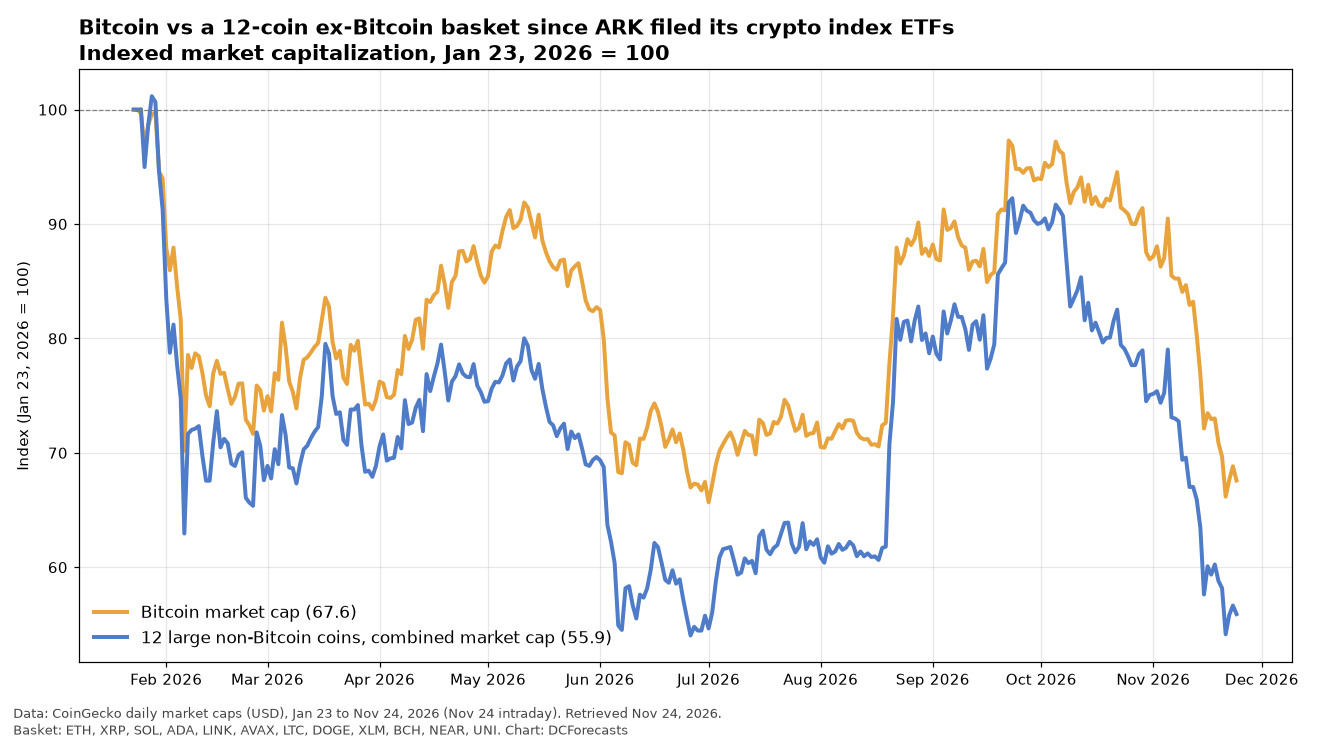
From January 23 to November 24, the combined market capitalization of those 12 coins fell 44.1%.
Bitcoin’s market capitalization fell 32.4% over the same stretch. That is a real drawdown, and we will not dress it up.
Yet the gap matters. An investor who removed Bitcoin from a large-cap crypto basket would have lost roughly 12 percentage points more.
Bitcoin’s share of our 13-coin group rose from 74.1% to 77.6% during the period.
Bitcoin Held Up Better Than Most of the Basket
The coin-by-coin picture tells the same story.
Bitcoin’s price moved from about $89,484 on January 23 to about $60,068 on November 24, a decline of 32.9%.
Ether fell 42.6%, Solana dropped 45.6% and XRP lost 52.5%. Cardano was down 59.8%, while Bitcoin Cash shed 67%.
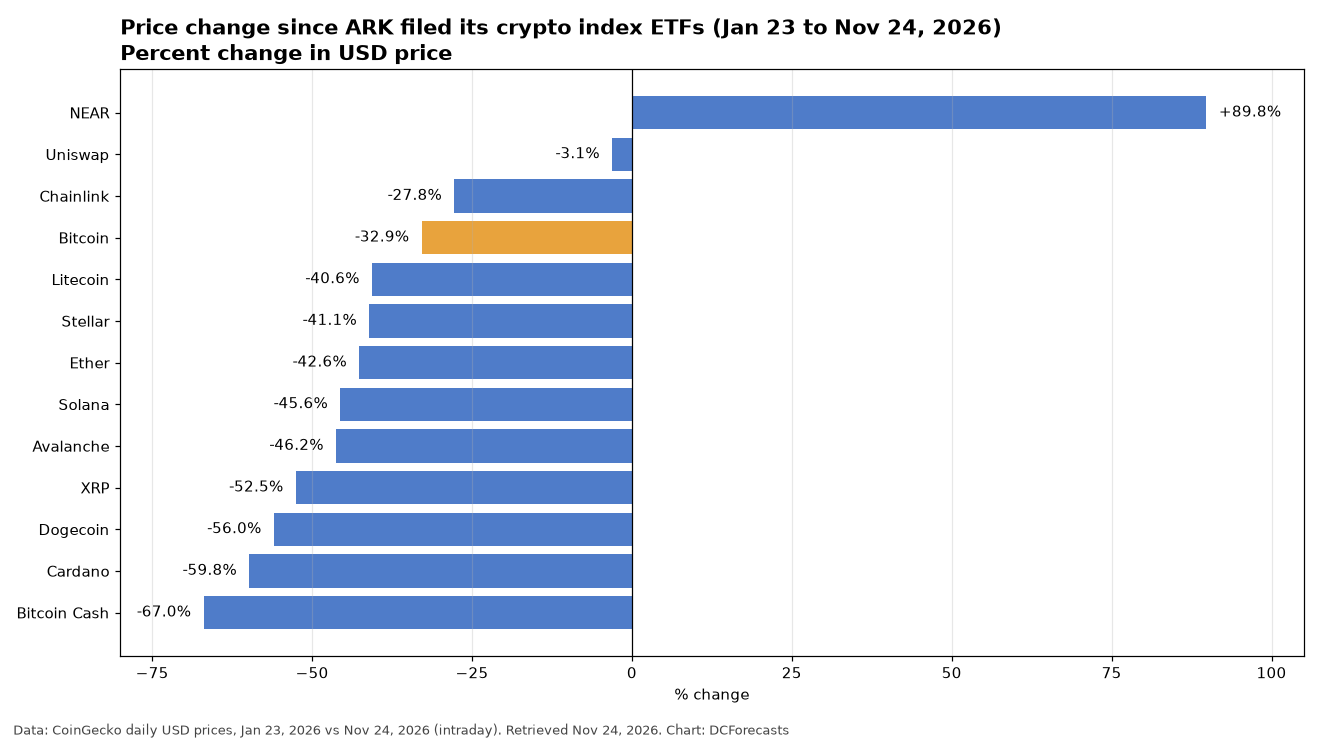
Only three of the 12 beat Bitcoin. NEAR rose 89.8%, Uniswap slipped just 3.1% and Chainlink fell 27.8%.
That shows altcoin baskets can still produce standout winners. However, the winners were too small to offset the slide in the larger names.
We believe this is the core problem for any ex-Bitcoin crypto index fund. In a falling market, the asset it removed was the one that cushioned the drop.
This fits with what we saw when Bitcoin dominance hit a one-year high against the biggest altcoins last week.
What the Crypto Index Fund Exit Says About ETF Demand
The withdrawals come during a tough month for crypto funds.
As we reported, Bitcoin ETF flows are on track for their worst month on record in November.
Outflows are uncomfortable, but spot Bitcoin ETFs remain the established, liquid route into the asset for mainstream investors.
Multi-coin products face a different challenge. They must convince advisers that a basket offers something a Bitcoin position does not.
Each new token in a basket adds its own custody, liquidity and regulatory questions. A futures-based structure also adds roll costs, which buyers of spot Bitcoin ETFs do not pay.
The ex-Bitcoin design added a further layer: a permanent short in CME Bitcoin futures. Holders would carry a standing short against the market’s largest and most liquid asset.
For us, the key takeaway is that sponsors seem to be backing simpler, Bitcoin-led exposure, while more complex altcoin structures struggle to reach launch.
Can Bitcoin Turn Relative Strength Into a Recovery?
Relative strength is not the same as a rally, and Bitcoin still needs about 49% to return to its January 23 level near $89,500.
The first hurdle is closer. Reclaiming and holding $60,000, the level Bitcoin was trading around on November 24, would be an early sign of stabilization.
We would watch three signals over the coming weeks.
- Whether daily spot Bitcoin ETF flows turn positive before November closes.
- Whether Bitcoin’s share of large-cap crypto keeps rising, a sign that capital is consolidating rather than leaving.
- Whether other issuers follow ARK in pruning multi-coin and altcoin filings.
We believe the long-term case remains intact. Bitcoin’s fixed 21 million supply, its deep futures and ETF markets, and its role as the reference asset all set it apart.
ARK’s decision removes one product designed to work without Bitcoin. The data since January suggest investors in that product would have needed Bitcoin more than the fund’s design allowed.
The coming weeks will show whether that relative strength becomes the base for Bitcoin’s next leg higher.
DC Forecasts is a leader in many crypto news categories, striving for the highest journalistic standards and abiding by a strict set of editorial policies. If you are interested to offer your expertise or contribute to our news website, feel free to contact us at [email protected]












Discussion about this post