



Bitcoin private keys can leak through one tiny signing mistake, and research presented at this year’s Financial Cryptography conference shows that automated bots are watching for it around the clock.
Two computer scientists at the University of Liège in Belgium, Vincent Jacquot and Benoît Donnet, scanned every ECDSA signature on six blockchains from launch through June 30, 2024. They recovered 3,620 private keys, and 3,278 of them came from Bitcoin.
The cause was the same each time: a “nonce”, a number that must be used only once per signature, had been used again.
For Bitcoin users, the important point is where the fault sits. It lives in badly built wallet software, not in Bitcoin’s protocol, and the fix has been known for more than a decade.
The bigger question is how much of this risk is still live, and how fast attackers move when it appears.
How a Reused Nonce Gives Away a Private Key
Every Bitcoin transaction is authorised with a digital signature. To make one, the wallet combines the private key with a fresh random number, the nonce.
If the same key signs two different messages with the same nonce, the two signatures form a pair of simple equations. Anyone who sees both can solve them and calculate the private key.
The Liège team went further. Following earlier work by Brengel and Rossow, they also caught cases where one nonce was shared across several different keys, which can be solved as a larger system of equations.
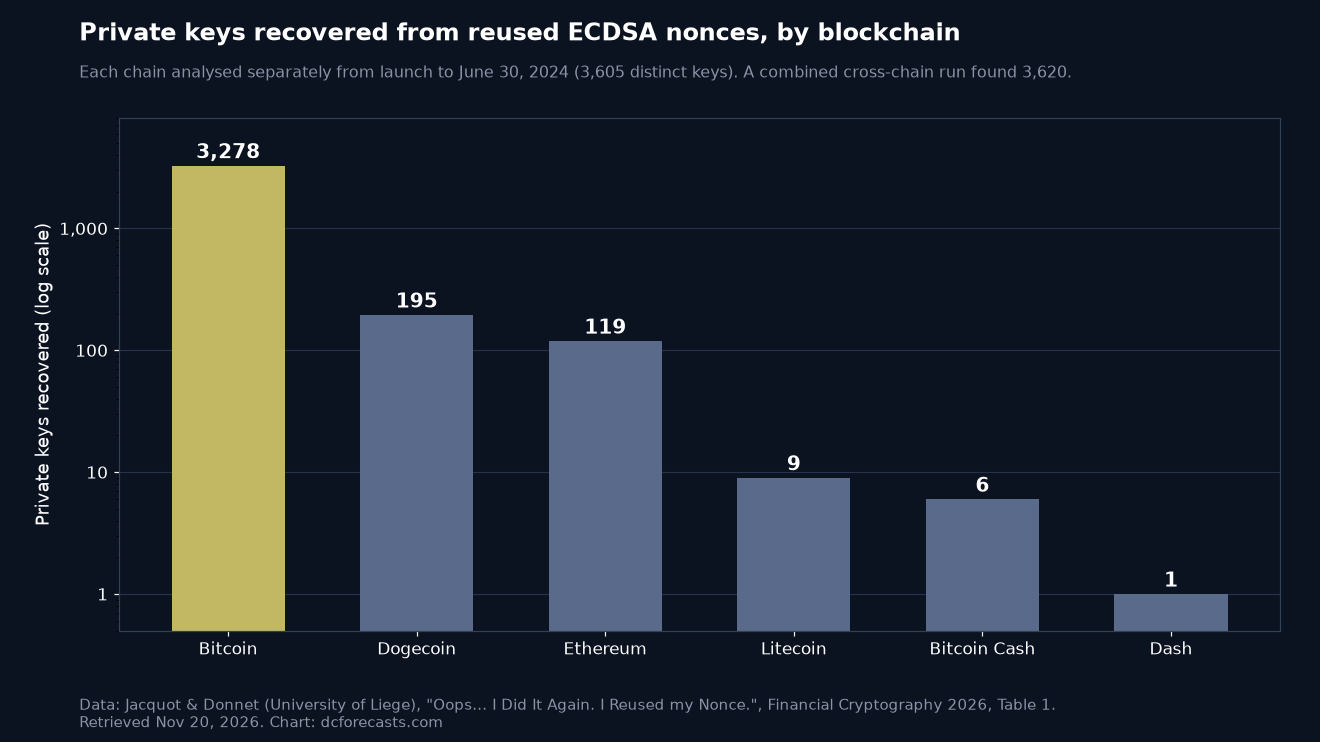
We suspect Bitcoin dominates the count mainly because it has the longest and busiest history of the six. Dogecoin produced 195 keys, Ethereum 119, and Litecoin, Bitcoin Cash and Dash just 16 between them.

Fifteen keys appeared only when all six chains were searched together. That points to wallet software that reused nonces across networks.
Bots Struck the Second the Bait Was Live
To check whether anyone is actually exploiting the flaw, the researchers set honeypots on April 28, 2025. They funded deliberately vulnerable Bitcoin and Ethereum addresses with $3 to $5 each.
On Bitcoin, transactions trying to sweep the funds appeared in the mempool “at the second the addresses became vulnerable,” the paper says. Two separate attempts to spend from one honeypot suggested rival bots racing for the same coins.
Interestingly, the fast bots only went after the simplest case, a single key reusing its own nonce. The trickier multi-key traps sat untouched until May 11, 2025, when another attack emptied all the remaining Bitcoin honeypots.
On Ethereum, every vulnerable address was drained, about three hours after it was exposed. A special trap that reused one nonce across Bitcoin and Ethereum had still not been touched as of December 2025.
We read this as a warning about speed rather than scale. Once a key is exposed on a public ledger, the window to react can close in seconds.
How Much Bitcoin Was Ever at Risk?
The study estimates that the vulnerable addresses held about €101 million at their combined peak balances, valued at Nov. 25, 2024 prices. That is a measure of exposure, not of confirmed theft. The researchers note that a transfer out of a vulnerable address is not necessarily an attack.
The risk was also concentrated in the past. The paper counts nine moments when more than €1 million was exposed at once, mostly between 2014 and early 2016, with Bitcoin keys the main contributors. The peak came in December 2014, at about €25 million.
The last two large episodes, in October 2022 and February 2023, were €11.2 million and €1.2 million, and most of those amounts came from Ethereum.
Most affected addresses were small. Some 67.25% of them held less than €100 at their peak.
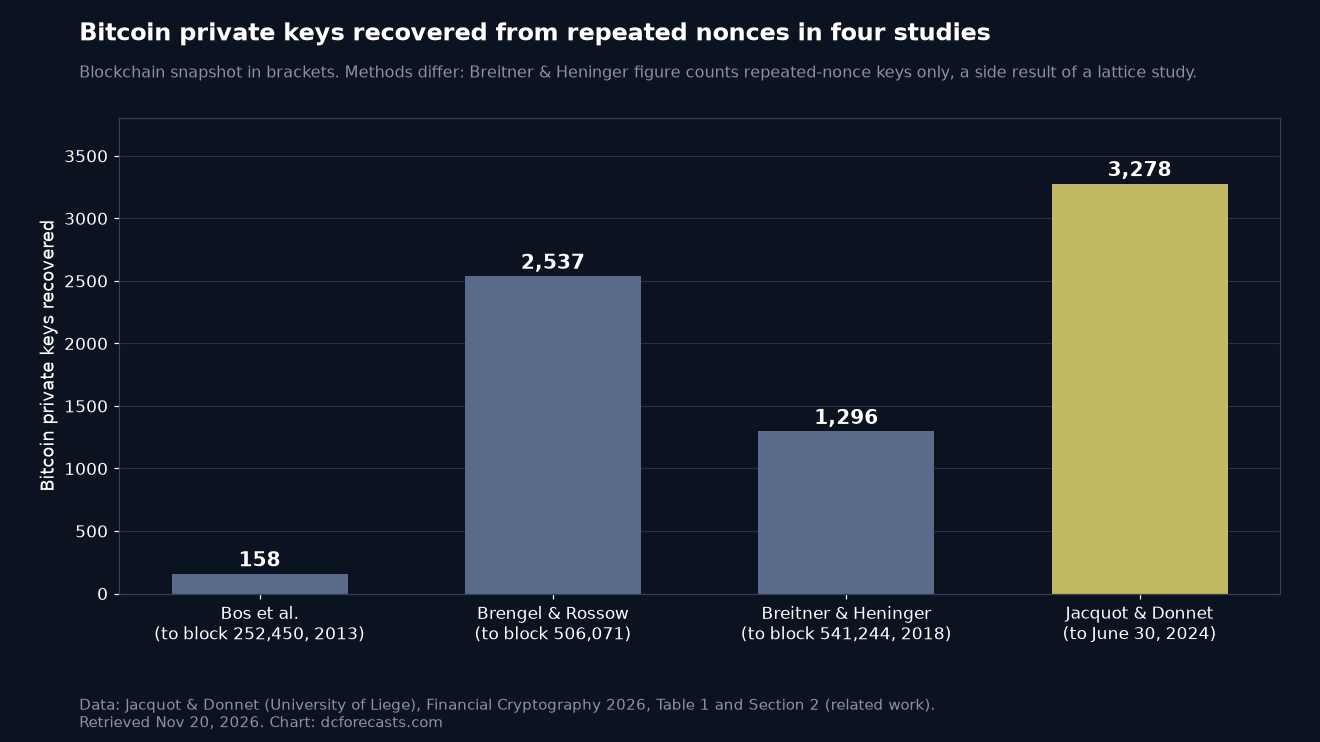
The comparison with earlier research is telling. A 2013 study found 158 Bitcoin keys, and later work on 2018 snapshots found up to 2,537. The new total is higher, but it covers six more years of a far larger network.
Why Bitcoin’s Design Is Not the Problem
The paper lists three reasons nonces get repeated, and none is a flaw in Bitcoin itself.
The first is cost cutting. The single most common repeated nonce appears in 2.48 million Bitcoin transactions, because it produces a shorter signature and therefore a slightly lower fee.
The second is buggy software. One example is the 2013 Android random number flaw catalogued by the U.S. National Vulnerability Database as CVE-2013-7372.
The third is human: some nonces look hand-picked, such as 123456.
The cure is standard. RFC 6979, published in August 2013, generates nonces deterministically, and the authors say that if it were used everywhere, the attack would not apply. Bitcoin Core switched to deterministic signing through the libsecp256k1 library in version 0.10.0, released in 2015.
That timeline matches the data, with the worst exposure clustered before 2016.
What Bitcoin Holders Should Take From This
The practical lesson is about tools. Well-maintained wallets have avoided this mistake for years, while old, abandoned or home-made signing code is where the danger sits.
It fits a pattern we have tracked this month, from the Ledger Flex drains in Berlin and Dubai to BTCPay Server’s rapid patch for five Nginx flaws. The weak points are usually devices, servers and software around Bitcoin, not the network.
Bitcoin developers are also thinking well ahead on signature security, as shown by the 131-page security proof for the SHRINCS quantum-resistant scheme.
We believe the study is ultimately reassuring. A public, auditable ledger let two researchers measure the problem precisely, trace it to known software faults, and confirm that the modern standard closes it.
For holders, that means choosing current, reputable wallet software and moving coins off any very old setup. Bitcoin’s cryptography keeps doing its job when the software around it is built correctly.
DC Forecasts is a leader in many crypto news categories, striving for the highest journalistic standards and abiding by a strict set of editorial policies. If you are interested to offer your expertise or contribute to our news website, feel free to contact us at [email protected]












Discussion about this post