



Bitcoin fees have barely reacted to the market’s slide toward $65,000. On Saturday evening, mempool.space’s fee estimator showed 2 sat/vB for next-block confirmation, and just 1 sat/vB for a transaction that can wait half an hour.
For a standard single-input, two-output transaction of about 141 virtual bytes, that works out to roughly 282 satoshis.
At mempool.space’s price of $65,411, that is about 18 cents for the fastest lane.
Sell-offs used to be the moment the Bitcoin network got crowded and expensive. This one has not followed that script. The question is what the quiet fee market tells us about how this decline is playing out.
What a Bitcoin Transfer Costs Right Now
The mempool, Bitcoin’s waiting room for unconfirmed transactions, held about 61,400 transactions and 36.1 million virtual bytes when we checked.
A block holds at most about 1 million virtual bytes, so that backlog equals roughly 36 full blocks, or about six hours of block space at the 10-minute target pace.
That sounds large, but much of it bids below 1 sat/vB, according to mempool.space’s fee histogram. Those transactions are waiting for a quiet moment rather than competing for the next block.
Anyone paying even 2 sat/vB jumps ahead of that queue.
That matters on a day like Saturday. Bitcoin touched $64,978 on Coinbase, as we covered in our report on Bitcoin’s busiest Saturday since February. Investors moving coins between exchanges, or out to their own wallets, could do it for small change.

Bitcoin Fees Ticked Up During the Sell-Off, but Only Slightly
We do not want to pretend the network was completely untouched. Fee rates did rise on the roughest days of the decline.
Averaged by day, the median fee rate in mined blocks reached 2.61 sat/vB on Nov. 13, the highest daily reading in the past 30 days. Nov. 5 was next at 2.44 sat/vB.
The 90th percentile, which shows what the most impatient senders paid, peaked at 5.33 sat/vB on Nov. 5.
Even at that rate, our 141-vbyte example would cost about 750 satoshis, or roughly 49 cents at today’s price.
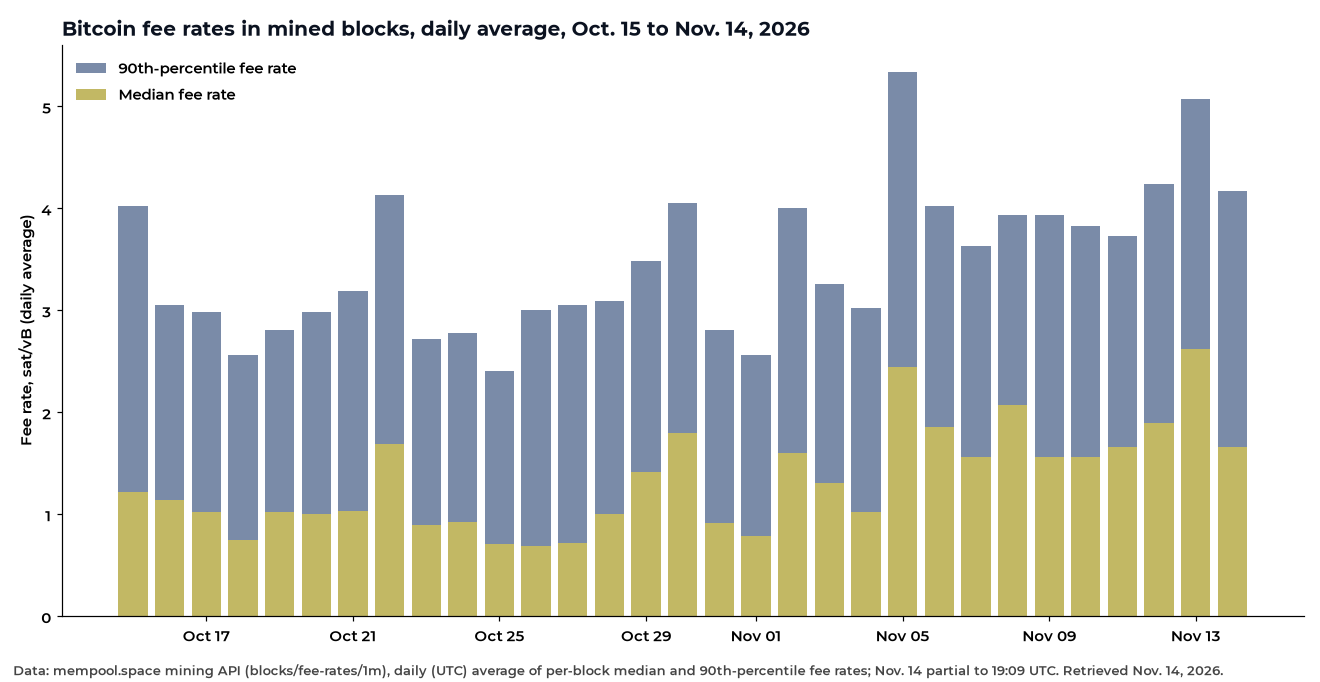
In late October, before the decline deepened, daily medians sat as low as 0.69 sat/vB.
So the sell-off roughly doubled or tripled fee rates from their floor. In dollar terms, that is still a move measured in cents.
How Far Bitcoin Fees Have Fallen Since 2024
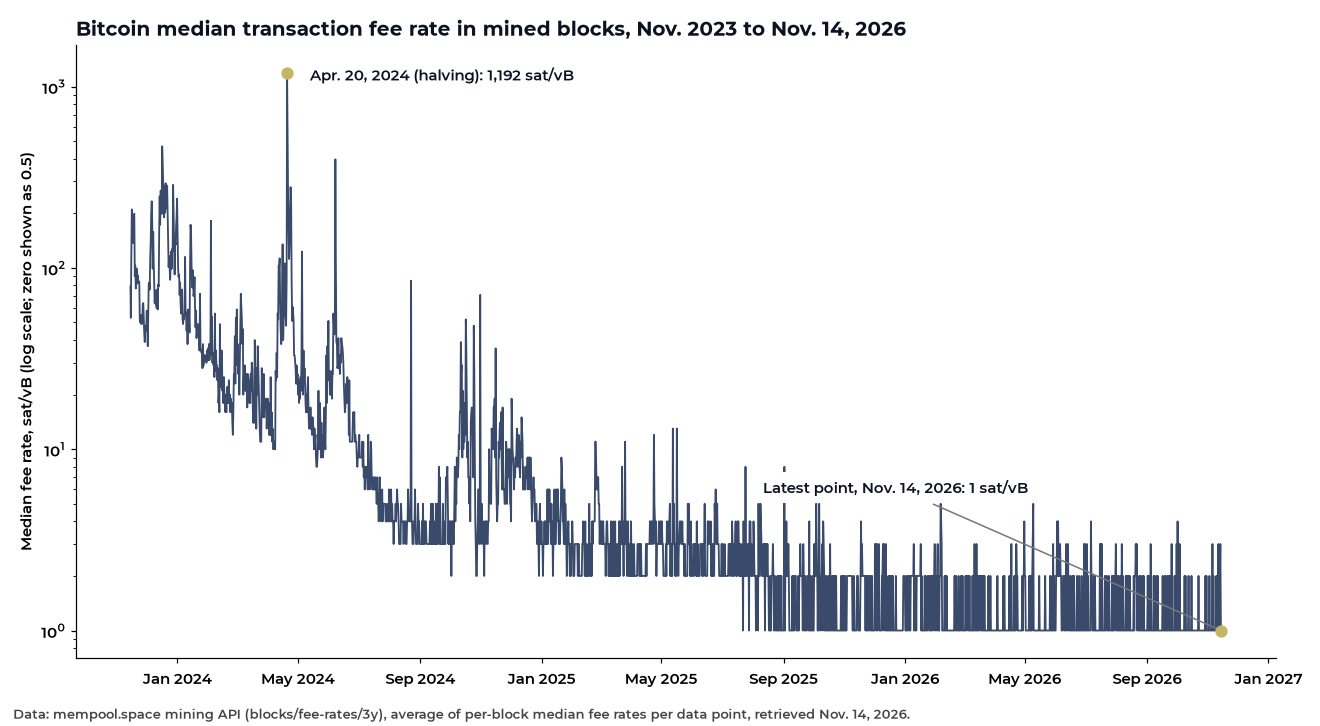
The long view shows how much the fee market has changed. On April 20, 2024, the day of the last halving, the median fee rate in mempool.space’s three-year series hit 1,192 sat/vB.
Using the same 141-vbyte transaction and mempool.space’s historical price of $63,847 for that date, a median-fee transfer cost about $107.
That was an extreme day, driven by the launch of the Runes token protocol at the halving block. Even so, the typical 2024 reading in the series was 12 sat/vB.
In 2025, the typical reading fell to 2 sat/vB. So far in 2026 it is 1 sat/vB, and no data point this year has exceeded 5 sat/vB.
Why Cheap Block Space Matters in a Downturn
We see low fees during a sell-off as a quiet strength. When prices fall fast, holders who want to move coins into self-custody, rebalance between platforms or settle large trades do not face a congested network.
That keeps Bitcoin’s base layer usable exactly when emotions run highest.
It also suggests the decline has not triggered a panic rush on-chain. Much of the selling appears to be happening inside exchanges and fund wrappers, where trades do not need a Bitcoin transaction at all.
There is a trade-off worth stating plainly. Low fees mean miners earn very little beyond the 3.125 BTC block subsidy. Our look at Saturday’s 9.13% difficulty cut found fees made up under 1% of recent miner rewards.
That is a long-term question for network security, not an immediate threat. For users today, it simply means block space is abundant and cheap.
What We Are Watching Next
Our first signal is the median fee rate. A sustained move above roughly 5 sat/vB would be the highest of 2026 and would show on-chain demand returning in force.
Our second is the mempool backlog. If the low-fee queue starts clearing quickly, it would mean more users are willing to pay to move coins.
Third, we are watching whether exchange withdrawals pick up as prices drop. Cheap fees make that move easy for anyone who prefers to hold their own keys.
We believe a calm fee market through a sharp decline says something positive about Bitcoin’s design. The network is processing every transaction at a fraction of the cost seen two years ago.
The coming weeks will show whether falling prices bring new buyers on-chain. If they do, Bitcoin fees will be the first place that demand shows up.
DC Forecasts is a leader in many crypto news categories, striving for the highest journalistic standards and abiding by a strict set of editorial policies. If you are interested to offer your expertise or contribute to our news website, feel free to contact us at [email protected]












Discussion about this post