



The Bitcoin Policy Institute, one of the most visible Bitcoin advocacy shops in Washington, has a new name. On Nov. 17, the think tank relaunched as the Finney Foundation for Open Technology, named after Hal Finney, the cryptographer who received the first Bitcoin transaction ever sent from one person to another.
A day later, on Nov. 18, it named its first class of 10 Finney Fellows. The lineup runs from a former Federal Reserve economist to the first patient to receive a Neuralink brain implant.
The remit now reaches well beyond money, but the organization was explicit that Bitcoin is not being pushed aside. In its launch announcement, the foundation said “Bitcoin remains a primary focus, and our Bitcoin programming under the BPI moniker will only expand.” We believe that framing matters: Bitcoin’s case in Washington is now being made as part of a broader argument about who controls powerful technology.
From Bitcoin Policy Institute to Finney Foundation
The new organization describes itself as “the think tank for an exponential age.” Its pitch is short: “Washington is deciding who gets to build or use powerful technology. We think the answer should be everyone.”
The research agenda now covers open-source AI, digital cash and encrypted messaging. The foundation groups these under one label, “open technology,” which it defines as tools that spread power out rather than concentrate it, “from open-weight intelligence to decentralized money, compute, communication, and energy.”
Under the slogan “For Us, Not Over Us,” the group published a long founding declaration on its website.
Bitcoin sits at the center of that argument. The declaration says that technologies such as Bitcoin and Tor show how to “build systems that route around authorities rather than trust them, and so empower individuals.” It then ties the threads together directly: “The fight for open money that anyone can use is the same fight as the fight for open intelligence that anyone can use.”
Why Hal Finney?
The name is a deliberate signal to Bitcoin’s oldest community. Finney (1956–2014) was an early cypherpunk who worked on PGP encryption, according to the foundation’s own profile of him. He was diagnosed with ALS in 2009 and died in 2014.
His place in history is easy to check on the blockchain itself. The first person-to-person Bitcoin transaction, sending 10 BTC from Satoshi to Finney, was confirmed in block 170 on Jan. 12, 2009, at 03:30 UTC. We checked that record on the public chain.

The foundation quotes a line of Finney’s that sums up its strategy: “If we want freedom and privacy, we must persuade others that these are worth having. There are no shortcuts.” For a policy shop, persuasion is the whole job.
The first Finney Fellows
Each of the 10 new fellows was announced with a stated research focus:
- Preston Byrne, a lawyer, will work on the First Amendment, technology and law.
- Samo Burja, founder of Bismarck Analysis, will focus on governance and emerging technology.
- Christian Jauregui, a former Federal Reserve economist, covers economics and quantitative research.
- Jonathan Looi, a former Google engineer, will work on emerging technology and national security.
- Marko Jukic, a senior analyst at Bismarck, covers space and industrial policy.
- Jesse Posner, chief executive of Vora, will work on AI and democracy.
- Freddie New, a lawyer and chief executive of BHODL, covers Bitcoin, finance and law.
- Noland Arbaugh, the first Neuralink patient, will focus on biotech, neuroscience and medical regulation.
- Chris Lengerich covers machine learning, science and health.
- An anonymous fellow known as Knower covers AI and emerging technology.
Those 10 join the 12 fellows who already worked under the Bitcoin Policy Institute banner. That group includes senior fellows Troy Cross, Matthew Ferranti, Josh Hendrickson, Sarah Kreps, Bradley Rettler and Craig Warmke, plus visiting fellow Nik Bhatia. All 12 are still listed on the foundation’s site.
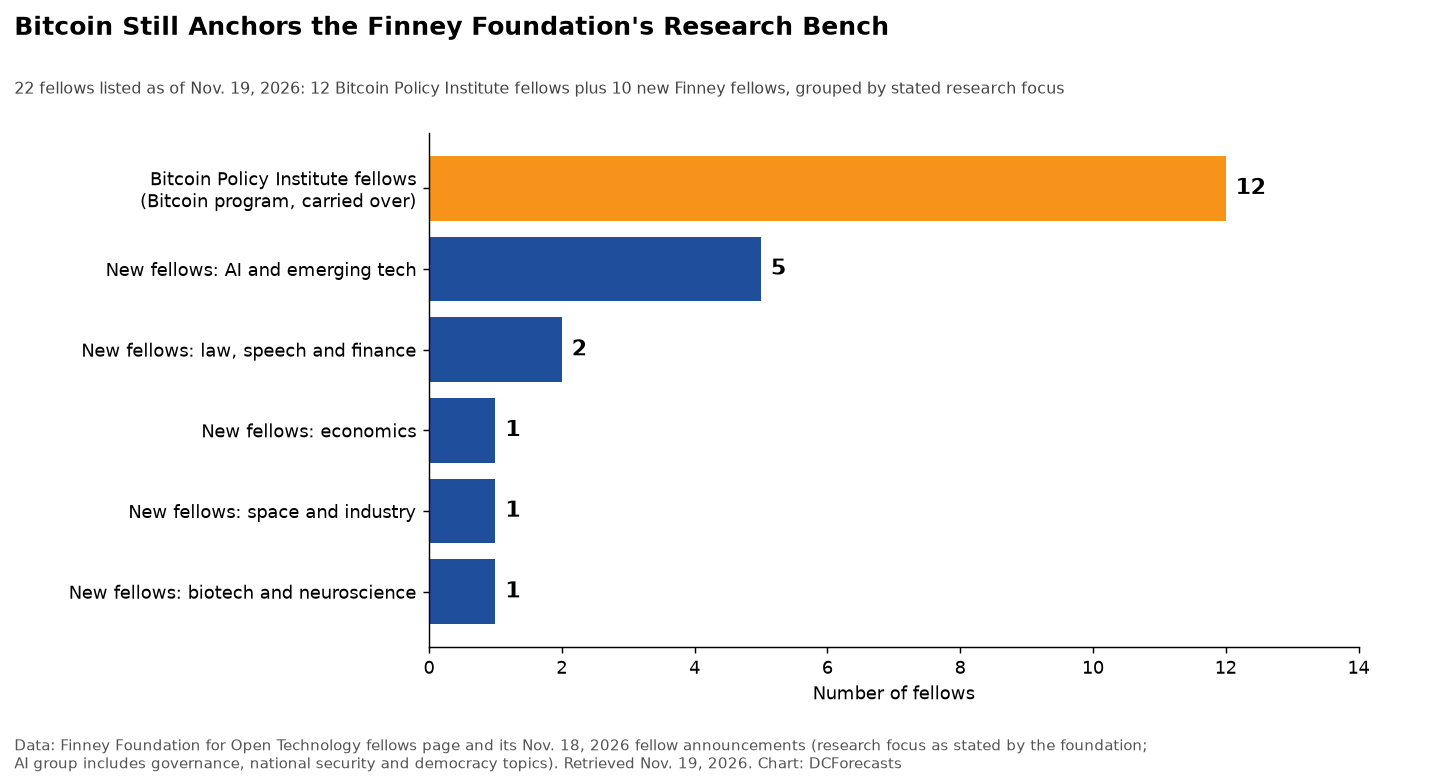
Of the 22 fellows now listed, 12 come from the Bitcoin program, more than half of the bench. The largest new cluster, five fellows, works on AI and emerging technology.
What the bitcoin policy institute rebrand signals
We see three reasons the move could help Bitcoin’s standing in Washington.
First, it puts Bitcoin in a bigger coalition. Many lawmakers who rarely think about money care a lot about AI and free speech. An organization that argues for open money and open AI in the same breath can reach a wider audience than a Bitcoin-only shop.
Second, it ties Bitcoin to a positive framing of civil liberties rather than speculation. The declaration’s core argument is that safety is not the only thing that matters in technology policy; freedom matters too. Self-custody, peer-to-peer payments and open-source code fit that argument neatly. The same spirit drives the developer funding in OpenSats’ latest round of Bitcoin grants.
Third, the staff is built for Washington work. The team page lists a head of government affairs, a head of policy, a head of research and a director of international affairs, alongside president David Zell and executive director Conner Brown.
The open question is focus. The foundation’s pledge that its Bitcoin programming “will only expand” is the commitment to watch. The evidence so far, a Bitcoin fellowship that is still the largest group on the roster, supports it.
The bottom line
The Bitcoin Policy Institute has become the Finney Foundation for Open Technology. It took the name of Bitcoin’s first transaction recipient, added 10 fellows across AI, law, economics, space and neuroscience, and kept its 12 Bitcoin fellows in place.
In our view, this is a sign of maturity for Bitcoin advocacy. The argument for open, permissionless money is now being made alongside the argument for open, permissionless technology in general. It is a case Hal Finney spent his life making, and one we expect to hear more often in Washington.
DC Forecasts is a leader in many crypto news categories, striving for the highest journalistic standards and abiding by a strict set of editorial policies. If you are interested to offer your expertise or contribute to our news website, feel free to contact us at [email protected]












Discussion about this post