


Almost every Federal Reserve policymaker expects to raise interest rates again, and a couple of them are open to a bigger move than usual in December, according to minutes of the Fed’s Oct. 27–28 meeting released on Nov. 18.
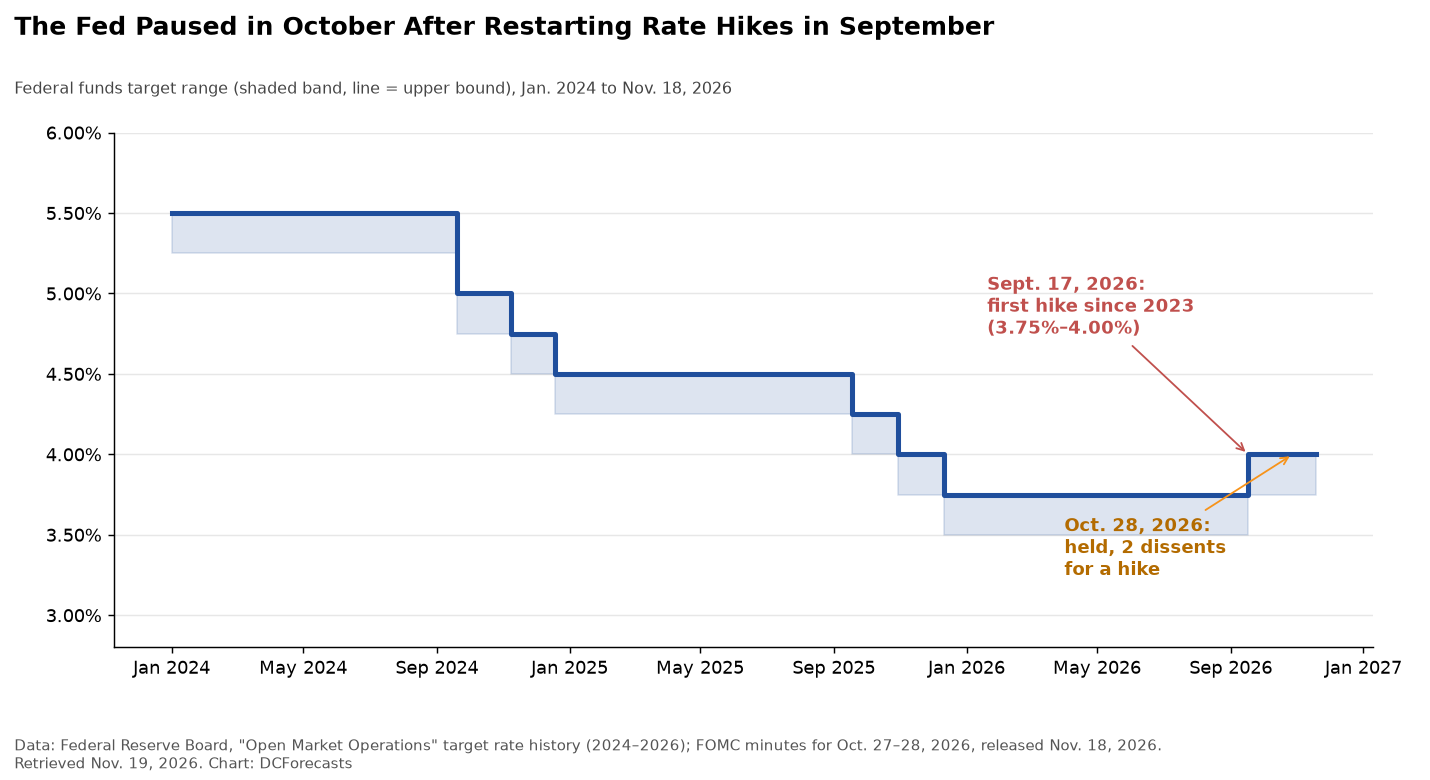
The Federal Open Market Committee held its target range for the federal funds rate at 3.75% to 4% in October, one meeting after it raised rates in September for the first time since 2023. But the minutes show the pause was not a softening of intent.
“Almost all participants judged that, under their baseline outlooks for inflation and the labor market, further action to raise the target range for the federal funds rate… would likely be appropriate,” the record states.
A Pause That Came With Two Dissents
The October vote was 10 to 2. Governor Lisa Cook and Cleveland Fed President Beth Hammack voted against holding steady. Both preferred to lift the range by a quarter of a percentage point at that meeting.
Chair Kevin Warsh, New York Fed President John Williams and Governor Christopher Waller were among the 10 members who backed the hold. Jerome Powell, Warsh’s predecessor as chair, also voted with the majority.
The minutes show the divide went deeper than the formal vote. “Some participants” favored a 25 basis point increase, arguing that inflation “had remained too high” with few signs of easing. A few of them warned that waiting longer risked letting high inflation become entrenched, or forcing “a larger and more disruptive tightening later.”
Even among supporters of the hold, a few described the decision as “a close call.” Many stressed that the pause “did not reflect a weakening of the Committee’s commitment” to bringing inflation back to 2%.
Why Officials Waited
Most participants said they wanted more information before moving again. They pointed to the durability of investment tied to artificial intelligence, shifting financing conditions, how the September hike was feeding through to the economy, and geopolitical developments.
A couple of participants argued that a gradual approach would give businesses and households time to adjust to higher borrowing costs. Several others said the stance of policy should be judged by the overall path of rates rather than by any single meeting.

Market pricing also gave officials cover to wait. Some participants noted that market expectations for tightening in December and next year were “broadly consistent” with their own views. The New York Fed’s survey of market participants showed a median expectation of one hike in December and another in March 2027, followed by a cut in early 2028.
Inflation Is the Core Problem
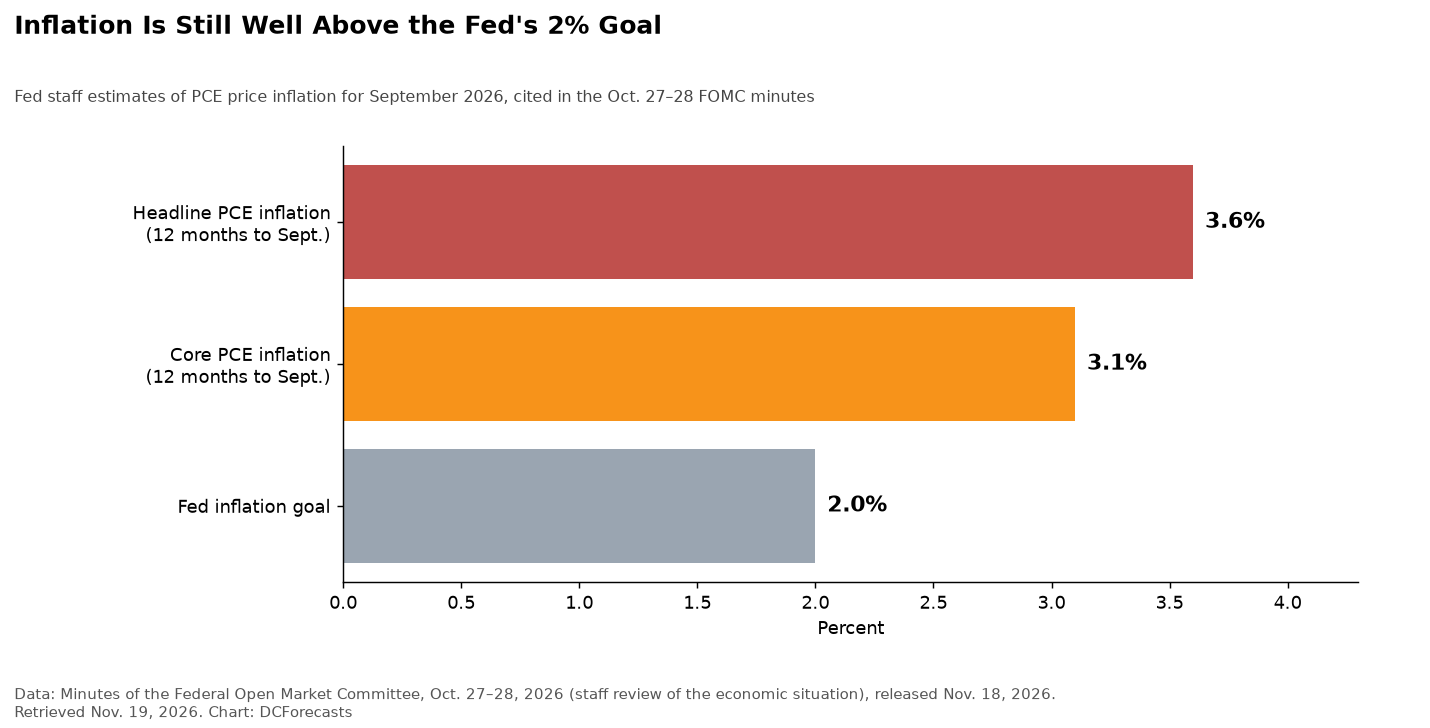
The staff’s economic review explains the hawkish tone. Fed staff estimated that headline inflation, measured by the personal consumption expenditures (PCE) price index, rose to 3.6% in the 12 months to September. Core PCE, which strips out energy and many food prices, edged up to 3.1%.
Both readings were higher than a year earlier. Staff attributed that largely to earlier tariff increases, higher energy prices and upward pressure on goods prices linked to the AI buildout.
The labor market gave the Fed little reason to back off. The unemployment rate edged up to 4.2% in September, still 0.2 percentage point below its average in the second half of 2025, while staff said real GDP was expanding at a solid pace.
A Bigger Hike Is on the Table
The most striking line for markets came near the end of the policy discussion. “A couple of participants noted that an increase of more than 25 basis points could warrant consideration at the next meeting if incoming inflation data were unfavorable.”
A few participants also warned that inflation “could prove more persistent than anticipated,” in which case a more restrictive stance could become necessary. As always, officials said future moves would depend on incoming data.
The next FOMC meeting is scheduled for Dec. 8–9. The Fed has already trimmed its 2027 calendar to seven rate decisions, which gives each meeting more weight.
AI Debt Now Tops the Fed’s Risk List
The minutes also show how central AI has become to the Fed’s financial stability worries. Staff flagged the rapid growth of debt tied to the AI buildout, warning that off-balance-sheet leasing commitments and “circular financing arrangements” among AI firms could amplify losses if returns disappoint.
Almost all participants discussed the risk of disappointing AI returns, and most noted that AI-related debt had grown through “complex and opaque financing structures.” That echoes the scenario work Chair Warsh described this week, when he said Fed staff are modeling an AI bubble burst among three possible futures.
What It Means for Bitcoin
Higher rates have weighed on risk assets this autumn, and Bitcoin has been no exception. It traded near $62,457 late on Nov. 18, down about 3.2% over 24 hours, according to CoinGecko.
Yet the minutes contain little that markets had not already priced. A December hike was already the median expectation, and officials themselves said market pricing matched their own path. That reduces the risk of a fresh shock from the Fed.
The bigger message is about money itself. With headline inflation at 3.6% and policymakers warning it could prove persistent, the case for an asset with a fixed supply of 21 million coins has rarely been easier to explain. Rate hikes can slow inflation, but they cannot add scarcity to the dollar. Bitcoin’s supply schedule does not change, whatever the Fed decides in December.
DC Forecasts is a leader in many crypto news categories, striving for the highest journalistic standards and abiding by a strict set of editorial policies. If you are interested to offer your expertise or contribute to our news website, feel free to contact us at [email protected]












Discussion about this post