



BTCPay Server has pushed an emergency update to fix five newly disclosed flaws in nginx, the web server that sits in front of most BTCPay installations. The project is urging merchants who run their own Bitcoin payment servers to update as soon as possible.
The fix does not change the BTCPay Server version number. Instead, it updates the bundled nginx component to version 1.31.9, which nginx released on Nov. 18 with fixes for 10 security issues.
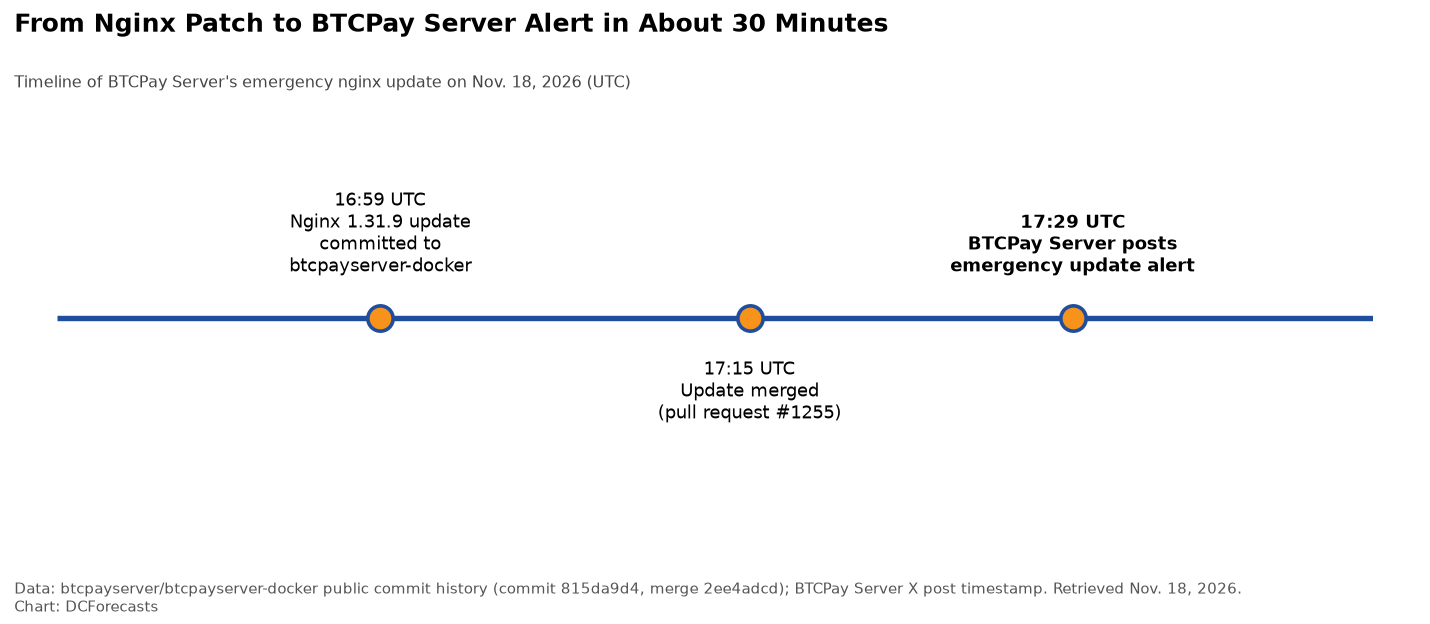
The speed of the response stood out. Public commit records show the nginx upgrade landed in BTCPay’s Docker deployment repository at 16:59 UTC, was merged at 17:15 UTC, and the project’s alert went out at about 17:29 UTC.
Five Nginx Flaws Behind the Alert
In its announcement, BTCPay Server listed five CVEs: CVE-2026-123007, CVE-2026-123634, CVE-2026-123633, CVE-2026-121810 and CVE-2026-113425. All five are fixed in nginx 1.31.9 on the mainline branch and 1.30.7 on the stable branch, according to nginx’s security advisories.
The most serious is CVE-2026-123007, rated major by nginx. It is a memory corruption bug in HTTP/2 flow control. Nginx’s change log says a flow control window overflow might let an attacker crash a worker process, “or might have potential other impact.”
Two of the other flaws are use-after-free bugs in HTTP/2 and HTTP/3. Another affects the resolver, and the fifth, also rated major, is in the mail proxy module.
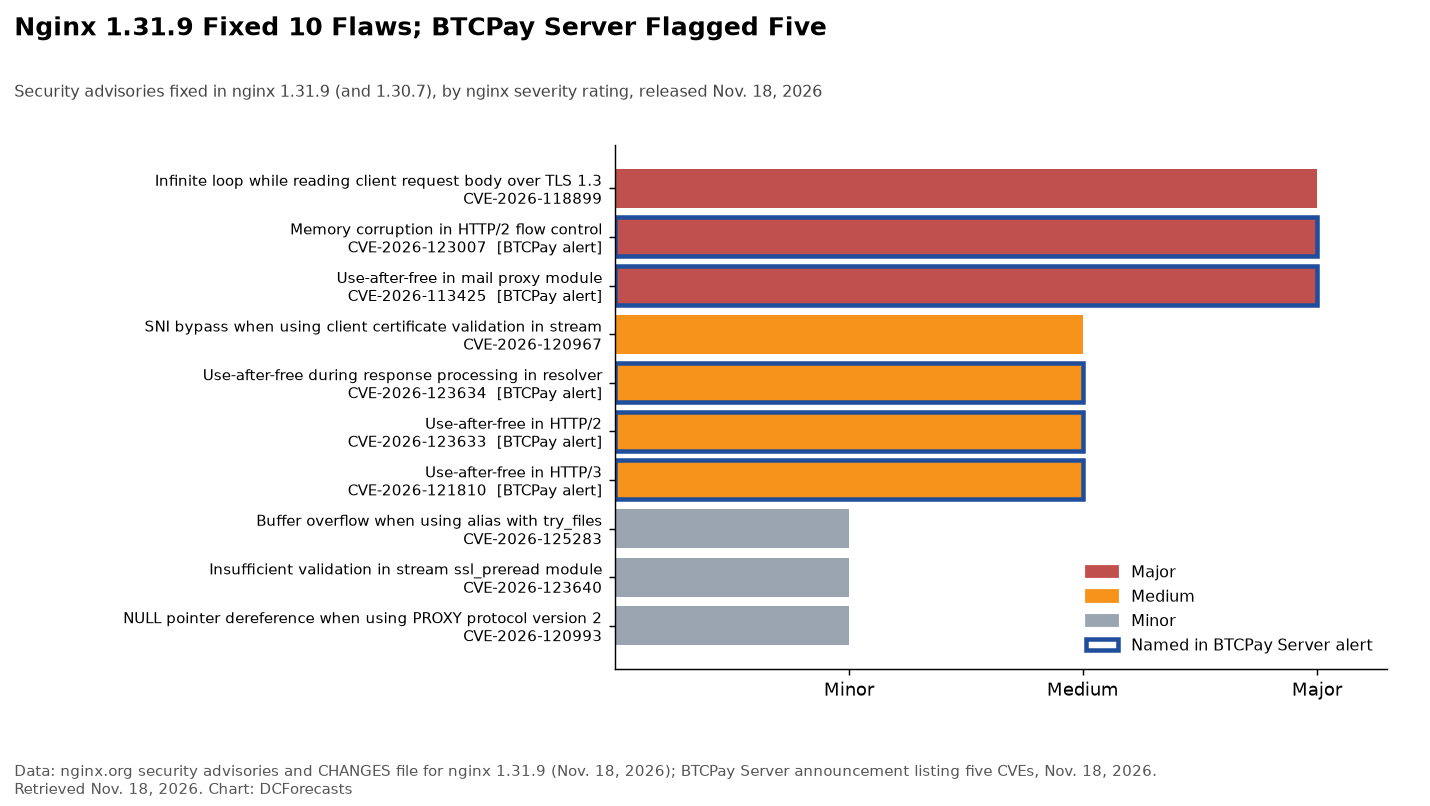
The nginx release also fixes five more issues that BTCPay did not name, including an infinite loop when reading request bodies over TLS 1.3, which nginx rates major.
Why Nginx Matters to a Bitcoin Payment Server
In the standard BTCPay Server Docker deployment, nginx works as the front door. It accepts incoming connections on the usual web and HTTPS ports and routes each request to the payment application or to other services running on the same machine.
That makes it the first piece of software an outside visitor touches, whether it is a customer paying an invoice or someone probing the server. A flaw there can expose the whole box, even if the payment software behind it is sound.

It also explains why the fix came as a dependency update rather than a new BTCPay release. The payment code did not change. Only the component in front of it did, which allowed the team to ship quickly without waiting for a full release cycle.
The same approach applies to other services in the deployment. In the past week alone, the repository’s public history shows routine updates to bundled components such as Tor and the Mempool block explorer.
How Merchants Can Update
For most operators, the fix is a standard server update. Administrators can run it from the BTCPay Server dashboard under the server settings and maintenance section, or from the command line with the project’s update script on Docker installations.
Because the BTCPay version number stays the same, the project told users how to check that the fix is in place. Running a version check inside the nginx container should now report nginx 1.31.9. A BTCPay account replying to users described the change as “a dependency update,” adding that the next version of BTCPay is in testing.
Users who run BTCPay through node platforms such as Umbrel or Start9 need to wait for those platforms to ship the update. For anyone who cannot update right away, a core contributor shared a temporary workaround that turns off HTTP/2 in nginx.
No Confirmed Attacks So Far
BTCPay Server was careful not to overstate the danger. In a post on Nov. 18, the project said it understands that “the referenced Nginx exploits are fragile and that, so far, no attacks have been publicly confirmed.”
“But as a FOSS project, we will always act as soon as possible to provide remediations for users,” it added.
That matters because BTCPay is self-hosted. There is no central company holding customer funds or pushing silent fixes to every server. Each merchant runs and updates their own node, so a clear, fast warning is the main line of defense.
Open-Source Security at Work
This is how open-source Bitcoin infrastructure is supposed to work. A widely used web server ships a security release, and within hours a volunteer-driven payment project has tested it, merged it and told its users exactly what to do.
BTCPay Server thanked its sponsors in the same thread, noting that their support keeps its open-source work sustainable so it “can keep up with security updates.” Among the backers it named were OpenSats, Spiral, Tether and the Human Rights Foundation. OpenSats separately funded 21 Bitcoin projects in its latest grant wave this week.
In our view, that support is money well spent. BTCPay lets merchants accept Bitcoin directly, with no middleman and no fees to a payment processor, and a fast security response is part of what makes self-custody practical for businesses.
The incident is also a reminder that most crypto security problems sit around the edges, in servers, support tools and dependencies, rather than in Bitcoin itself. Earlier today, Etherscan and LOBSTR reported attacks on their customer support systems, which run on third-party help desk software. No funds were lost in either case.
What Operators Should Do Now
Merchants running BTCPay Server should install the update, confirm that nginx reports version 1.31.9, and keep an eye on their node platform if they use Umbrel or Start9.
Those who must delay should apply the HTTP/2 workaround as a stopgap only. The nginx release fixes problems beyond HTTP/2, so the full update remains the real fix.
DC Forecasts is a leader in many crypto news categories, striving for the highest journalistic standards and abiding by a strict set of editorial policies. If you are interested to offer your expertise or contribute to our news website, feel free to contact us at [email protected]












Discussion about this post