



Core CPI is the number that will set the tone on Tuesday, when the U.S. releases October inflation data with energy prices still running about 20% above last year’s level.
The Bureau of Labor Statistics is scheduled to publish the report on November 10 at 8:30 a.m. Eastern time, according to its official CPI release schedule.
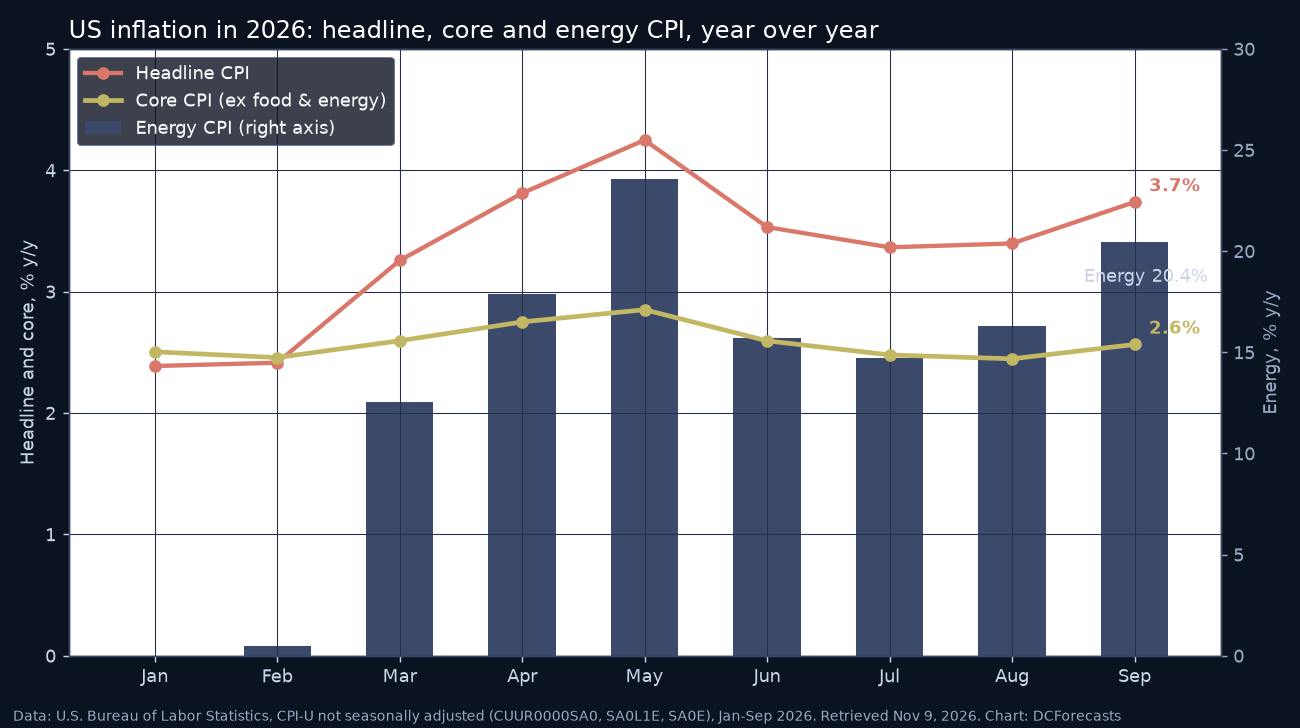
In September, core prices, which exclude food and energy, rose 2.6% from a year earlier, while headline CPI climbed 3.7%.
For Bitcoin investors, the gap between those two figures is the most interesting part of the story.
The bigger question now is whether October confirms that underlying inflation is behaving even as fuel and power bills stay high.
What Did the September CPI Report Show?
We pulled the latest index values directly from the BLS public data API on November 9.
The year-over-year picture for September looks like this:
- Headline CPI: up 3.7%, with a 0.6% seasonally adjusted gain on the month.
- Core CPI: up 2.6%, with a 0.3% monthly gain.
- Energy: up 20.4%.
- Food: up 2.5%.
- Shelter: up 3.2%.
Energy is doing almost all of the heavy lifting.
The energy index jumped 11.9% in March alone and peaked at a 23.5% annual rate in May, when headline inflation touched about 4.3%.

Core inflation barely moved through that shock, topping out just under 2.9% and easing back toward 2.5% over the summer.
Why Core CPI Matters More Than the Headline Number
Energy prices can swing hard from month to month, which is exactly why policymakers and traders lean on core CPI to judge the trend.
A 2.6% core reading is not far from where it sat in January, before the energy spike began.
That tells us that higher fuel costs have not yet spread widely into rents, services and other everyday prices.
We believe that is the key detail for anyone holding risk assets.
If core stays near 2.5% to 2.6% on Tuesday, the inflation problem still looks like an energy problem rather than a broad one.
A hotter core print would be harder to dismiss, and markets would likely treat it that way.
There is also a technical wrinkle this month: the BLS database holds no October 2025 index value, a gap left by last year’s federal government shutdown.
That makes the monthly change and the core trend even more useful than the annual comparison in this release.
How Is the Federal Reserve Reading Inflation?
The Fed raised its target range to 3.75% to 4% in September and then held it there on October 28.
The October FOMC statement said plainly that “inflation remains elevated.”
The vote was 10 to 2, with Lisa Cook and Beth Hammack preferring another quarter-point increase.
So the debate inside the committee is about whether to tighten further, not about when to cut.
That is why Tuesday’s numbers carry extra weight.
A soft core reading would strengthen the case of the majority that chose to wait, and that could ease pressure on yields and the dollar.
A firm one would hand the two dissenters a stronger argument heading into December.
How Has Bitcoin Traded on CPI Days in 2026?
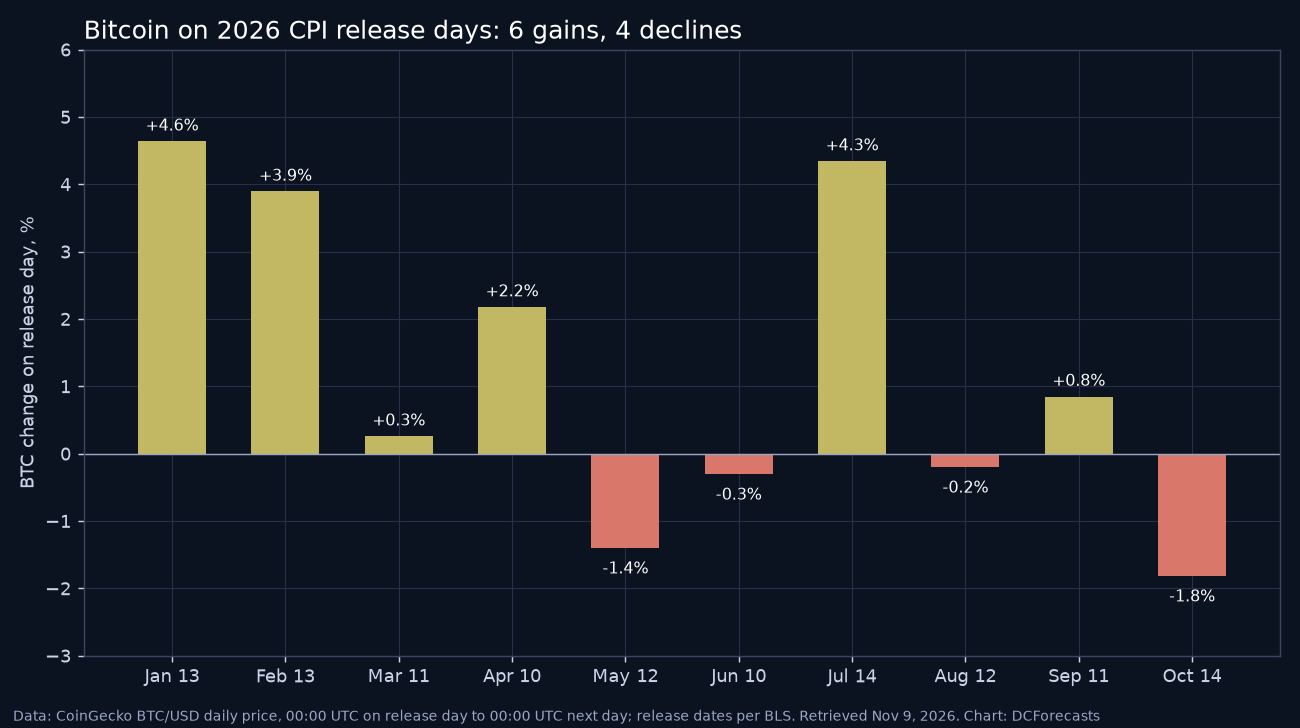
Bitcoin has had ten CPI release days so far this year, and its record on them leans positive.
Measured from midnight UTC on each release day to midnight the next day, using CoinGecko price data, BTC rose six times and fell four times.
The average move was a gain of about 1.2%.
The largest gains came on January 13 (+4.6%), July 14 (+4.3%) and February 13 (+3.9%), while the weakest day was October 14 (-1.8%).
We should be clear that a sample of ten days proves nothing on its own.
Still, it shows that inflation releases have more often been a chance for Bitcoin to bounce than a trigger for heavy selling, even in a year when energy prices surged.
BTC traded near $75,480 early on November 9, Asia/Jerusalem time, according to CoinGecko, little changed over 24 hours.
As we noted when Bitcoin’s 200-day moving average held, the market has spent recent weeks building a base rather than breaking down.
Derivatives positioning also looks lighter, as our report on falling CME futures shorts showed, which leaves less forced selling if the data surprises.
What Should Investors Watch After the CPI Release Date?
Tuesday is only the start of a busy inflation week.
The BLS producer price index for October follows on Friday, November 13.
We would watch four things:
- Monthly core CPI: a gain of 0.2% or less would mark a clear step down from September’s 0.3%.
- Energy: any cooling from the 20.4% annual pace would pull the headline rate lower.
- Shelter: the largest core component, now rising 3.2% a year.
- Treasury yields and the dollar: the channel through which inflation data usually reaches Bitcoin.
Policy changes beyond rates matter too, including the retirement rule that names Bitcoin now under White House review.
We believe the longer story favors Bitcoin regardless of a single print.
A year in which consumer prices have risen 3.7% is a reminder of why an asset with a fixed 21 million supply keeps attracting savers and institutions.
If core CPI confirms that inflation is cooling underneath the energy shock, Tuesday could give Bitcoin the macro opening it has been waiting for.
DC Forecasts is a leader in many crypto news categories, striving for the highest journalistic standards and abiding by a strict set of editorial policies. If you are interested to offer your expertise or contribute to our news website, feel free to contact us at [email protected]









Discussion about this post