



Paolo Ardoino has put his weight behind RGB, a protocol for issuing assets on Bitcoin, as a home for tokenized assets.
“Tokenisation should be agnostic from the transport layer, but I think RGB could be a very good product for that,” the Tether chief executive said in a clip from the Stephan Livera Podcast that Bitfinex shared on X on Nov. 17.
The comment is short, but it comes from the head of the company behind the largest stablecoin in the world. And the numbers show how much room Bitcoin has to grow into that role.
Of the roughly $175.4 billion of USDT in circulation on Nov. 18, only about $80 million, or 0.05%, sat on Omni, the Bitcoin-based layer where the token first launched in 2014.
What Paolo Ardoino Said About RGB
Ardoino’s point was that the rails used to move a tokenized asset should stay a choice for issuers and users, not a fixed requirement.
Within that open field, he singled out RGB as a strong candidate. Bitfinex, which is closely tied to Tether, framed the clip as a discussion of how RGB can scale.
The remark fits a longer pattern. On Aug. 28, 2025, Tether announced plans to launch USDT on RGB, shortly after the protocol reached mainnet with its 0.11.1 release.
“Bitcoin deserves a stablecoin that feels truly native, lightweight, private, and scalable,” Ardoino said at the time. “With RGB, USD₮ gains a powerful new pathway on Bitcoin, reinforcing our belief in Bitcoin as the foundation of a freer financial future.”
Tether said users would be able to hold USDT and bitcoin in the same wallet, make private transfers and even send and receive value offline.

How RGB Works on Top of Bitcoin
RGB does not change Bitcoin’s rules or ask every node to track every token.
Instead, it uses what developers call client-side validation:
- Ownership of an asset is tied to a Bitcoin transaction output.
- Bitcoin records only a small cryptographic commitment, acting as the anchor.
- The detailed contract data and transfer history stay with the people involved, whose wallets check it themselves.
That design keeps token traffic off the base chain, which helps privacy and avoids crowding blocks. It also connects to the Lightning Network, so assets can move through payment channels.
The protocol’s open-source tooling includes libraries for issuing assets, creating invoices and processing transfers, so wallet developers can add support without building everything from scratch.
The trade-off is that wallets and service providers must manage proofs and backups carefully, since the full history does not live on the public ledger.
For Bitcoin, the appeal is simple. Every RGB transfer that settles on-chain still needs a Bitcoin transaction, so more tokenized activity means more demand for block space secured by Bitcoin miners. Today that block space is cheap, as fees have sat near 1 sat/vB for most of the year.
USDT Left Bitcoin Once. The Data Shows How Far
USDT began life on Bitcoin, through the Omni Layer, before moving mostly to other networks with cheaper and faster transfers.
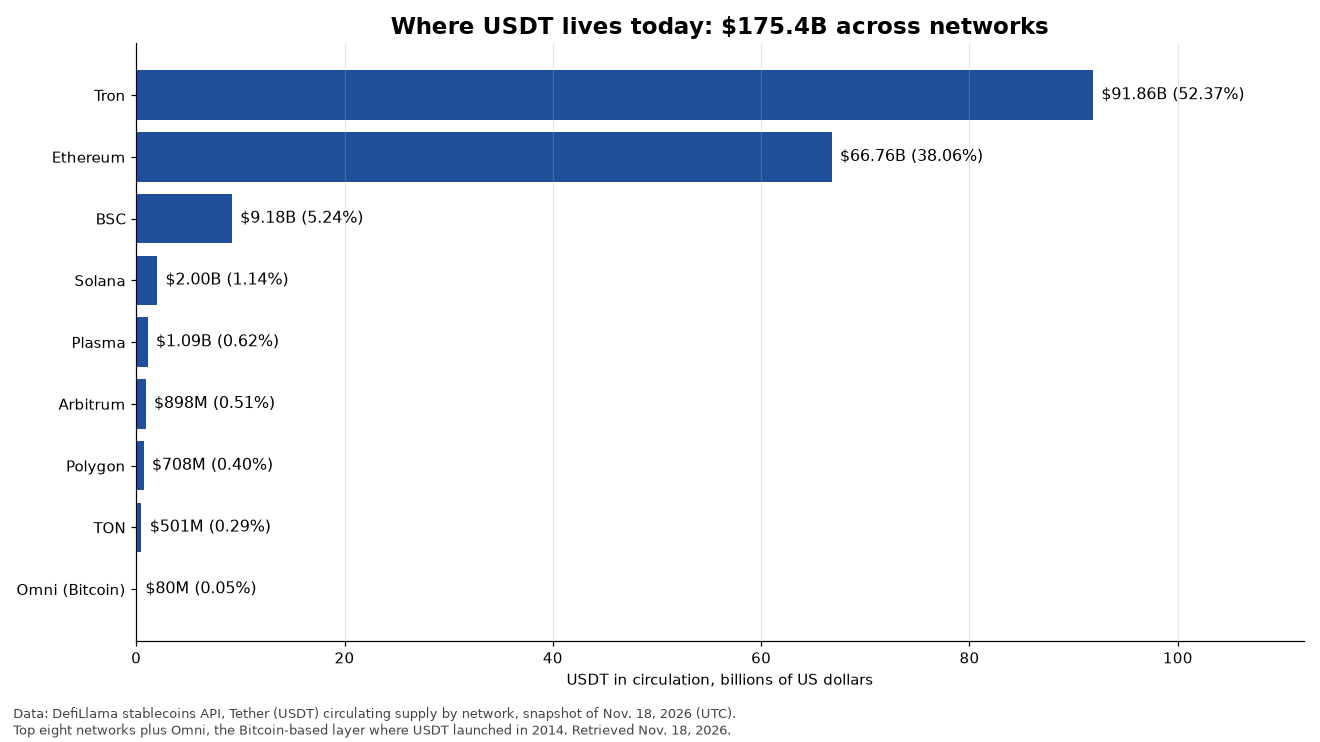
As of Nov. 18, Tron carried about $91.9 billion of USDT, or 52.4% of the total. Ethereum held about $66.8 billion, or 38.1%. BNB Chain was a distant third at about $9.2 billion.
Omni’s slice has kept shrinking. In this dataset it peaked near $1.33 billion in July 2022 and was down to about $83 million by the day Tether announced its RGB plans.
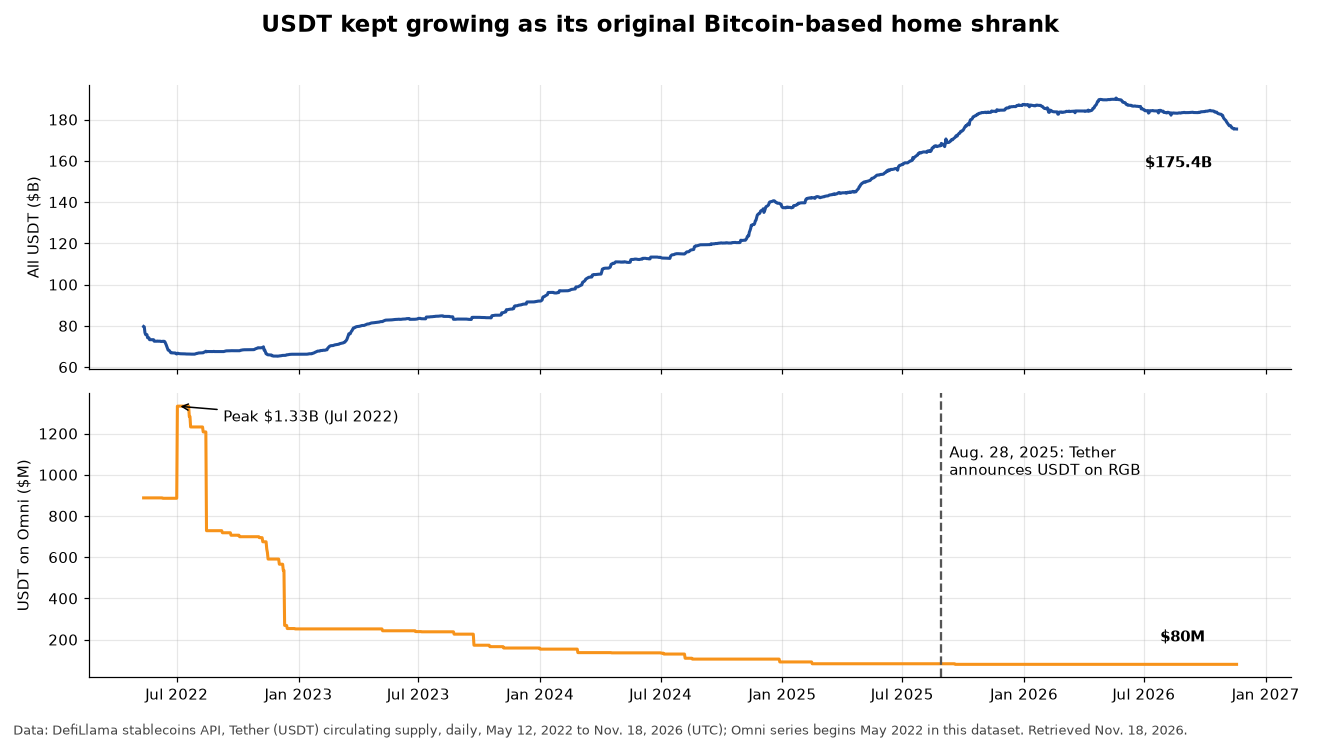
Over the same period, total USDT more than doubled, from about $79.7 billion in May 2022 to a peak of about $190.4 billion on May 20, 2026, before easing to $175.4 billion.
We read that gap as an opportunity rather than a verdict. Demand for digital dollars clearly exists. What Bitcoin has lacked is a lightweight way to carry them, and that is exactly the gap RGB and similar tools are trying to fill.
Why Tokenization on Bitcoin Matters for Holders
Stablecoins have become one of crypto’s biggest real-world uses, from trading to cross-border payments. We have tracked that shift in markets such as Brazil, where USDT dominates local crypto volume, and in banking, where major institutions are adopting USDC.
Bringing that activity back to Bitcoin would let people hold savings in BTC and spend in dollars from one wallet, without trusting a separate chain or a bridge.
It would also strengthen the case that Bitcoin is not only digital gold but a settlement layer that other assets can lean on.
What to Watch Next
The key test is adoption. Watch for a live USDT issuance on RGB, wallets that support it by default, and exchanges that accept deposits and withdrawals over the protocol.
Another marker is whether Lightning wallets start routing RGB assets alongside bitcoin payments, which would bring the instant-settlement side of the design to everyday users.
Ardoino’s words do not move any money on their own. But when the issuer of a $175 billion stablecoin keeps pointing to Bitcoin as the base for tokenization, it is a signal worth taking seriously.
If even a small share of USDT returns to Bitcoin rails, the 0.05% figure in today’s data could look very different a year from now.
DC Forecasts is a leader in many crypto news categories, striving for the highest journalistic standards and abiding by a strict set of editorial policies. If you are interested to offer your expertise or contribute to our news website, feel free to contact us at [email protected]












Discussion about this post