


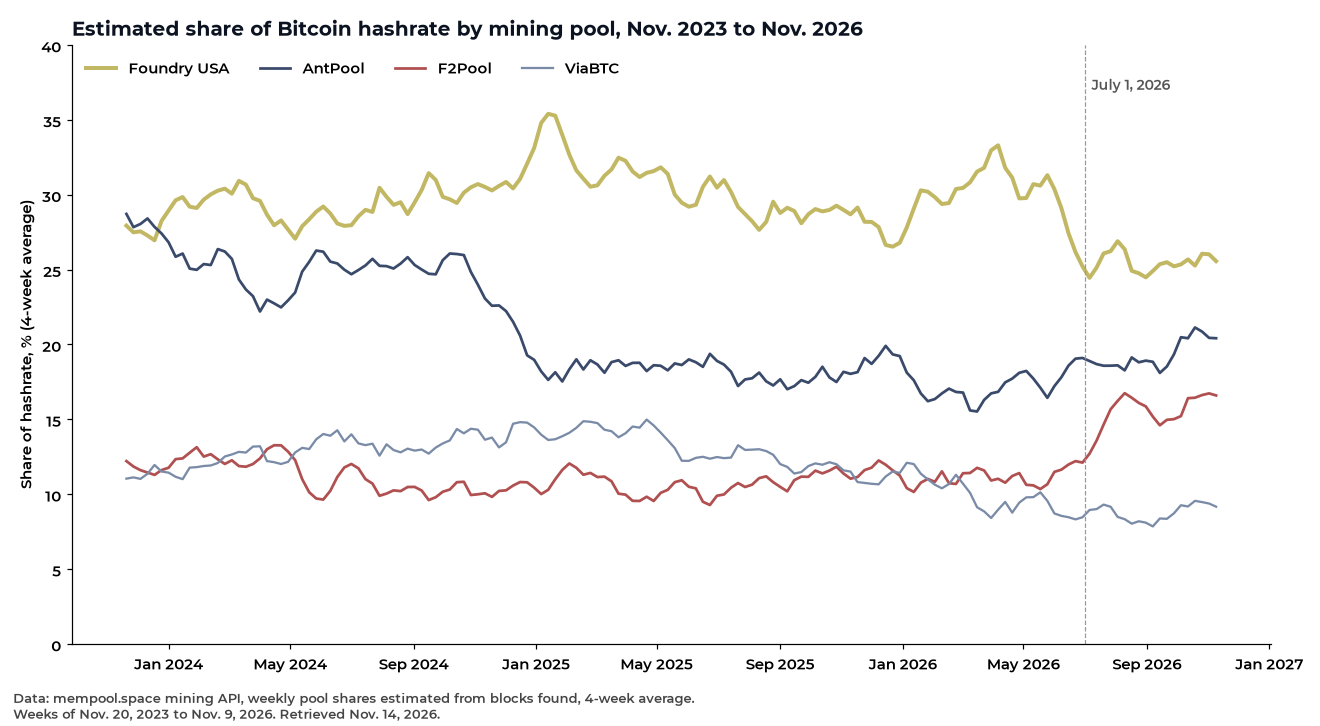
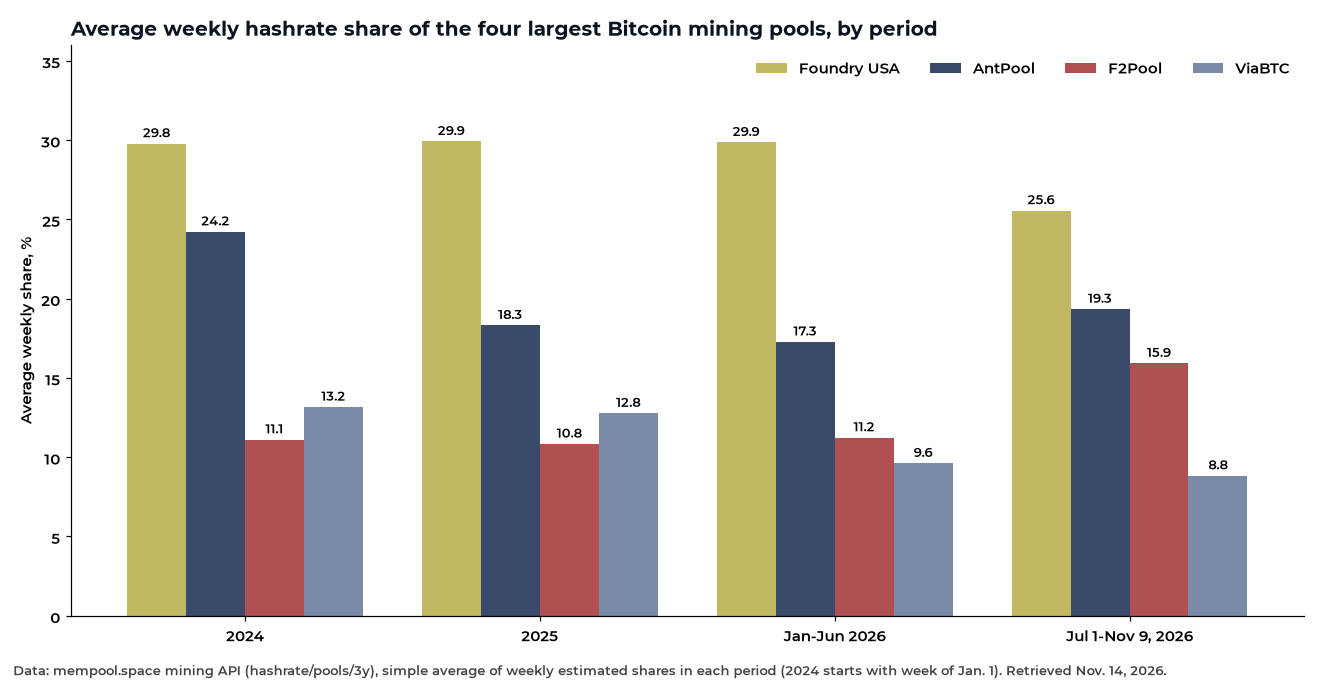
Foundry USA is still Bitcoin’s biggest mining pool, but its lead has narrowed sharply this year. Since July 1, Foundry USA’s estimated share of the network’s hashrate has averaged 25.6% a week, according to mempool.space data.
That compares with an average of 29.9% in the first half of 2026, and the same 29.9% across 2025.
Over the same stretch, F2Pool’s average share jumped from 11.2% to 15.9%.
For Bitcoin holders, the interesting part is not which pool wins. It is whether block production is spreading out, and what the numbers can and cannot tell us about that.
Foundry USA Lost About Four Points of Hashrate Share
Mining pools combine the computing power of many independent miners and split the rewards. Mempool.space estimates each pool’s weekly share from the blocks it finds.
On that measure, Foundry USA averaged 29.8% in 2024 and 29.9% in 2025. Its highest single week in the three-year series was 36.2%, in the week of Jan. 6, 2025.
The change came in June 2026. Foundry USA’s weekly share was 32.3% in the week of May 4, then dropped to 23.9% by the week of June 15.
It has not returned to 30% since. In the 19 weeks from July 1 through the week of Nov. 9, its best reading was 29.1%, and its lowest was 23.4%.
F2Pool Reached a Three-Year High
F2Pool has been the clearest gainer. Its weekly share averaged 11.1% in 2024, 10.8% in 2025 and 11.2% in the first half of 2026.

Since July 1, that average has climbed to 15.9%. In the week of Oct. 12, F2Pool reached 18.2%, its highest weekly share in mempool.space’s three-year series.
AntPool also edged higher, from an average of 17.3% in the first half of the year to 19.3% since July.
ViaBTC moved the other way, slipping from 9.6% to 8.8%. Back in 2024, it averaged 13.2%.
What the Latest Week of Blocks Shows
The block counts for the past seven days tell a similar story. Of the 859 blocks found, Foundry USA mined 209, or 24.3%.
AntPool found 162 blocks, or 18.9%, and F2Pool found 138, or 16.1%.
Over the past 365 days, Foundry USA’s share of all 52,202 blocks was 27.9%. That longer figure still includes the strong first half of the year.
These are estimates built from blocks, not audited hashrate. A single week of 859 blocks can swing by a few points on luck alone, which is why we lean on longer averages.
Is Bitcoin Mining Becoming Less Concentrated?
Partly, and the honest answer needs both halves. The largest pool’s lead has clearly narrowed, and the top two pools together averaged under 45% in recent months.
Back in late 2023, AntPool and Foundry USA together often held well over half of the network in a single week.
The top five pools, however, still found about 77% of blocks over the past year, roughly the same as over three years. So hashrate is being shared more evenly among the leaders, not spread across many more pools.
We see that as a modest, real improvement. A smaller gap at the top reduces reliance on any one pool operator for transaction selection.
It is also worth remembering that pools are not miners. Individual operators can switch pools quickly, and they regularly do when fees, payouts or policies change.
Why Pool Shares Matter in a Tough Market for Miners
These shifts are happening while miners face tight economics. As we covered in our look at hashprice and the hash ribbons, revenue per unit of hashrate is under pressure.
Saturday’s 9.13% difficulty cut gave miners some relief after a slow run of blocks.
Hard markets tend to reshuffle the industry. Miners chase better payout terms, and pools compete for their hashrate.
We believe that competition is healthy for Bitcoin. It keeps pool operators accountable to the miners they serve, and it keeps any single operator from becoming too comfortable at the top.
What We Are Watching Next
First, whether Foundry USA’s share stays in the mid-20s or drifts back toward 30% as the market settles.
Second, whether F2Pool can hold above 15% for the rest of the year, which would confirm its gains are more than a run of good luck.
Third, the combined share of the top two pools. A sustained reading below 45% would mark one of the least top-heavy stretches in the three-year data.
The coming weeks will show whether this is a lasting rebalancing. Either way, a network that keeps producing blocks while its biggest players compete for share is doing exactly what Bitcoin was designed to do.
DC Forecasts is a leader in many crypto news categories, striving for the highest journalistic standards and abiding by a strict set of editorial policies. If you are interested to offer your expertise or contribute to our news website, feel free to contact us at [email protected]











Discussion about this post