



Twenty One Capital has finally printed a profit, and a big one. The bitcoin treasury company reported net income of $1.087 billion for the third quarter ended Sept. 30, according to its Form 10-Q filed with the SEC on Nov. 13.
Almost all of it came from one line: a $1.093 billion fair-value gain on the 43,514 BTC the company holds. It is the company’s first quarterly profit since its 2025 public debut.
Chief executive Rapha Zagury was quick to put the number in context. “We welcome Bitcoin’s appreciation. But gains from an asset we own are not the same as earnings from businesses we operate,” he wrote in his quarterly shareholder letter.
We think that candour is the most telling part of this report.
How Twenty One Capital Swung From Losses to a $1.09 Billion Profit
Under U.S. accounting rules, companies now mark their Bitcoin to market every quarter. When the price rises, the gain flows straight into net income. When it falls, so does profit.
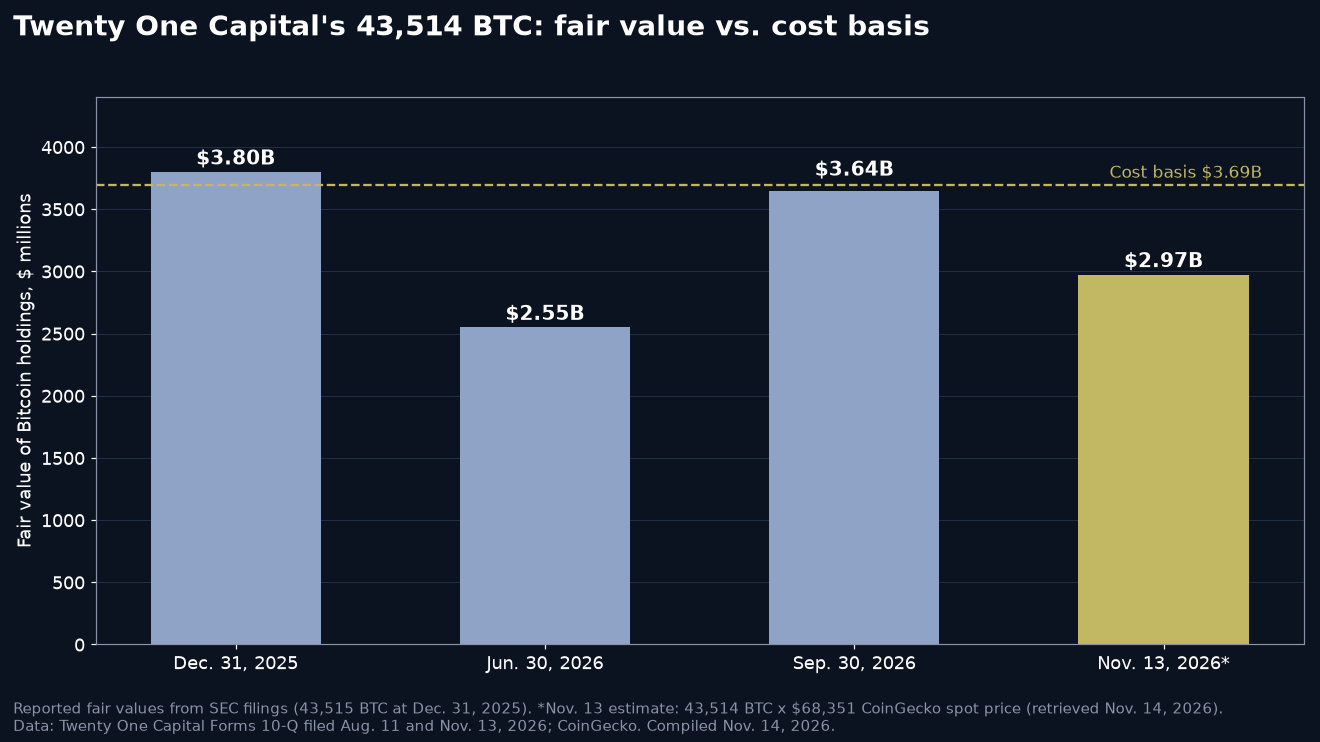
That is exactly what happened in 2026. Twenty One lost about $859.7 million in the first quarter and $413.5 million in the second, as Bitcoin slid. The company’s own filings show its holdings were worth $2.55 billion on June 30, which works out to roughly $58,600 per coin.
Then the third quarter flipped the script. Bitcoin climbed to about $83,700 by Sept. 30, a rise of roughly 43% from the June quarter-end level, and the value of the stack jumped to $3.64 billion.
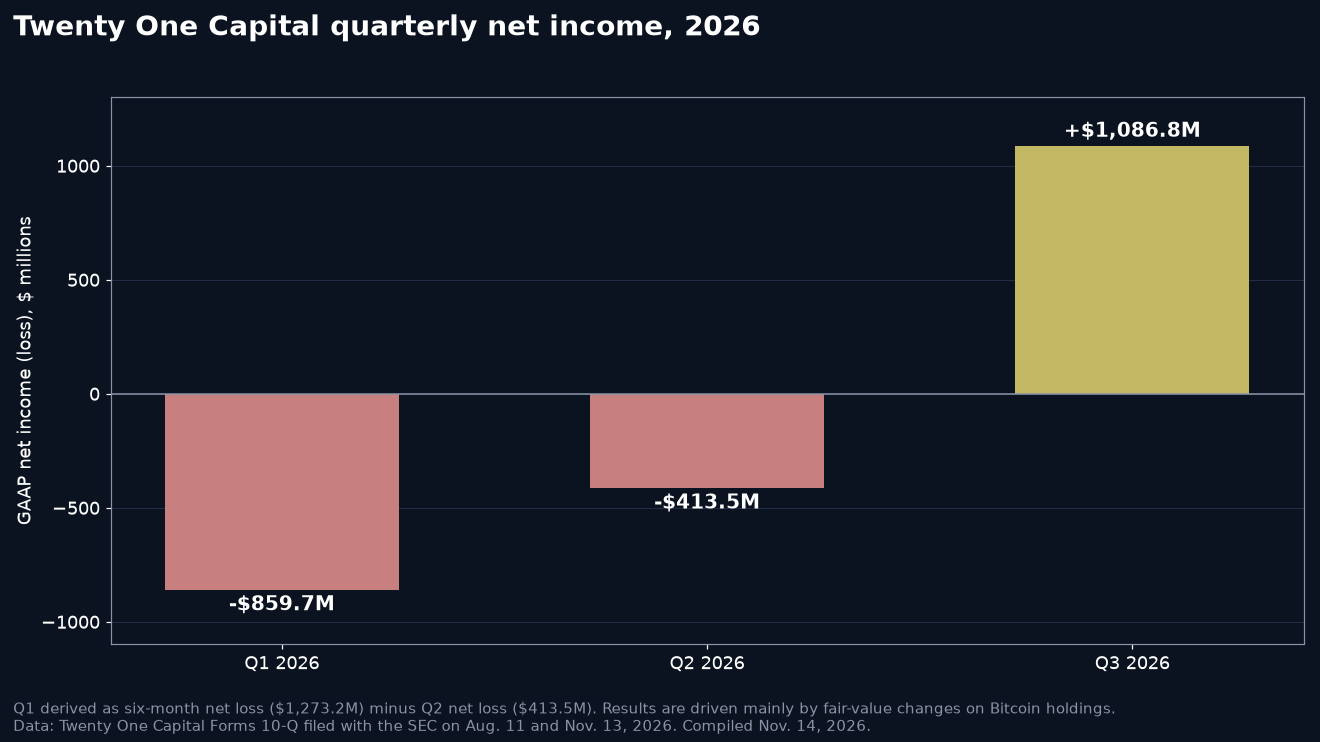
Basic earnings came to $3.13 per Class A share, or $2.85 on a diluted basis. Even so, the company still shows a nine-month net loss of $186.5 million, because the first-half markdowns were larger than the third-quarter rebound.
What the 10-Q Says About Twenty One Capital’s Bitcoin Stack
The coin count barely moved. Twenty One held 43,514 BTC at the end of September, compared with 43,515 at the end of 2025. The single coin that left was used for a vendor payment on March 31, according to the filing.

The total cost basis stands at $3.69 billion, an average of about $84,865 per Bitcoin. That matters, because Bitcoin traded near $68,351 on CoinGecko early on Nov. 14.
At that price the holdings are worth roughly $2.97 billion, about $719 million below cost and around $669 million less than at the Sept. 30 quarter-end. If prices stay there, the fourth quarter will show a fair-value loss, just as the first half did.
We would not read too much into that swing. Accounting volatility is the price of holding a scarce asset on a balance sheet, and Twenty One has not sold into weakness.
Debt, Collateral and Cash on the Balance Sheet
The company carries $486.5 million in principal on 1.0% convertible senior notes due 2030. Those notes are secured by about 16,116 BTC, roughly 37% of the treasury, and the pledged coins cannot be used for general corporate purposes while they serve as collateral.
At the end of September, that collateral was worth about $1.35 billion. At $68,351 per coin it would be worth roughly $1.10 billion, or about 2.3 times the outstanding principal.
The low coupon and long maturity give the company time. Twenty One also ended the quarter with $102.8 million in cash and cash equivalents.
The weaker side of the ledger is operations. Net cash used in operating activities reached $13.25 million over the first nine months of 2026. Twenty One does not yet have a business that pays its own way, and management says so openly.
Why Zagury Is Treating Bitcoin as the Benchmark
The shareholder letter reads less like a victory lap and more like an investment memo. “A balance sheet is not a business. It is our starting point,” Zagury wrote.
He said the company is evaluating opportunities across mining, lending, treasury and energy, and has already walked away from deals where the terms did not make sense. Any capital deployed, he added, “should justify the risk, complexity, and opportunity cost of not simply owning more Bitcoin.”
That is a striking standard. It treats Bitcoin itself as the hurdle rate, the return every other project must beat.
The letter also opens the door to buybacks. When shares trade below the value of the assets attributable to them, Zagury said, “repurchases deserve serious consideration,” subject to liquidity, approvals and other restrictions.
On governance, the company added David Goldschmidt, the former head of Skadden’s global capital markets practice, to its board and audit committee. It is also looking at ways to support independent Bitcoin development and security research, including AI-assisted vulnerability detection and potential quantum threats.
What Twenty One Capital’s Quarter Tells Us About Bitcoin Treasuries
We see this report as a sign of a maturing bitcoin treasury company model. The first wave of these firms was judged almost entirely on how many coins they could accumulate.
Twenty One is now saying the next test is cash flow per share, with Bitcoin as the yardstick.
Investors watching XXI stock should keep two things in mind. Reported profits will keep swinging with Bitcoin’s price each quarter, and the real progress will show up in operating cash flow, not in fair-value gains.
The constructive takeaway is simple. Twenty One has held its 43,514 BTC through a volatile year, its debt is long-dated and well collateralised, and its leadership is explicitly measuring success against Bitcoin. Like other leveraged holders we have tracked, such as Nakamoto’s Kraken-backed loan, the coverage on its borrowing remains comfortable even after the latest pullback.
For a company built around the hardest asset in finance, that may be the most important profit of all: the discipline to wait.
DC Forecasts is a leader in many crypto news categories, striving for the highest journalistic standards and abiding by a strict set of editorial policies. If you are interested to offer your expertise or contribute to our news website, feel free to contact us at [email protected]












Discussion about this post