


Tokenized stocks have passed a quiet but important test: a real company dividend, paid in digital dollars straight to crypto wallets.
Securitize CEO Carlos Domingo said on Nov. 20 that the firm had processed its first on-chain dividend for its tokenized Apple stock, sending USDC directly to holders’ wallets on Solana.
The amounts were tiny. On-chain data traced by blockchain analytics firm Bitquery shows $43.14 went out to 20 wallets, and about 93% of it landed with the token’s market maker.
For crypto investors, the size matters less than the mechanics. A public stock’s cash dividend was handled on a public blockchain, on the same day it was paid to ordinary shareholders.
The bigger question is whether outside buyers will now show up in numbers large enough to make that plumbing matter.
What Apple Paid, and How It Reached Solana
Apple’s board declared a cash dividend of $0.27 per share with its fiscal fourth-quarter results on Nov. 2, according to the company’s earnings release filed with the SEC.
The dividend was payable on Nov. 16 to shareholders of record at the close of business on Nov. 12.
Securitize’s token followed that calendar. Bitquery found that a funding wallet sent $43.22 in USDC to a payout wallet on the afternoon of Nov. 16, UTC.
Roughly three hours later, the payout wallet sent $43.14 in four transfers over four minutes. Per token, the payments worked out to Apple’s 27-cent rate.

Circle CEO Jeremy Allaire shared Domingo’s post on Nov. 20 and called it “the first of many to come,” adding: “Real-time dividends paid with digital dollars.”
Who Collected the First Tokenized Stock Dividend?
The answer is mostly the market maker, the firm that keeps an inventory of tokens to sell to buyers.
According to Bitquery, 160 Apple tokens existed on payout day. One inventory wallet held about 148 of them and received $40.03.
Securitize’s October launch announcement named Jump Trading as the market maker for the product. Bitquery tied the inventory wallet to Jump through its own address labels, while noting no public statement names these wallets.
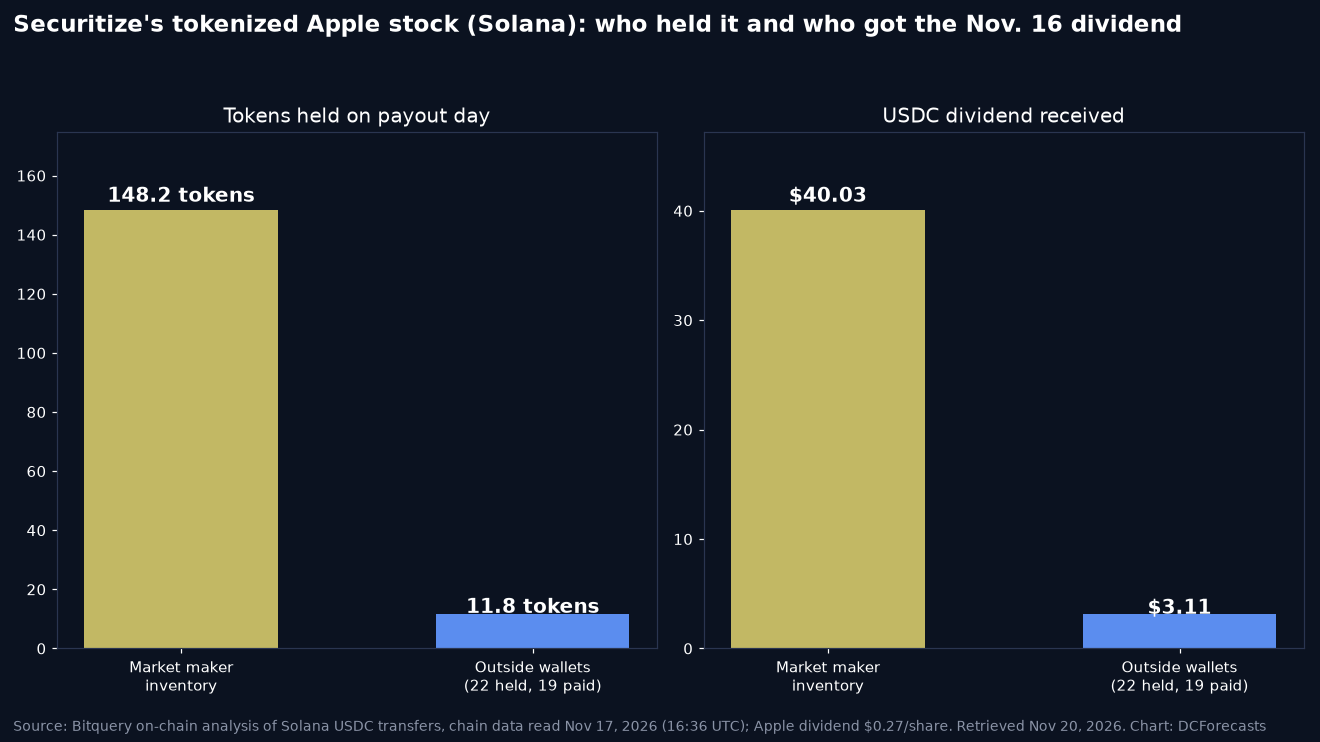
Outside the market maker, 22 wallets held roughly 12 tokens. Nineteen of them shared $3.11.
The largest outside payment was $1.58. Ten wallets got a single cent.
That split is not a flaw in the design. It simply shows how early this market still is, with the token’s inventory far larger than its customer base.
Why the Details Look Like a Real Brokerage
What stands out is how closely the payout followed traditional stock rules.
A wallet that bought a fraction of a token on Nov. 12, Apple’s ex-dividend date, received nothing, Bitquery found. Two wallets that bought earlier that week were paid.
Three payments came in 15% or 30% short of the full amount. Those cuts match the 30% default US withholding on dividends paid to foreign holders and a common 15% treaty rate, which the IRS describes in its guidance on NRA withholding.
Bitquery stressed that the tax reading is its own inference, since it cannot see who owns the wallets.
It also flagged one gap. A wallet holding 0.032 tokens since Oct. 7 had received no payment when the firm last read the chain on Nov. 17.
We believe that kind of public, checkable trail is the real story. A brokerage statement is visible only to its owner. This payout can be audited by anyone.
How Securitize Structures Its Tokenized Stocks
Securitize says each token is backed one for one by an underlying share and represents a security entitlement under UCC Article 8.
That structure passes through dividends and, where the share class carries them, voting rights. The company says the backing shares are not lent out.
Trading runs on Solana and settles in USDC through Securitize Markets, an SEC-registered broker-dealer. On Nov. 2, the firm expanded the lineup from 12 to 25 US stocks, adding to an original set that included Apple, Microsoft, Nvidia and Strategy.
The product sits in a fast-growing corner of the market. As we covered when the IOSCO report put tokenized assets at $37 billion, stock tokens have been among the quickest growers.
Competition is also building, from OKXICE’s 24/7 tokenized stock trading to Securitize’s own push into asset-backed finance.
A Steady Dividend Meets a New Settlement Rail
Apple’s dividend itself is one of the most predictable payments in markets. Its declared dividends rose from $0.795 per share in fiscal 2020 to $1.06 in fiscal 2026, SEC filing data shows.
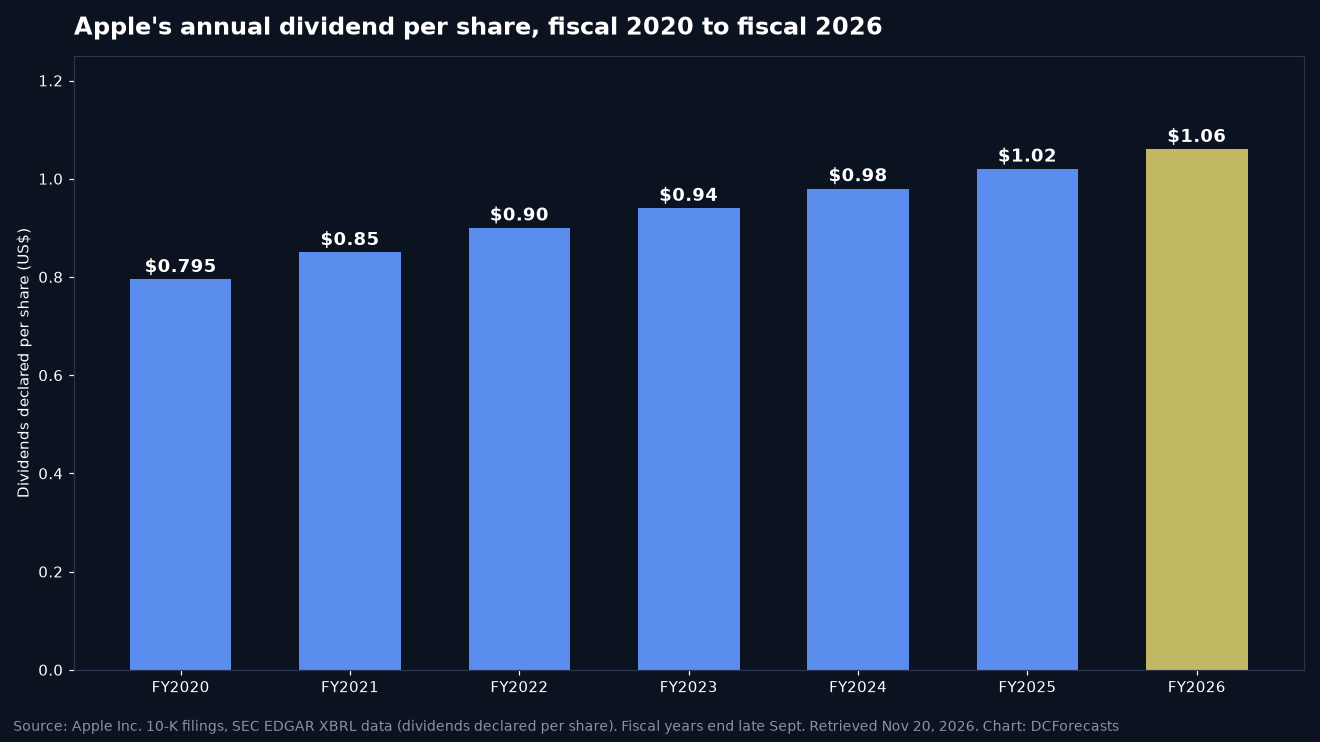
Apple paid $15.72 billion in dividends and dividend equivalents in fiscal 2026, according to its earnings release. The on-chain slice was a rounding error.
Still, every new rail starts small. The test here was whether a corporate action could move from a share register to a wallet without breaking the rules on record dates and tax. On the evidence so far, it largely did.
Can Tokenized Stocks Win Real Holders?
The next step is demand. With most tokens still in market-maker inventory, the product needs outside buyers before dividends become meaningful income for anyone.
We would watch three things: growth in tokens held outside the inventory wallet, whether the unpaid holder is corrected, and whether Securitize publishes how it handles withholding.
For Bitcoin holders, the lesson is familiar. Open networks keep winning work once reserved for back offices, and transparent settlement is a feature that Bitcoin has offered from its first block.
The coming quarters will show whether Apple’s next dividend reaches many more wallets, or mostly the same one.
DC Forecasts is a leader in many crypto news categories, striving for the highest journalistic standards and abiding by a strict set of editorial policies. If you are interested to offer your expertise or contribute to our news website, feel free to contact us at [email protected]










Discussion about this post