



Variational has raised a $110 million Series B at a $1.5 billion valuation to push Wall Street markets onto its Omni perp DEX, and our snapshot of the platform’s own trading data shows how far that shift has already gone.
Traditional-asset markets handled 53.7% of Omni’s $2.62 billion in 24-hour volume when we pulled the platform’s public stats on Saturday morning.
Yet the single busiest market was not a stock index or gold. It was Bitcoin, at $806.5 million.
For Bitcoin investors, that is the detail worth holding onto. A venue built to sell tokenized stocks trading to crypto users still leans on BTC as its anchor market.
The bigger question is whether onchain venues can keep both crowds as they add hundreds of new listings.
What Variational Is Funding With $110 Million
Bain Capital Crypto led the round, with Dragonfly, HSG, Peak XV and 50T Funds among the backers, according to Variational’s announcement.
The company says the money will lift open-interest caps on Omni and add hundreds of new stock, index, commodity and currency listings.
It also plans a public trading API and wants to move its swap markets toward 24/7 trading.
Variational says Omni has processed more than $475 billion in volume across more than 100,000 accounts since its 2025 launch.

Its live stats feed already showed $491.0 billion in cumulative volume and 595 listed markets at the time of our snapshot.
The firm says more than $80 billion has traded through its swaps since it launched them in September, using liquidity sourced from traditional financial institutions.
Those figures are company-reported. We have not independently audited them, but the live feed lines up with the direction of the claims.
Where Omni’s Volume Actually Comes From
We grouped all 595 markets in the feed by asset type, using the names Variational assigns to each listing.
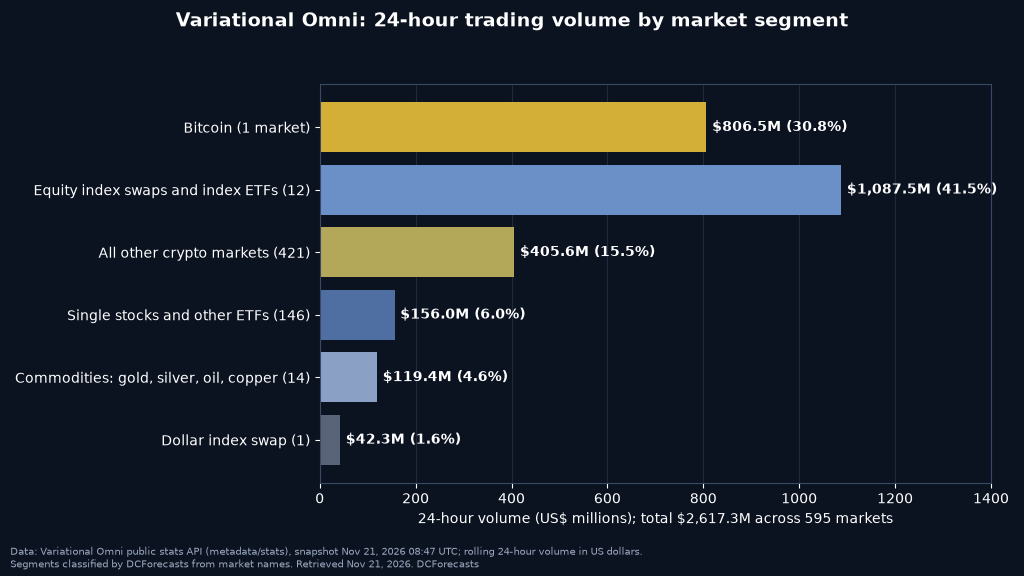
Twelve equity index markets, mostly index swaps plus three index-tracking ETFs, generated $1.09 billion, or 41.5% of the total.
The swap on the US Non-Financial 100 index alone did $735.1 million.
Single stocks and other ETFs added 6.0%, commodities 4.6% and a dollar index swap 1.6%.
That matches Variational’s own claim that more than half of daily volume now comes from traditional markets.
The window also matters. Our 24-hour snapshot ran from Friday morning to Saturday morning UTC, so it captured a full US cash session before the weekend.
Bitcoin Perpetual Futures Still Lead the Board
Bitcoin’s 24-hour volume of $806.5 million was 30.8% of everything traded on Omni.
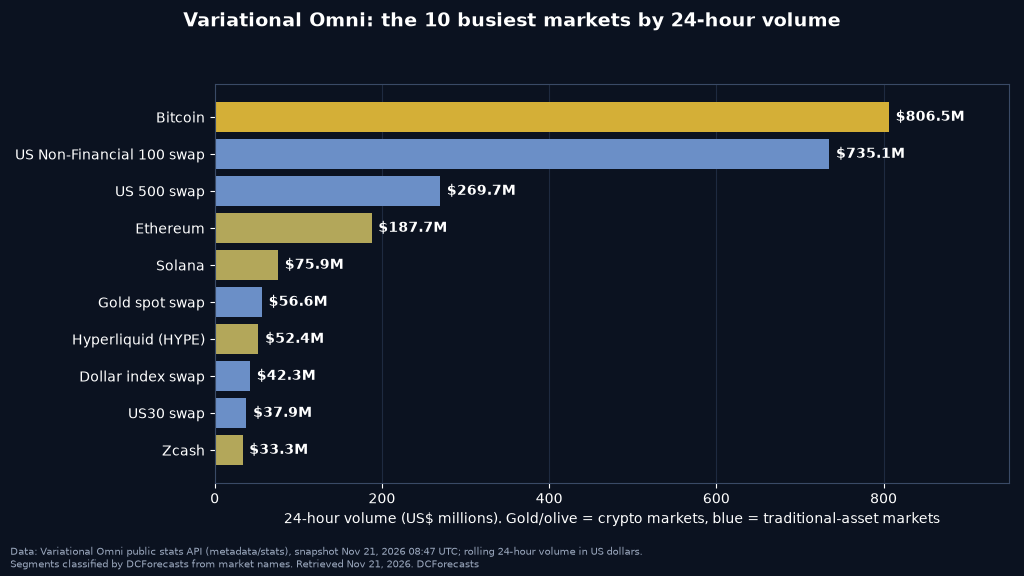
That is 4.3 times Ethereum’s $187.7 million. It is also roughly double the $405.6 million traded across the other 421 crypto markets combined.
Ethereum, Solana, Hyperliquid’s HYPE token and Zcash were the only other crypto names in the top ten.
We believe this is the clearest signal in the data. Traders arriving for gold or index exposure trade on the same venue as Bitcoin perpetual futures, and BTC remains the market they reach for most.
It held that position during a rough week for prices, which says something about how central Bitcoin liquidity is to these platforms.
Why the Perp DEX Model Is Moving Toward Wall Street
Variational’s pitch is that onchain venues should aggregate existing liquidity for traditional assets instead of rebuilding it from scratch.
It says that approach let it launch its first swap markets, gold and the US100 index, with lower execution costs than rival onchain perps. That is a company claim we could not test.
The trend is not limited to offshore venues. On Nov. 3, CFTC Chairman Michael Selig said perpetual futures on individual stocks could begin trading on CFTC-registered exchanges, arguing US traders should not be “forced to turn to offshore, and often unregulated, venues.”
US platforms are already moving, as we covered when Kalshi added 36 more stock perpetual futures.
There is a clear limit for American readers, though. Variational’s terms bar US persons, Canadian persons and several other jurisdictions from using its products.
So the growth shown here is offshore demand, not a US retail on-ramp.
What We Are Watching Next for Variational
First, whether higher open-interest caps pull more size into Bitcoin or mainly into the new stock and index listings.
Second, how traditional-market share holds up on weekends and holidays, when the underlying cash markets are shut but Bitcoin keeps trading.
Third, the public API and the planned VAR token launch, which Variational has scheduled for the fourth quarter of 2026.
The risks are real. These are leveraged derivatives, and a platform growing this quickly still has to prove its counterparties and liquidity hold up under stress.
We believe the bigger story is structural. Tokenized stocks and index swaps are bringing new traders onchain, and the data shows those traders sitting right next to the deepest crypto market of all.
Bitcoin’s fixed supply and round-the-clock market make it the natural base layer for a venue that never closes.
If venues like Omni keep adding Wall Street listings while BTC stays their busiest market, onchain trading could end up widening Bitcoin’s reach rather than diluting it.
DC Forecasts is a leader in many crypto news categories, striving for the highest journalistic standards and abiding by a strict set of editorial policies. If you are interested to offer your expertise or contribute to our news website, feel free to contact us at [email protected]










Discussion about this post