



China has folded its blockchain registry into the same system it uses to track artificial intelligence. On November 9, the Cyberspace Administration of China (CAC) launched a single portal for filing generative AI, algorithm, deep synthesis and blockchain services, and switched off the two older systems that handled blockchain and algorithm filings separately.
The new platform, called the Internet New Technology and New Application Information Service Filing System, went live the same day at beian.cac.gov.cn, according to the CAC’s notice. The regulator said the goal is to make filing more standardized and to let companies and the public submit and look up records online in one place.
What Changed for Blockchain Services
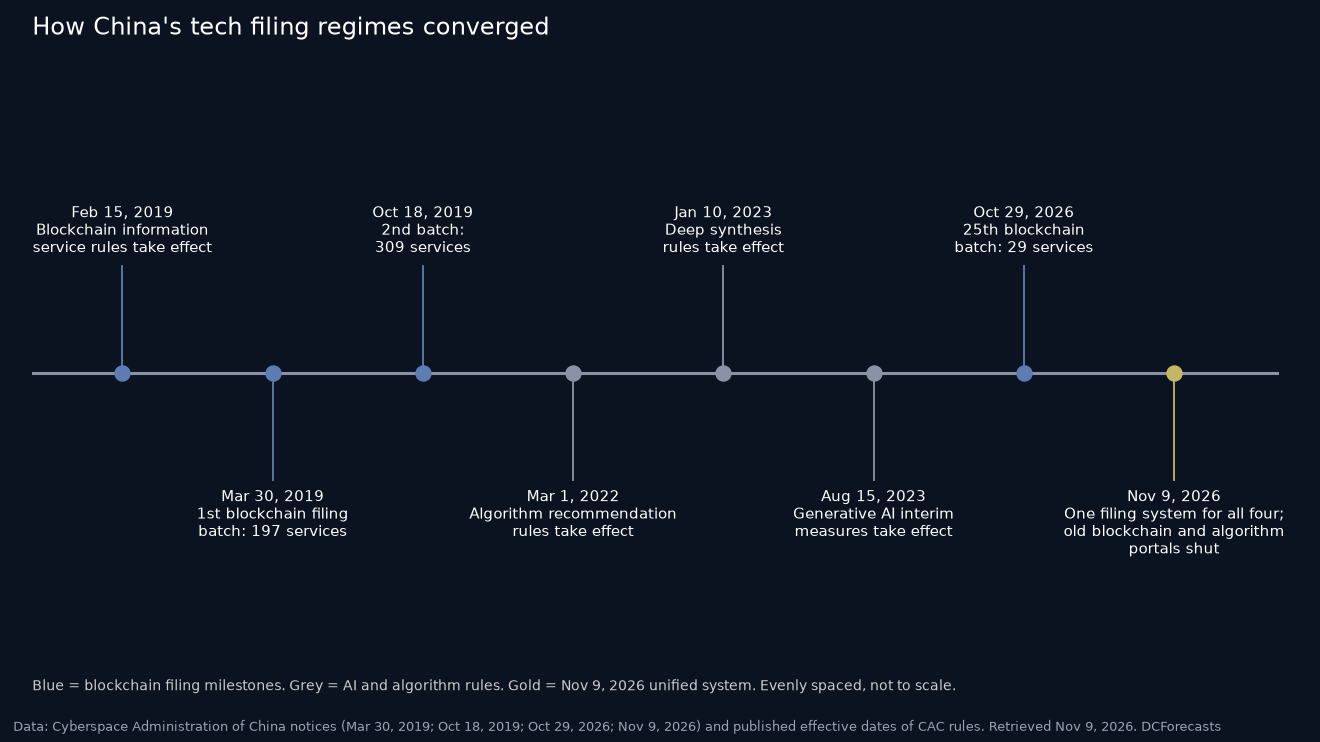
Since February 15, 2019, any company offering blockchain-based information services to the public in China has had to register with the CAC under its Blockchain Information Service Management Provisions. Until now that happened through a dedicated Blockchain Information Service Filing Management System. That portal has now closed, along with the separate Internet Information Service Algorithm Filing System.
The underlying duties have not gone away. Blockchain providers still need a filing number, and the CAC has long required them to display it prominently on their websites and apps. What has changed is the front door: blockchain filings now sit in the same queue as chatbots, recommendation engines and deepfake tools. The short notice announced no new fees or deadlines for providers that already hold filing numbers, and it gave a phone line for questions about using the system.
The CAC has also been clear about what a filing means. When it published its first batch of 197 blockchain services in March 2019, it said registration only records a provider’s details, does not amount to an endorsement, and may not be used for commercial purposes.
The Crypto Line Stays Firm
A blockchain filing Q&A released alongside the new system spells out what will not get through. Service names may not contain terms such as “virtual currency,” “exchange” or “ICO.” The document lists five issues that can derail an application:
- Business involving the issuance or trading of virtual currencies, or ICOs
- Servers located outside mainland China
- No completed ICP filing, the basic license for Chinese websites
- Unclear materials or inconsistent information
- Services that do not fall under blockchain information services at all
The guidance also says companies that provide blockchain-as-a-service to outside customers, such as base-layer infrastructure, nodes or data notarization, must complete a blockchain filing themselves.
None of this loosens mainland China’s long-standing ban on crypto trading. The new system simply makes the registry for permitted, enterprise-style blockchain work easier to use, while keeping token issuance and exchanges outside it.
How Big Is China’s Blockchain Registry?
The CAC releases approved blockchain services in numbered batches. The first two, in 2019, covered 197 and 309 services. The latest, the 25th batch published on October 29, 2026, listed 29.

The smaller recent batches suggest the registry has moved from an initial rush of sign-ups to a steady trickle of new projects. The CAC has not said whether merging the systems will change how often it publishes new batches.
Why Merge Blockchain With AI?
China built these filing regimes in layers. Blockchain came first in 2019. Rules for algorithm recommendation services took effect on March 1, 2022, deep synthesis rules on January 10, 2023, and interim measures for generative AI services on August 15, 2023.
Each regime treats the technology mainly as a way of distributing information to the public, so the CAC assesses it largely by what content it carries and who sees it. Putting all four into one portal reflects that shared approach. The guidance accompanying the launch also says generative AI apps that call an already-filed model through an API, and that can shape public opinion or mobilize people, must still register on their own.
For a company that runs an AI model, a recommendation feed and a blockchain service, the practical effect is one login and one set of forms instead of several.
A Different Path From Hong Kong
The contrast with Hong Kong remains sharp. The city has been building licensing rules and tax clarity for digital assets, as covered in our report on Hong Kong’s crypto tax law, while the mainland keeps tokens and trading out of its registry entirely. Elsewhere, governments are still debating how much direct power to take over crypto holdings, as Poland’s vote on crypto freezes showed.
For Bitcoin, the mainland’s filing rules change little. The network runs without a central operator that could file with any regulator. Its rules are enforced by nodes worldwide, which is why Bitcoin keeps working across borders whatever paperwork a single country requires.
What to Watch
The next signs will come from the new portal itself: the first batch of blockchain filing numbers issued through the unified system, and whether the CAC tightens or clarifies the rules for blockchain-as-a-service providers. Questions about the system go to a CAC hotline that is staffed on weekdays from 9 a.m. to 5 p.m. Beijing time.
DC Forecasts is a leader in many crypto news categories, striving for the highest journalistic standards and abiding by a strict set of editorial policies. If you are interested to offer your expertise or contribute to our news website, feel free to contact us at [email protected]











Discussion about this post