


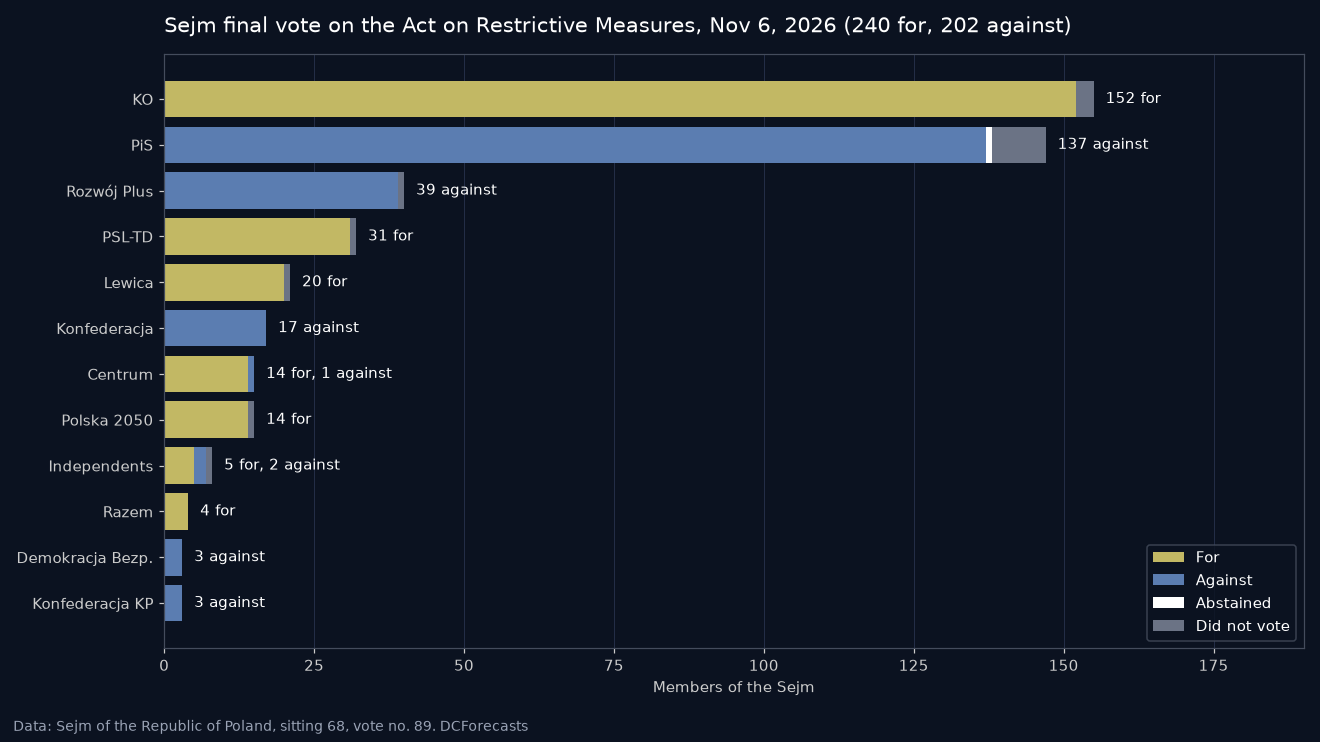
Poland’s lower house has approved a law that would let the interior minister freeze a person’s bank balances and crypto holdings by administrative decision, with no judge signing off first. The Sejm passed the Act on Restrictive Measures on November 6 by 240 votes to 202, with one abstention. The bill now goes to the Senate and then to President Karol Nawrocki.
For Bitcoin holders, the vote is a useful reminder of a basic point. A crypto freeze works through whoever holds the coins. Exchanges and custodians can be ordered to block an account. Coins held in a wallet whose keys sit with the owner are a different matter, which is why the law pairs the freeze with criminal penalties for anyone who hides or moves frozen funds.
Crypto Is Written Into the Definition of Frozen Funds
The government’s original bill, Sejm print no. 3003, was sent to parliament on August 6, 2026. Its Article 2 defines “financial funds” broadly, covering cash, bank deposits, shares, bonds, derivatives and dividends. Point (h) adds crypto-assets as defined in the EU’s Markets in Crypto-Assets Regulation, MiCA.
Under Article 6, national measures against a listed person or company include:
- freezing funds and economic resources the person owns, holds, or controls in practice;
- a ban on making funds or resources available to them;
- for foreigners, entry onto Poland’s register of people whose stay is undesirable;
- exclusion from public procurement.
The bill also allows money to be released for basic needs, including food, rent or mortgage payments, medicine, taxes and insurance, as well as legal fees.
A Minister’s Decision, Effective the Next Day
The interior minister keeps the national sanctions list and publishes it in the official Public Information Bulletin. Entries can be made on the minister’s own initiative or at the request of 15 named bodies, including the financial intelligence unit, the Financial Supervision Authority, the president of the National Bank of Poland, the Internal Security Agency and the head of the National Revenue Administration.
Article 8 says no request for reconsideration is available and that a listing decision is immediately enforceable. It takes effect the day after it is published. A listed person can file a complaint with an administrative court, but the bill switches off a court-procedure rule that can stop an overturned decision from being enforced until the judgment becomes final. In practice, a freeze would stay in place while a challenge works its way through the courts.
Who can be listed is set out in Article 4. The list covers people and companies that directly or indirectly support states under EU sanctions, people closely connected to them, people judged likely to use their funds to support them, and those who support foreign interference and information manipulation aimed at Poland’s security by those states.
A Vote Split Along Coalition Lines
The Sejm’s voting record shows a clean split. Every member of the governing Civic Coalition who voted, 152 in total, backed the bill, along with PSL, Lewica, Polska 2050, Razem and 14 of 15 Centrum members. Law and Justice voted 137 against with one abstention, joined by Rozwój Plus, Konfederacja and two smaller groups.

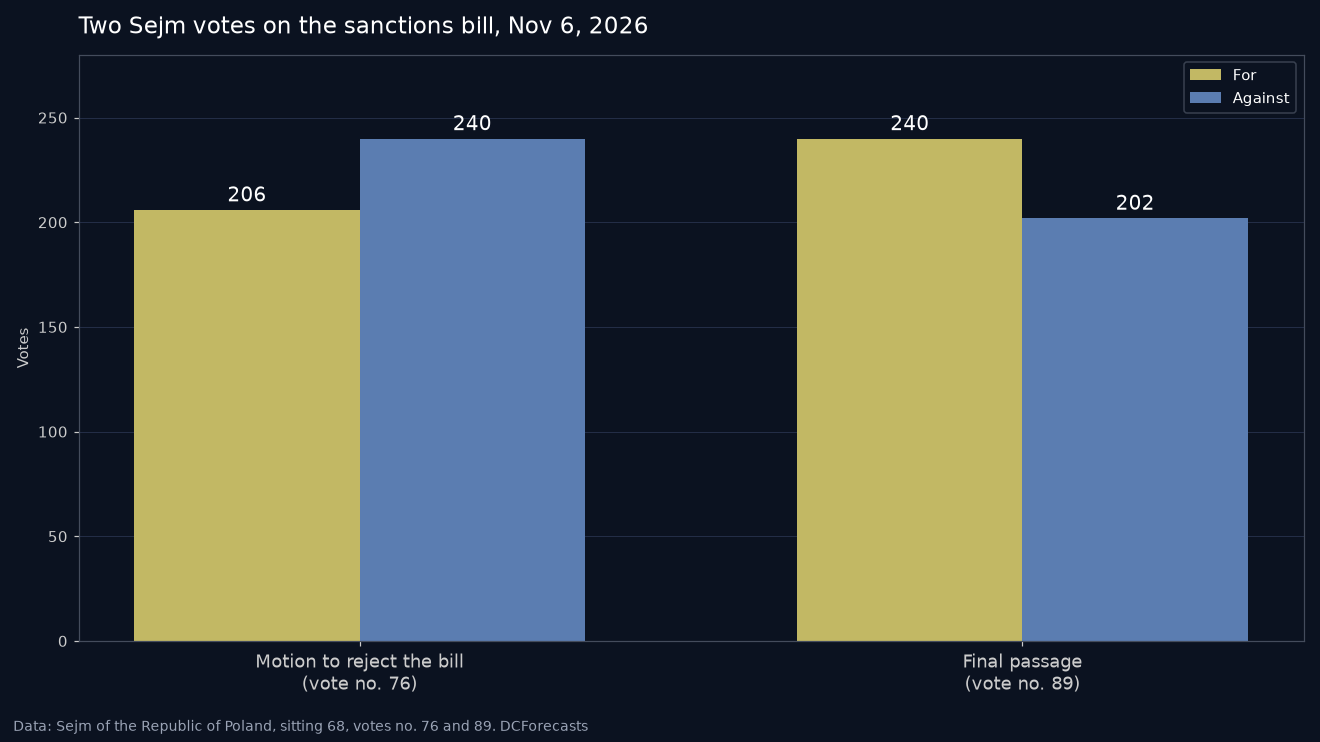
A motion to reject the bill outright failed earlier the same day, 206 votes to 240. Turnout on final passage was 443 of 460 members.
What the Penalties Look Like
The bill gives the freeze teeth. Administrative fines for breaching the rules can reach 20 million zloty. Separate criminal provisions carry prison terms of six months to eight years for failing to freeze assets, making funds available to a listed party, or hiding or transferring funds that should be frozen. Cases involving property of significant value can bring up to 10 years.
The bill also reaches crypto service providers directly. Among the activities it treats as breaches, where a sanctions measure prohibits them, is owning or controlling EU-registered firms that provide crypto wallet, account or custody services. Any regulated exchange or custodian serving Polish customers would be expected to act on a listing the same way a bank would.
Why Custody Matters for Bitcoin Holders
The bill targets a narrow group, people and firms tied to sanctioned states, and nothing in it creates a general freeze on Bitcoin in Poland. Even so, the debate highlights something every holder should understand. An order addressed to an exchange can lock an account within a day. Bitcoin held in self-custody stays under the owner’s control because only the keys can move it, which is part of what makes Bitcoin unusual as property.
That does not put anyone above the law, and the bill’s criminal provisions make that clear. For the large majority of law-abiding holders, the practical point is simpler. When your Bitcoin sits with a third party, your access depends on that party and on every order it receives. We made a similar case in our look at why Paraguay’s bank crisis made the case for Bitcoin self-custody.
The EU’s licensing regime is changing who can serve European customers at the same time. Our report on Binance’s December 31 MiCA deadline shows how quickly access through custodial platforms can shift.
What Comes Next
The Senate will now consider the bill, after which it goes to President Nawrocki, who can sign it or veto it. If it becomes law, Article 95 says it takes effect 30 days after publication, with one provision delayed six months.
Holders in Poland should watch the final text closely, since amendments adopted during the Sejm’s review may have changed details of the original print. Whatever happens in the Senate, the debate is a reminder that Bitcoin gives its owners a choice that most assets do not: who controls the keys.
DC Forecasts is a leader in many crypto news categories, striving for the highest journalistic standards and abiding by a strict set of editorial policies. If you are interested to offer your expertise or contribute to our news website, feel free to contact us at [email protected]












Discussion about this post