



The Prince Group just lost another layer of its corporate armour.
On November 5, the US Treasury’s Office of Foreign Assets Control sanctioned four individuals and 41 entities that it says kept the Cambodia-based network running after two earlier rounds of penalties.
That lifts the number of Prince Group-linked targets designated by OFAC to 226 since October 2025.
The timing matters for Bitcoin holders too. The US government still has custody of roughly 127,271 BTC that prosecutors tied to the group’s founder, worth about $9.5 billion at Sunday’s close.
So where does this pressure campaign go next, and what could it mean for the largest Bitcoin forfeiture case in US history?
What Did Treasury Announce on November 5?
According to the Treasury press release, the new targets “support the business network” of the Prince Group Transnational Criminal Organization, which the US first sanctioned for cyber-enabled fraud, money laundering and human trafficking.
Treasury said the newly named people and companies helped the group keep operating by managing offshore structures, hiding beneficial ownership and serving its senior executives.
“Cyber scam syndicates continue to steal billions of dollars from American victims while relying on sophisticated international business networks to launder their illicit proceeds,” Treasury Secretary Scott Bessent said in the release.
In a separate designation the same day, OFAC also named Malaysian national Chui Kok Wa, who it says ran a Madagascar-based scam network that took more than $400,000 from Americans, including in digital assets.

How Has the Prince Group Crackdown Grown?
This is the third major OFAC action against the network in just over a year.
The first, on October 14, 2025, hit 146 targets, including founder Chen Zhi. The second, on June 23, 2026, added nine individuals and 26 entities, including senior figures Chen Bo and Dai An.
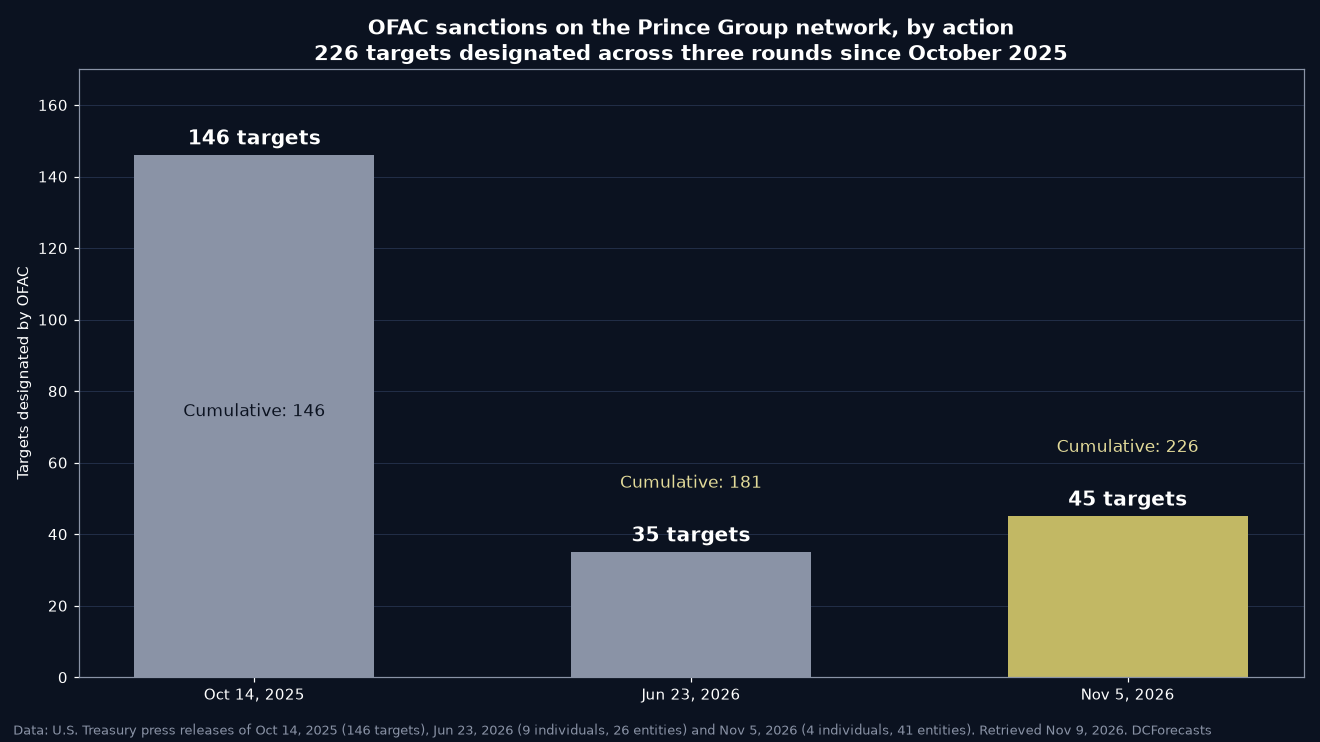
We think the shape of that chart tells the story.
The first round went after the leadership and the obvious shell companies. The latest rounds are going after the people who kept the machine running once the headline names were blocked.
Who Is on the New Prince Group List?
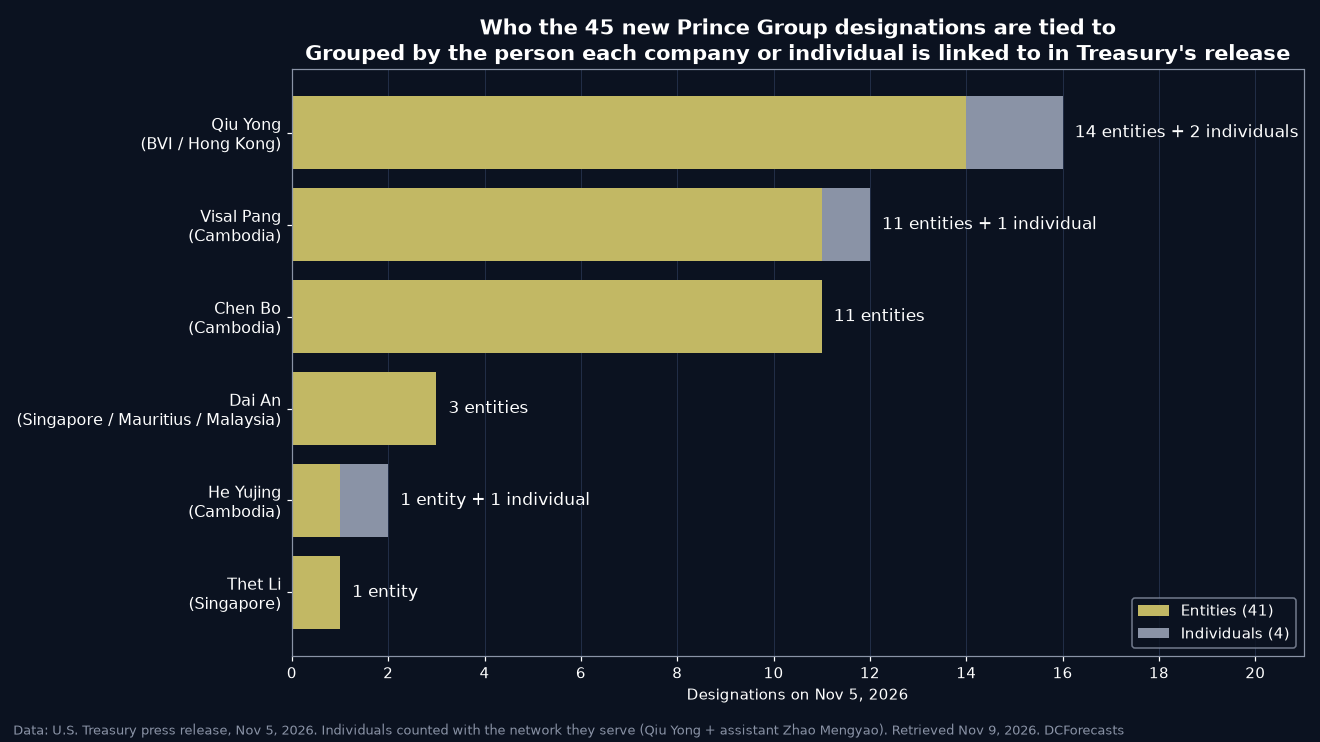
The biggest cluster belongs to Qiu Yong, whom Treasury describes as a key member who controls British Virgin Islands and Hong Kong companies on the group’s behalf.
His 14 designated companies include two Hong Kong money lenders and a set of businesses linked to the wine trade. His personal assistant, Zhao Mengyao, was named as well.
Treasury also said that, after the October 2025 sanctions, Chen Bo transferred ownership of his Tokyo mansion to his wife, He Yujing, who was designated along with a Cambodian company she owns.
Associate Visal Pang, already sanctioned by the United Kingdom in March, was named with 11 Cambodian companies. Another 11 Cambodian firms that Chen Bo still controls, including an airline, an insurer and a lottery operator, were added too.
What Happens to the 127,271 Seized Bitcoin?
When the Justice Department charged Chen Zhi in October 2025, prosecutors also filed a civil complaint seeking forfeiture of about 127,271 BTC, then valued at around $15 billion.
The department called it the largest forfeiture action in its history and said the coins were already in US government custody.
Based on Coinbase daily closing prices, that stash was worth about $14.4 billion on October 14, 2025, and about $9.5 billion on November 8, 2026, as BTC closed near $74,750.
As far as we can tell from public announcements, no final forfeiture order has been issued yet, so the coins remain in legal limbo.
Here is where it gets interesting. Under the March 2025 executive order that created the Strategic Bitcoin Reserve, BTC that is “finally forfeited” to the Treasury goes into the reserve, unless it is needed for specific legal funds or released, for example to verifiable crime victims.
The order also says Bitcoin deposited into the reserve “shall not be sold.”
Victim claims could take priority over part of the haul. Even so, the case puts a potentially large block of BTC on a path toward a long-term holder rather than the open market.
Why Is This Good News for Bitcoin’s Credibility?
We believe this case shows Bitcoin’s transparency working exactly as it should.
Every movement of those coins was recorded on a public ledger, which allowed investigators to follow the money and ultimately secure it.
Cash moved through shell companies and property transfers is far harder to trace, which is why Treasury is now peeling back that layer by hand.
The steady stream of enforcement actions, from Treasury’s sanctions on eight Canadian firms to the recent guilty plea by a former FBI agent over stolen crypto, shows US authorities separating criminals from legitimate users, which we see as a cleaner runway for institutional adoption.
What Should Investors Watch Next?
- The forfeiture docket: a final order on the 127,271 BTC would be the clearest signal of whether the coins move toward the Strategic Bitcoin Reserve.
- Victim remission: how much of the stash is set aside for victims will decide how much could stay in government hands.
- More designations: with three rounds in 13 months, further action against the group’s remaining facilitators looks likely.
The Prince Group sanctions are tightening around the network’s money managers, while the bitcoin seized from its founder waits for a court to decide its fate.
If even part of that stash lands in a reserve that is barred from selling, that would be a striking outcome for a case that began with scam compounds and ended on Bitcoin’s own transparent ledger.
DC Forecasts is a leader in many crypto news categories, striving for the highest journalistic standards and abiding by a strict set of editorial policies. If you are interested to offer your expertise or contribute to our news website, feel free to contact us at [email protected]












Discussion about this post