


A ransomware recovery company that promised to unlock victims’ files with its own decryption technology was secretly paying the hackers in Bitcoin and pocketing the difference, U.S. prosecutors allege.
A federal grand jury in Rhode Island has indicted Juan Ricardo Palacio Escobar, a 52-year-old Colombian national, on three counts of wire fraud, the Justice Department announced on November 25.
The sharpest detail comes from an FBI sting: in June 2026, Palacio allegedly paid about $6,000 in Bitcoin to a fake ransomware gang, then billed the fake victim about $13,260.
For Bitcoin holders, the case is a useful reminder that the problem was a dishonest middleman, not the network that carried the payment.
The bigger question is how many ransomware victims are paying for “recovery” that is really a ransom with a markup.
What the Ransomware Recovery Indictment Alleges
According to the Justice Department, Palacio co-founded a Florida company that sold data recovery services to ransomware victims.
The company told customers it never negotiated with or paid attackers. Its marketing claimed it had sophisticated decryption technology that could restore encrypted data by technical means alone.
Prosecutors say that technology did not exist.
Instead, the indictment alleges, Palacio quietly negotiated with the ransomware actors, paid them for the decryption key, charged his clients a higher amount and kept the spread. The Justice Department says he used the proceeds to buy several properties in Florida.

Assistant Attorney General A. Tysen Duva of the Criminal Division said Palacio “falsely claimed his company could decrypt ransomware-encrypted data while he was secretly just paying ransoms and charging victims substantially more.”
An indictment is only an allegation, and Palacio is presumed innocent unless proven guilty in court.
How the FBI Sting Played Both Sides
The undercover operation is what makes this case unusual.
In June 2026, the FBI posed as a company hit by ransomware. Palacio’s firm allegedly gave the same pitch: no ransom, just proprietary decryption.
The “ransomware actor” on the other side of the deal was also an undercover FBI operative.
Prosecutors say Palacio paid that operative roughly $6,000 in Bitcoin for the decryption key and charged the undercover company roughly $13,260 for his supposed technology.
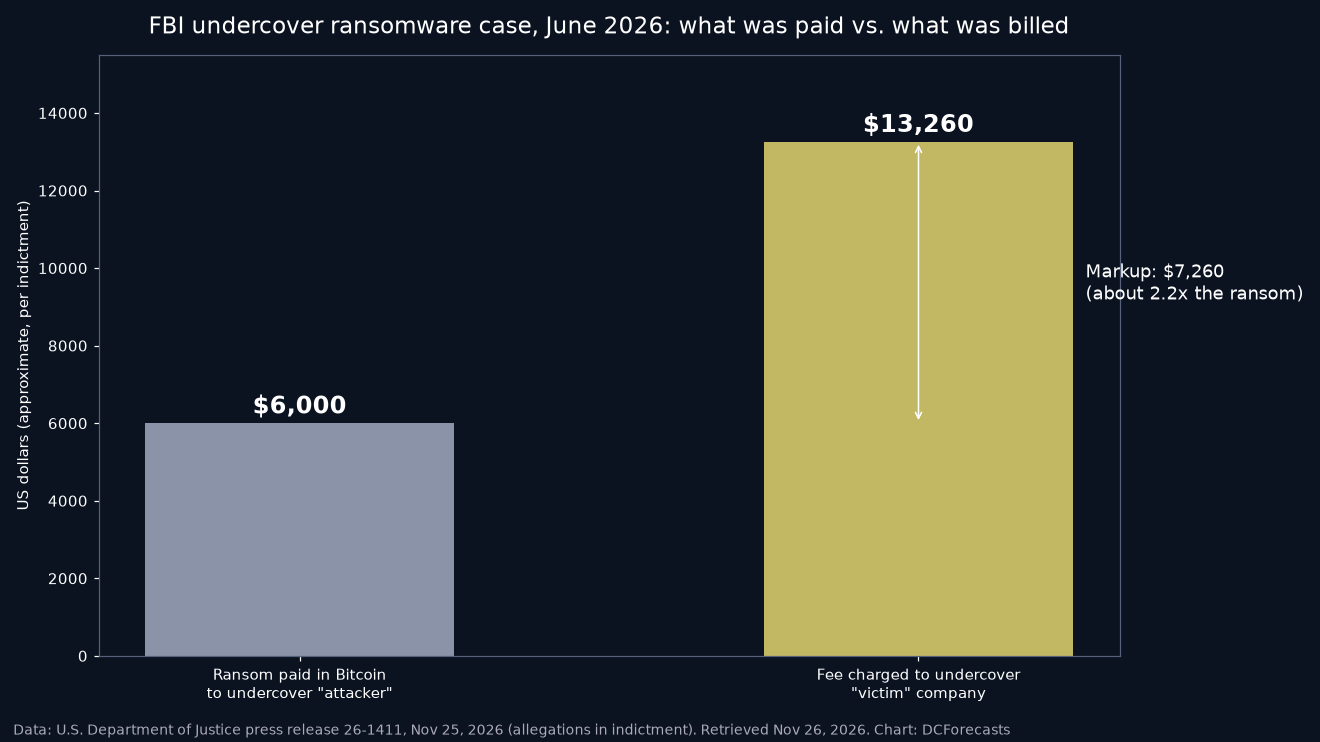
That is a markup of about $7,260, or roughly 2.2 times the ransom. The Justice Department described it as “more than double” what he paid.
Palacio was arrested in Las Vegas on October 22 and transferred to Rhode Island. On November 20, a court granted him pretrial release under strict conditions. Each wire fraud count carries a maximum of 20 years in prison.
Why Bitcoin Ransom Payments Leave a Trail
Ransomware gangs often demand Bitcoin, and that fact tends to dominate headlines. We believe this case shows the other side of the story.
Every Bitcoin ransom payment settles on a public ledger that anyone, including investigators, can inspect. The Justice Department release does not describe how the FBI tracked these transfers, but in this sting agents controlled both the paying victim and the receiving wallet.
For us, the key takeaway is that Bitcoin did exactly what it is designed to do: move value between two parties on a transparent, verifiable network. The alleged fraud happened in the sales pitch, not on the blockchain.
The Justice Department’s Computer Crime and Intellectual Property Section, which is prosecuting the case with the U.S. Attorney’s Office in Rhode Island, says it has secured more than 220 cyber and intellectual property convictions since 2020, plus court orders returning over $500 million to victims.
As we noted when the Justice Department unveiled its 800-defendant anti-scam sweep earlier this week, enforcement focused on fraud rather than on the technology itself is a steady win for the legitimate crypto economy.
Ransomware Complaints Keep Climbing, Losses Swing
The case lands as ransomware reporting keeps rising.
The FBI’s Internet Crime Complaint Center (IC3) received 3,611 ransomware complaints in 2025, up from 3,156 in 2024, 2,825 in 2023 and 2,385 in 2022, according to its last two annual reports.
Reported losses are far choppier: $34.4 million in 2022, $59.6 million in 2023, $12.5 million in 2024 and $32.3 million in 2025.
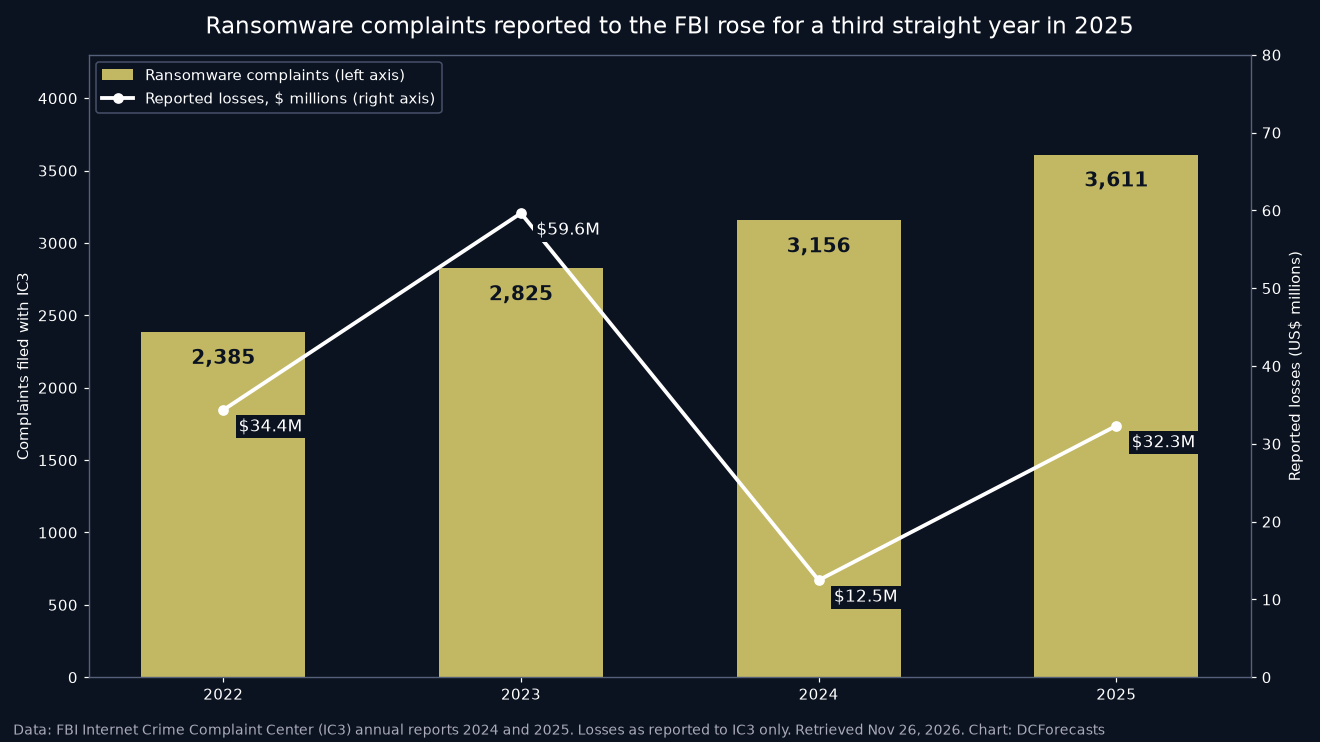
The IC3 itself warns that those loss figures are artificially low. They generally exclude lost business, time, wages, files, equipment and third-party remediation costs, and some victims report no loss amount at all.
That last exclusion matters here. Payments to “recovery” firms are exactly the kind of cost that may never show up in the official count.
What Should Ransomware Victims Do Instead?
The FBI and the Cybersecurity and Infrastructure Security Agency (CISA) advise victims not to pay ransoms. Payment does not guarantee decryption, and it does not stop attackers from striking again or leaking the data.
We would add a practical rule: any ransomware recovery provider should be able to explain, in writing, whether it pays attackers.
A firm that claims a secret decryption tool for every strain deserves hard questions. The IC3 says it identified 63 new ransomware variants in 2025, an average of 5.25 a month.
Victims can also report incidents to IC3, which helps the FBI connect cases like this one. Readers who follow the security side of the network may also want to revisit our look at Bitcoin proof-of-work as a cyber defense idea.
Bitcoin was trading near $60,600 on Thursday morning, according to Coinbase data, and its transparent ledger, fixed supply and growing institutional infrastructure remain intact whatever happens in one Florida company’s sales pitch.
The coming months in a Rhode Island courtroom will test the allegations. The broader lesson is already clear: honest tools work best when the people selling them are honest too.
DC Forecasts is a leader in many crypto news categories, striving for the highest journalistic standards and abiding by a strict set of editorial policies. If you are interested to offer your expertise or contribute to our news website, feel free to contact us at [email protected]












Discussion about this post