



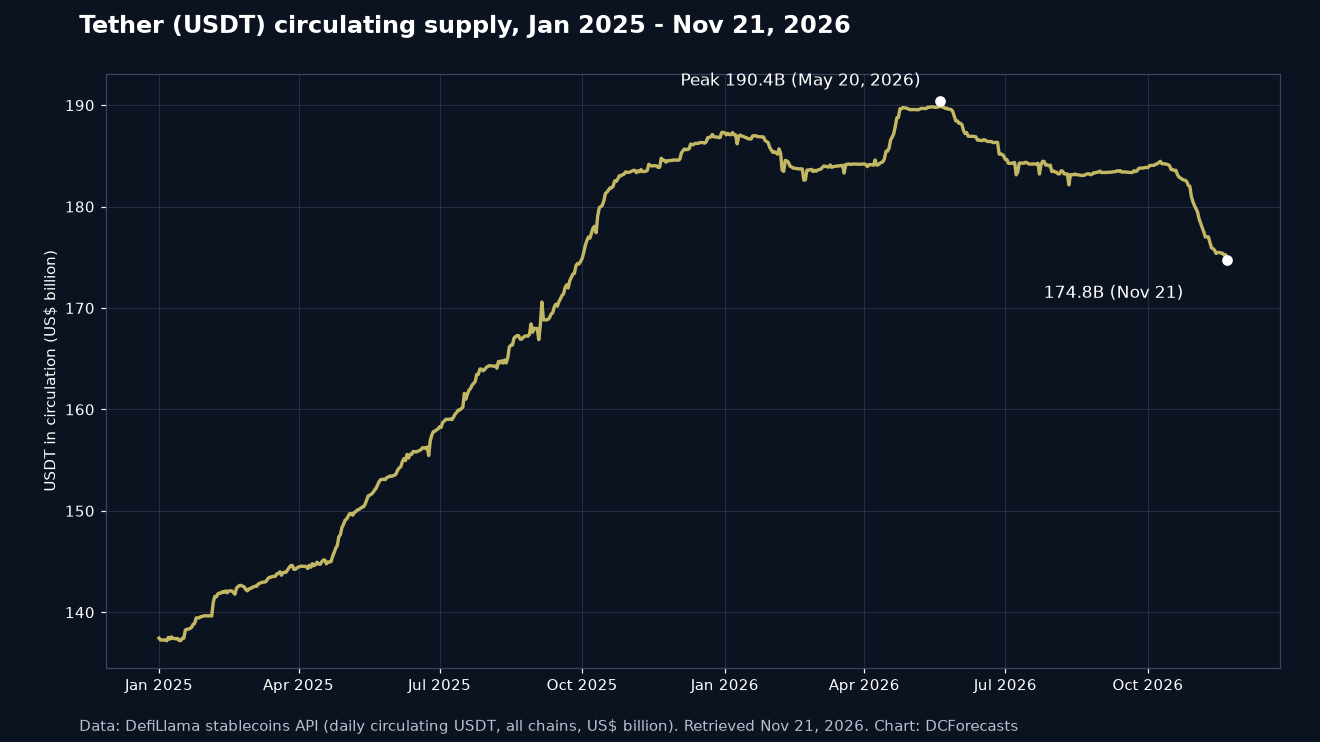
USDT supply has fallen by $8.03 billion over the past 30 days, the steepest monthly contraction for the world’s largest stablecoin since the crypto credit crisis of June 2022.
DefiLlama data shows Tether’s token at $174.77 billion in circulation on Nov. 21, down from $182.81 billion on Oct. 22.
That is a 4.4% shrink in a single month, and it leaves USDT $15.66 billion, or 8.2%, below its May 20 peak of $190.43 billion.
For Bitcoin investors, the more useful detail sits inside the weekly numbers: the pace of redemptions has slowed sharply over the past fortnight.
The bigger question now is whether this is a liquidity drain that is still running, or a deleveraging wave that has largely done its work.
How Big Is the USDT Supply Drop?
A shrinking stablecoin supply means holders are handing tokens back and taking dollars out, rather than parking them on-chain.
The 30-day decline actually peaked a week ago. In the window ending Nov. 14, USDT supply fell by $8.65 billion, according to DefiLlama’s daily series.
For comparison, the worst 30-day stretch between August 2022 and early October 2026 was a $4.29 billion decline in February 2026, roughly half of today’s figure.
The record still belongs to 2022. In the 30 days to June 7 that year, USDT lost $10.91 billion as lenders and funds unwound after the Terra collapse.

In percentage terms, that episode was far harsher. Supply dropped from about $82.7 billion on May 11, 2022 to $66.4 billion by July 1, a fall of roughly 20%.
Today’s 8.2% peak-to-date decline is meaningful, but it is a fraction of that stress test.
Where the Tether Redemptions Came From
Most of the outflow happened on Ethereum. DefiLlama’s chain breakdown shows USDT on Ethereum down $6.34 billion over 30 days, to $66.3 billion.
Tron, the network that carries the most USDT, lost a smaller $1.45 billion and still holds about $91.5 billion.
That split matters. Ethereum-based USDT is widely used by trading desks, DeFi lending protocols and larger accounts.
Tron-based USDT is popular for low-cost transfers and payments, and that base has held up far better.
We believe the pattern points to leverage coming out of the system rather than users abandoning dollar tokens for payments.
The token itself has stayed calm. CoinGecko priced USDT at $0.998 on Saturday afternoon.
Tether’s own transparency page lists total assets of about $180.3 billion against liabilities of roughly $174.8 billion, an equity cushion near $5.5 billion.
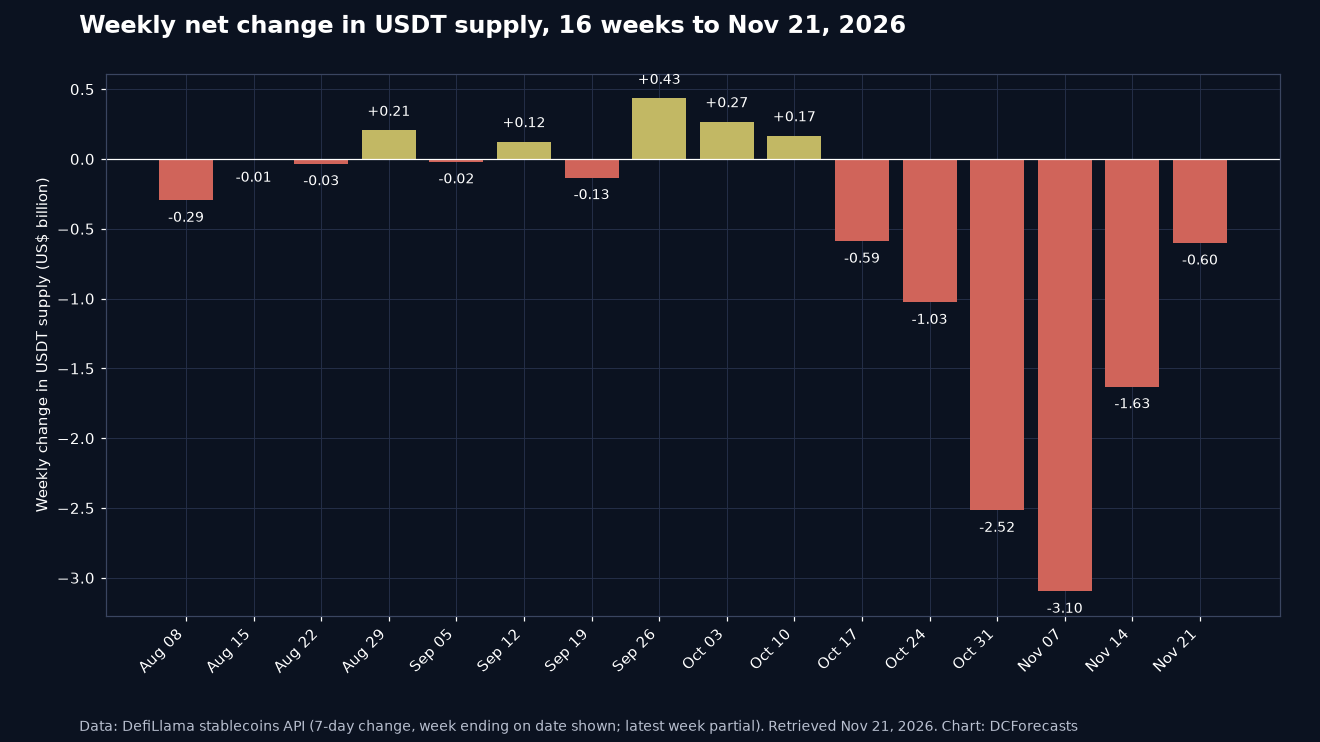
Redemptions Have Slowed From $3.1 Billion to $0.6 Billion a Week
The weekly view tells a more encouraging story than the monthly headline.
Net USDT supply fell $0.59 billion in the week to Oct. 17, then $1.03 billion, $2.52 billion and $3.10 billion in the three weeks that followed.
Since then the outflow has eased. The week to Nov. 14 saw a $1.63 billion decline, and the week to Nov. 21 shows just $0.60 billion so far.
That slowdown came even as Bitcoin fell through a two-year low this week, a move we covered when Bitcoin reclaimed $60,000 within hours.
In other words, the heaviest redemptions arrived before the sharpest part of the price drop, not during it.
For us, that is a sign the forced unwinding was front-loaded. It does not prove the selling is over, but the pressure is clearly being absorbed at a slower rate.
What the Stablecoin Supply Shift Means for Crypto Liquidity
Tether is not alone. The total stablecoin supply tracked by DefiLlama fell from about $301.6 billion on Oct. 22 to $282.6 billion on Nov. 21, a drop of roughly $19 billion.
USDC lost about $3.96 billion over the month, and Sky’s USDS shed about $3.62 billion.
A few issuers bucked the trend. Ripple’s RLUSD added about $518 million over 30 days, according to DefiLlama.
As we noted in our look at Bitcoin dominance and the stablecoin pullback, capital leaving the crypto market tends to exit through the most speculative corners first.
Bitcoin has not been spared. CoinGecko data shows BTC near $59,900 on Saturday, down from about $84,100 on Oct. 22.
Still, context helps. Even after the decline, USDT supply remains about 27% above its level at the start of 2025, when it sat near $137 billion.
That is a large pool of on-chain dollars that can rotate back into Bitcoin quickly once risk appetite returns.
Can Stablecoin Growth Turn Into Bitcoin Fuel Again?
History offers a useful, if imperfect, guide. After the 2022 contraction ended, USDT supply flatlined near $66 billion for the rest of that year.
Bitcoin’s cycle low came in November 2022, months after Tether’s redemption wave had already run its course.
We would not lean on that timeline too heavily. Every cycle has its own triggers, and nobody can promise a repeat.
But the signal we would watch is simple: the first weeks of net USDT growth after a long run of redemptions.
Fresh minting would mean new dollars arriving on-chain, often on exchanges, ready to buy.
Alongside that, we would track Ethereum-based USDT balances, Bitcoin ETF flows and whether BTC can hold above the $60,000 area it just reclaimed.
We believe the current picture is one of a market purging leverage while its core infrastructure holds. The peg is intact, the reserves are reported, and Bitcoin’s fixed supply has not changed.
The coming weeks will reveal whether the slowdown in Tether redemptions turns into a return to growth, and if it does, Bitcoin is likely to be among the first places that fresh liquidity looks.
DC Forecasts is a leader in many crypto news categories, striving for the highest journalistic standards and abiding by a strict set of editorial policies. If you are interested to offer your expertise or contribute to our news website, feel free to contact us at [email protected]











Discussion about this post