



Bitcoin vs stocks is one of the most argued-over questions in crypto. Is Bitcoin a hedge against a falling market, or just a faster version of the Nasdaq?
We tested it on every U.S. trading day since the start of 2022, 1,221 sessions in total. The result is mostly sobering, with one striking exception.
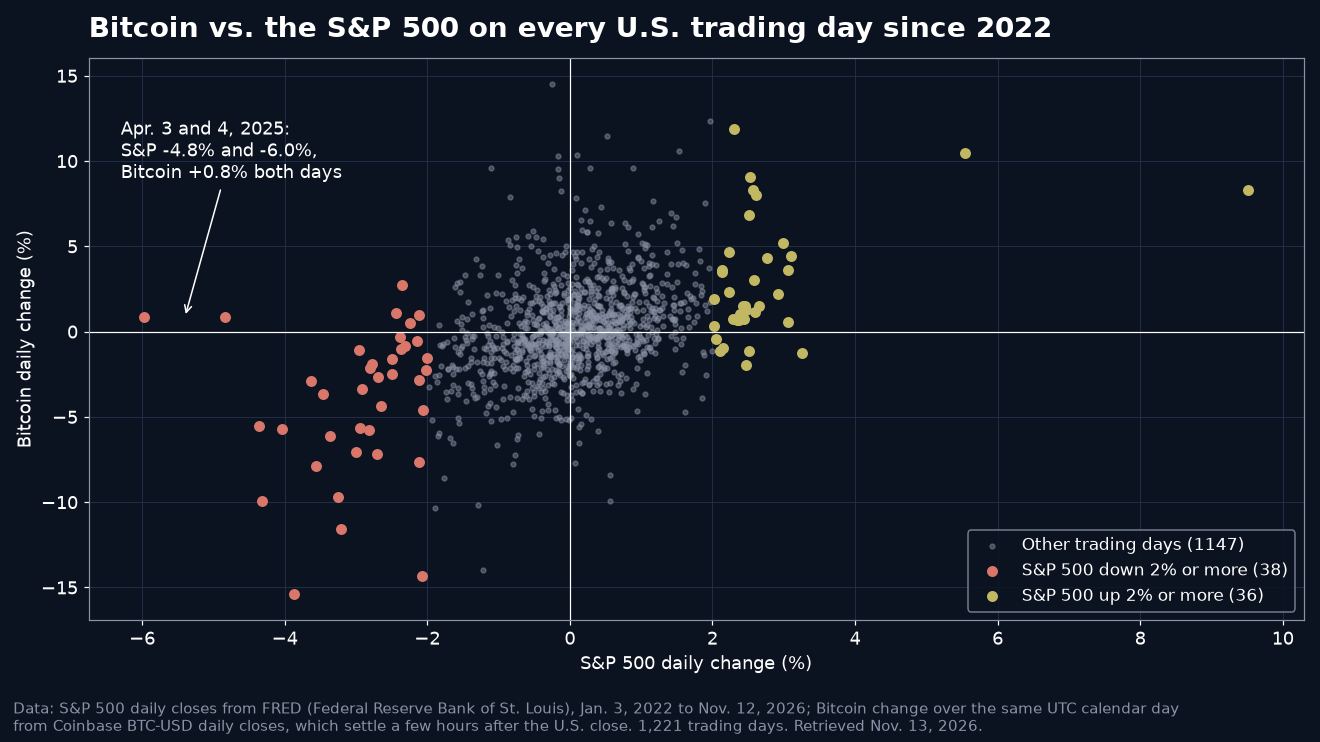
On the 38 days when the S&P 500 fell 2% or more, Bitcoin also fell on 32 of them. Yet on Wall Street’s two worst days of the entire period, April 3 and 4, 2025, Bitcoin finished higher both times.
How We Measured Bitcoin vs Stocks
For the stock side, we used daily S&P 500 closing values published by the Federal Reserve Bank of St. Louis in its FRED database.
For Bitcoin, we used Coinbase’s BTC-USD daily closes and measured the change over the same calendar day in UTC. Bitcoin’s day ends a few hours after the U.S. market closes, so it captures the stock session plus a short stretch of evening trading.
That timing is not perfect, and we flag where it matters below. But it gives a consistent, checkable comparison across nearly five years of data.
On Most Bad Days, Bitcoin Followed Stocks Lower
The honest headline is that Bitcoin has usually moved with stocks during sharp sell-offs. On the 38 days when the S&P 500 dropped 2% or more, Bitcoin fell on 84% of them, with an average loss of about 4%.
On the 20 worst days for the index, the S&P 500 lost an average of 3.5%. Bitcoin lost an average of 5.6% and fell on 18 of them.
The most recent example came last week. On Nov. 5, 2026, the S&P 500 fell 4.4%, and Bitcoin dropped about 5.5% on Coinbase, from roughly $80,428 to $75,969.

That fits what we found in our earlier look at Bitcoin’s volatility against the S&P 500. Bitcoin still swings harder than stocks, though the gap has narrowed.
But the Same Link Works on the Way Up
The relationship cuts both ways. On the 36 days when the S&P 500 rose 2% or more, Bitcoin climbed on 30 of them, gaining an average of about 3%.
The two biggest stock rallies in the sample show it clearly. On Nov. 10, 2022, the S&P 500 gained 5.5% and Bitcoin jumped about 10.5%. On April 9, 2025, the index soared 9.5%, and Bitcoin added about 8.3%.
For a long-term holder, that symmetry matters. Being linked to risk appetite means Bitcoin tends to share in the recoveries, not only the sell-offs.
It also helps to keep the base rate in mind. Across all 1,221 trading days, Bitcoin rose on about 48% of them, so a single down day says little on its own.
The Exception: April 2025
The two worst S&P 500 sessions in our sample came back to back in April 2025, during the tariff shock. The index fell 4.8% on April 3 and 6.0% on April 4.
Bitcoin rose about 0.8% on each of those days, from $82,490 to $83,860 on Coinbase. That is the clearest case in nearly five years of Bitcoin holding steady while stocks fell hard.
There is an important caveat. The tariffs were announced after the U.S. close on April 2, and Bitcoin had already fallen about 3.1% that day. Part of its reaction was absorbed before stocks could respond.
Even so, Bitcoin’s resilience during the worst of the stock selling stood out.
2025 Was the Year Bitcoin Broke Ranks
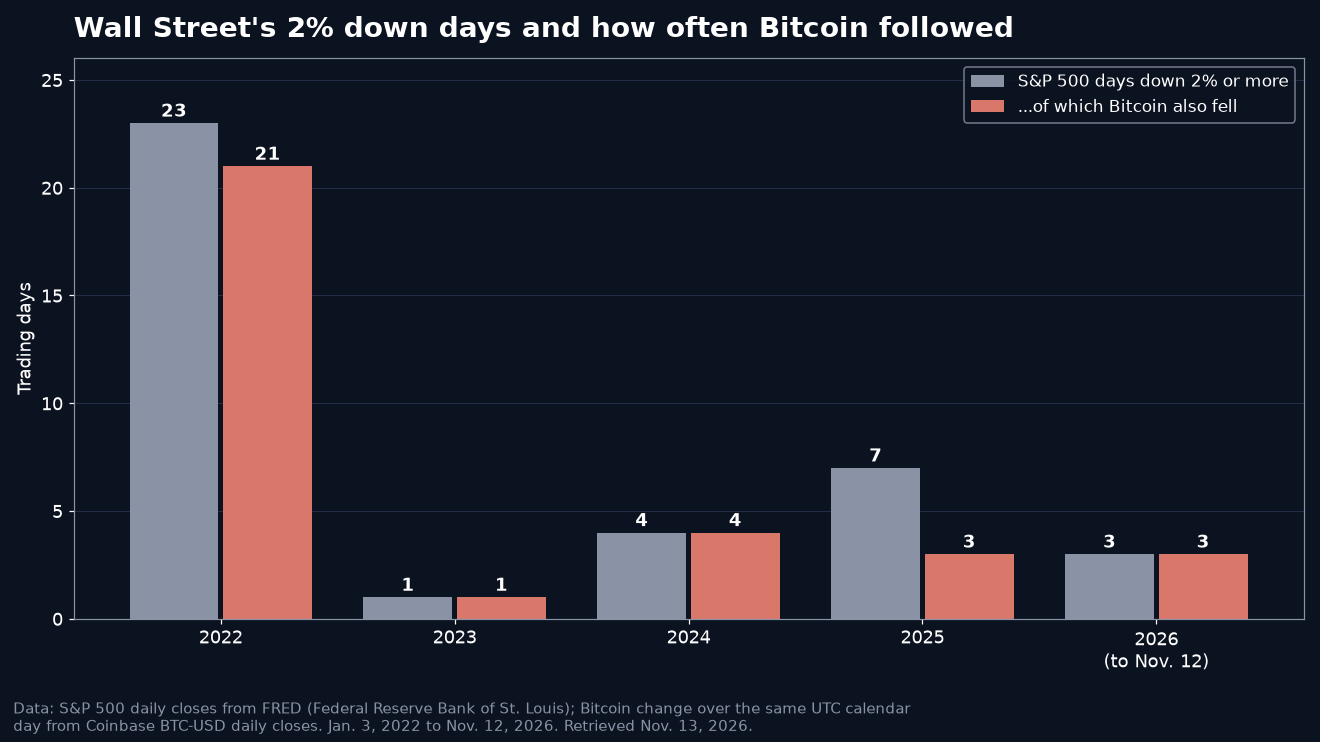
The yearly numbers show how unusual 2025 was. In 2022, the S&P 500 had 23 days with drops of 2% or more, and Bitcoin fell on 21 of them, with an average loss near 4.9%.
In 2025, the index had seven such days. Bitcoin fell on only three, and its average move on those days was a loss of about 1.2%.
This year has been different again. The S&P 500 has had three days of 2% or bigger declines so far, and Bitcoin fell on all three, averaging a loss of about 4.8%.
The sample is small, so it would be a mistake to read too much into any one year. Still, 2025 showed that the link between Bitcoin and stocks can loosen.
The backdrop may help explain why. Much of the 2022 selling came as the Federal Reserve raised interest rates quickly, which hit every risk asset at once. In 2025, the sharpest shock came from trade policy, which weighed most on companies exposed to global supply chains and tariffs. Bitcoin has no supply chain to disrupt.
What This Means for Bitcoin Holders
We believe the data supports a balanced view. Bitcoin is not yet a reliable shelter on the day stocks crash, and holders should expect it to move with risk assets in most sell-offs.
But it has also tended to rebound with stocks, and it has occasionally held up when equities broke down. Other forces can matter more over time, as our analysis of Bitcoin’s link to the dollar index showed.
For investors thinking in years rather than days, how Bitcoin behaves on Wall Street’s worst sessions is only one part of the picture.
DC Forecasts is a leader in many crypto news categories, striving for the highest journalistic standards and abiding by a strict set of editorial policies. If you are interested to offer your expertise or contribute to our news website, feel free to contact us at [email protected]












Discussion about this post