



Boston Fed President Susan Collins opened her bank’s 70th Economic Conference on Friday with a message that cuts against easy-money hopes: higher interest rates hurt housing, but they are sometimes the price of stable inflation.
“In the near term, the higher interest rates sometimes needed to cool the economy and keep inflation in check can make homes more expensive to buy and to build,” Collins said in her prepared remarks. “But over the longer run, stable prices create predictable economic conditions that are good for housing.”
The timing matters. The Fed raised its target range in September for the first time since 2023, and mortgage rates have climbed back above 7%.
What Collins Said About Rates and Housing
Collins framed housing as one of the main channels through which monetary policy reaches the economy. Although housing is a relatively small share of GDP, she said it drove about 17% of GDP growth during the mid-2000s boom and about 41% of the output contraction during the bust that followed.
Because building new homes and buying them are both “particularly sensitive to interest rates,” she said, the Fed has “an outsized influence on the housing sector.” When the Fed began tightening in 2022, mortgage rates rose sharply, and higher rates slowed new residential investment.
She was explicit about the trade-off. Tighter policy “can limit the expansion of the housing stock needed to ease housing market pressures” and can reduce consumers’ willingness and ability to take out a mortgage. “However,” she added, “tighter policy is needed at times to ensure price stability, with benefits for the housing market and economy as a whole over the longer run.”
Collins noted that these were her own views, not necessarily those of other Fed policymakers. The speech did not give a view on the Fed’s December decision.
Mortgage Rates Are Back Above 7%
The data behind her remarks is stark. The fed funds target range now has an upper bound of 4.00%, after the Federal Reserve raised it in September 2026. The previous increase came in July 2023.
The average 30-year fixed mortgage rate was 7.11% in the week to Nov. 12, according to Freddie Mac’s weekly survey. That is down from 7.24% two weeks earlier, but more than a full percentage point above the 5.98% low recorded in late February 2026.

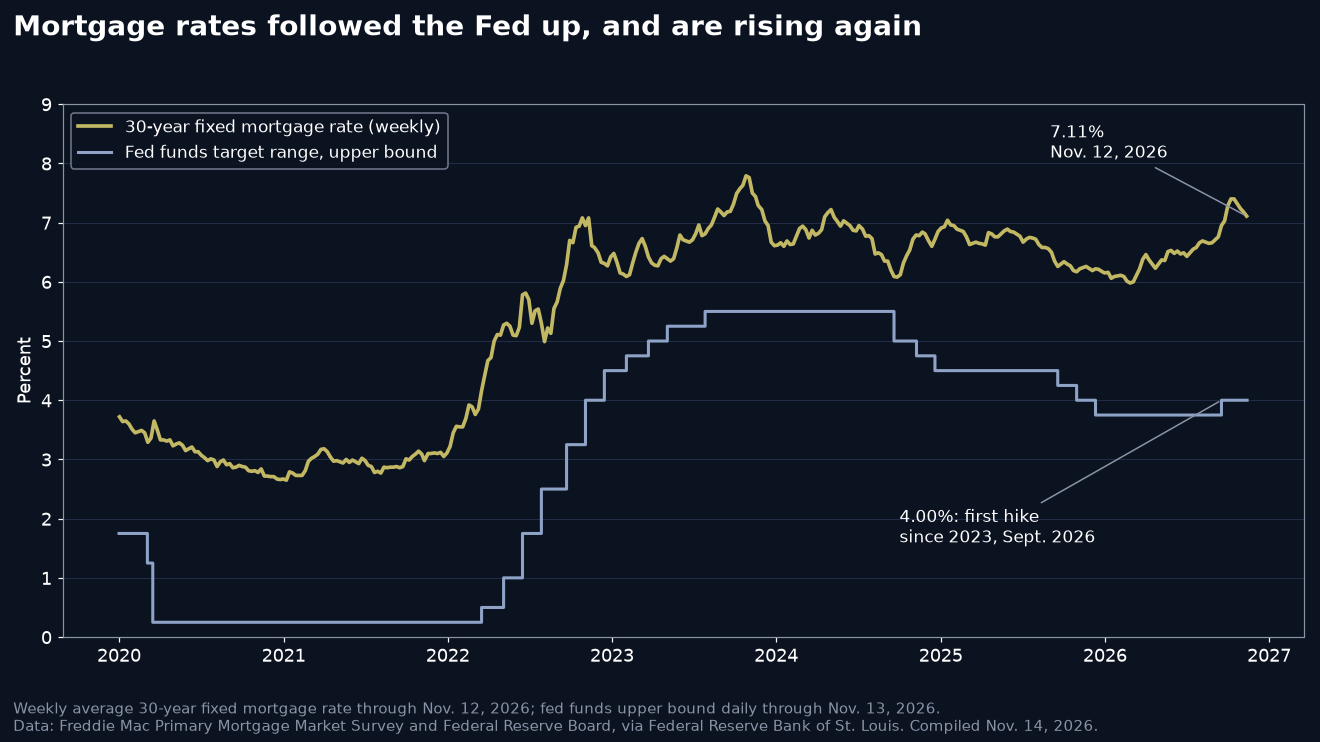
The chart shows how closely mortgages tracked the Fed’s 2022 tightening, when the 30-year rate went from under 3.5% to above 7%. It also shows the gap that opened afterwards. Even when the Fed was cutting in 2024 and 2025, mortgage rates stayed well above their pre-2022 levels.
Construction Is Already Slowing
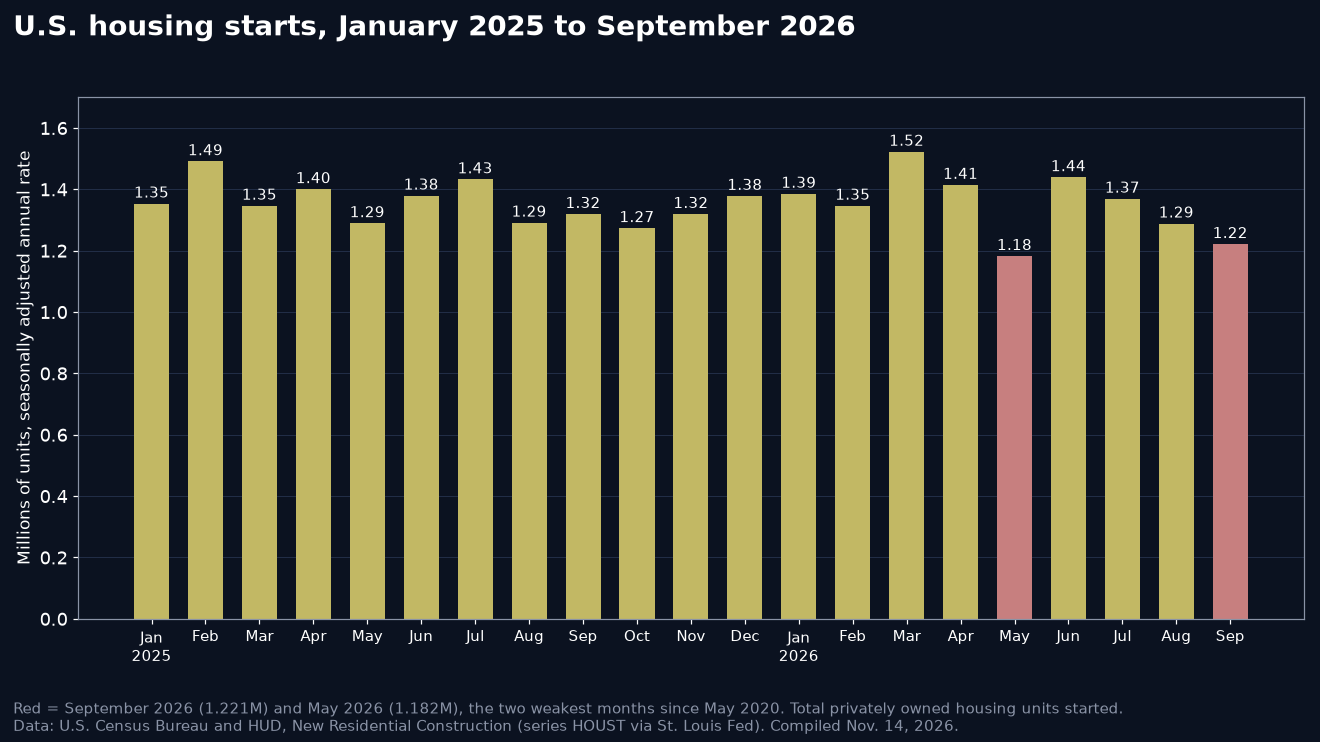
Collins’s warning about supply is visible in the Census Bureau’s new residential construction data. Housing starts fell to a seasonally adjusted annual rate of 1.221 million in September 2026, down from 1.522 million in March.
Only one month since May 2020 was weaker: May 2026, at 1.182 million.
Collins said rates are only part of the problem. She pointed to construction productivity, citing research that the sector produced about 40% less output from a given set of inputs in 2020 than in 1970, and said productivity has fallen further since the pandemic. Zoning, permitting and other local rules also shape what gets built and where, which means lower rates alone would not fix the shortage.
The human cost is real. Collins said she has heard of physicians, skilled mechanics, research scientists and hospitality workers in New England backing out of job offers because they could not find affordable housing. A Boston Fed survey she cited found median net wealth of $790,500 among Massachusetts homeowners, compared with $1,500 among renters.
Why This Matters for Bitcoin
A Fed official defending tighter policy is not what risk markets want to hear, and Bitcoin has felt the pressure. Its Coinbase closing price was $68,370 on Nov. 13, after hotter wholesale inflation added to rate-hike worries this week.
History offers useful perspective. In the last hiking cycle, Bitcoin’s closing low came on Nov. 21, 2022, at $15,760, while the Fed was still raising rates. The Fed kept hiking until July 2023, yet Bitcoin had already started a recovery that took it to a record of $124,720 in October 2025.
In other words, the market tends to price tightening before the Fed finishes it. DCForecasts’ look at the end of quantitative tightening found a similar pattern: Bitcoin tripled while the Fed was still shrinking its balance sheet.
Collins’s underlying argument also deserves attention from long-term Bitcoin holders. She defends tight policy because stable prices protect savings and make planning possible. Bitcoin was built around the same goal, with a fixed supply schedule that no central bank can adjust.
What Comes Next
- Minutes of the Fed’s Oct. 27-28 meeting, normally released three weeks after a meeting, should show how many officials share Collins’s view.
- The next policy meeting runs Dec. 8-9 and includes a fresh Summary of Economic Projections, the first full set of forecasts since September’s hike.
- New Census figures on housing starts will show whether September’s weakness is spreading.
Until then, Collins’s speech is a reminder that at least one Fed president is comfortable with the costs of tighter policy, and that housing is likely to keep feeling them first.
DC Forecasts is a leader in many crypto news categories, striving for the highest journalistic standards and abiding by a strict set of editorial policies. If you are interested to offer your expertise or contribute to our news website, feel free to contact us at [email protected]












Discussion about this post