


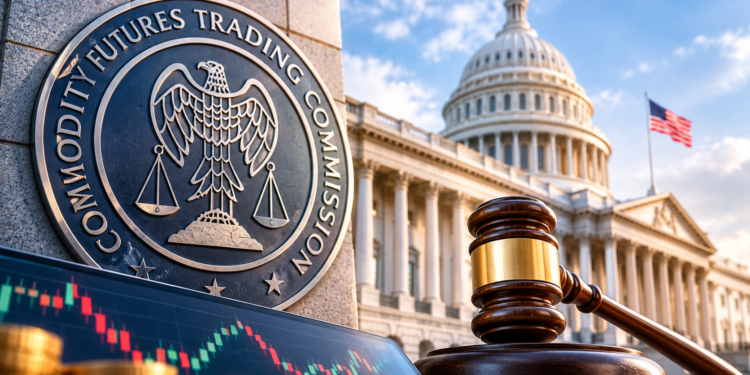
CFTC faces backlash after nine Democratic US senators are calling the regulatory body to withdraw its latest guidance on prediction markets, warning that the move could put trading platforms on a collision course with state gambling laws and existing court orders.
The dispute follows a November 5 interpretation requiring designated contract markets to remove geographic restrictions within 30 days or explain why they cannot comply. The directive could affect platforms such as Kalshi and Polymarket, which have faced legal challenges over offering event contracts in certain states.
In a letter dated November 16, the senators argued that the agency’s position risks encouraging companies to disregard judicial decisions restricting prediction market activity.
Democrats Urge CFTC to Reconsider Geographic Restrictions
The letter was led by California Senator Adam Schiff and signed by Amy Klobuchar, Elissa Slotkin, Gary Peters, Maria Cantwell, Patty Murray, Catherine Cortez Masto, Jacky Rosen and Alex Padilla.
The lawmakers questioned the CFTC’s interpretation of federal derivatives rules, arguing that it conflicts with court decisions involving Michigan, Nevada, Washington and tribal lands in California.
In these jurisdictions, courts have issued orders requiring platforms to block certain event contracts or maintain restrictions on users based on their location. The senators warned that the regulator’s latest directive could place exchanges in a position where complying with federal guidance means disregarding active judicial orders.
They called on the CFTC to withdraw the interpretation or pause its implementation while the legal disputes continue.
CFTC Defends Nationwide Access for Prediction Markets
CFTC Chairman Mike Selig has defended the agency’s approach, arguing that federally registered prediction markets should operate under a consistent national regulatory framework.
The November 5 interpretation states that geographic restrictions conflict with federal impartial-access requirements for designated contract markets. Platforms were given 30 days to remove those restrictions or provide an explanation for their continued use.

Selig maintains that federal derivatives law takes precedence over state attempts to regulate these platforms as gambling businesses. However, the senators argue that federal registration does not automatically eliminate state and tribal authority over gambling activity.
They also referenced decisions from the Sixth and Ninth Circuit Courts of Appeals that support the application of state gambling laws to certain prediction market contracts.
Louisiana and Arkansas Intensify the Legal Dispute
The disagreement is spreading as additional states challenge prediction market operators.
In Louisiana, a judge allowed state officials to pursue restrictions on certain event contracts. The state’s Gaming Control Board has argued that sports-related contracts and other markets offered by prediction platforms constitute illegal gambling.
A temporary restraining order targeted companies including Kalshi, Polymarket, Robinhood, Coinbase, Gemini and Crypto.com. The CFTC subsequently filed its own legal action challenging the state’s restrictions, with some companies joining the regulator’s case.
Arkansas has also entered the dispute. The state sued Kalshi on November 4, accusing the platform of operating an illegal gambling business. The CFTC later filed a lawsuit against Arkansas as it seeks to defend its regulatory authority.
Supreme Court Could Shape Prediction Market Regulation
The growing conflict comes as the CFTC faces changes in its leadership. Chairman Selig is currently the commission’s only serving member, despite its five-member structure.
The White House has nominated Nathan Anonick, a Republican Senate Agriculture Committee staffer, and Matthew Rowland, a former senior adviser to a Democratic commissioner. A confirmation hearing was scheduled for November 17.
Democrats are also expected to take control of the Senate Agriculture Committee’s majority and agenda in less than two months, potentially increasing congressional scrutiny of the regulator.
With courts reaching conflicting conclusions over federal and state authority, the dispute could eventually reach the US Supreme Court. Until then, prediction market operators face uncertainty over where their contracts can legally be offered.
Should the CFTC have exclusive authority over prediction markets, or should states retain the right to restrict them? Could the growing legal battle slow the industry’s expansion?
DC Forecasts is a leader in many crypto news categories, striving for the highest journalistic standards and abiding by a strict set of editorial policies. If you are interested to offer your expertise or contribute to our news website, feel free to contact us at [email protected]








Discussion about this post