



BLSH stock heads into the post-earnings session with a headline few would have predicted in June: Bullish swung to a third-quarter net profit of $576.3 million, after three straight quarterly losses.
The institutional crypto exchange reported its results on Nov. 18 in a filing with the U.S. Securities and Exchange Commission.
Its board also authorized a share repurchase program of up to $300 million on Nov. 17.
For Bitcoin investors, the most telling part is where the profit came from: a $598.4 million gain on the digital assets Bullish holds, led by a bitcoin position of about 19,680 BTC.
The bigger question is how much of Bullish’s story is the business itself, and how much is simply bitcoin’s price.
What Bullish Reported for the Third Quarter
Under IFRS accounting, Bullish earned $576.3 million in the three months to Sept. 30, against $18.5 million a year earlier.
Profit attributable to shareholders was $555.9 million, or $3.57 per diluted share, compared with $0.10.
The company’s own non-IFRS measures, which strip out mark-to-market swings, tell a quieter but steadier story.
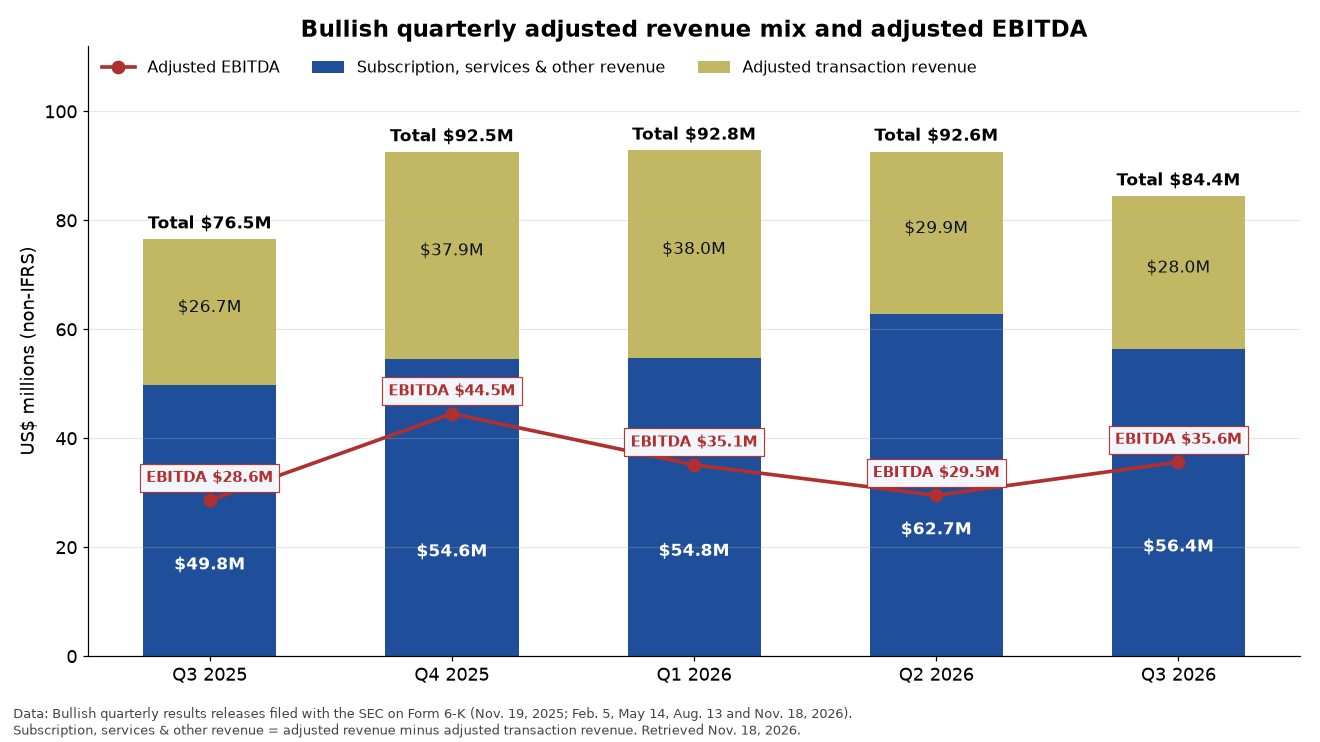
- Adjusted revenue: $84.4 million, up from $76.5 million a year earlier.
- Adjusted EBITDA: $35.6 million, up from $28.6 million.
- Adjusted net income: $18.7 million, up from $13.8 million.
- Digital asset sales: $32.1 billion, down from $41.6 billion.
Chief financial officer David Bonanno said the company “attained a 42% margin” on adjusted EBITDA, which matches $35.6 million divided by $84.4 million.

The softer spot is turnover. Digital asset sales fell about 23% from a year earlier, and adjusted transaction revenue of $28.0 million was the lowest since the third quarter of 2025.
Why Bitcoin’s 43% Quarter Did the Heavy Lifting
Bitcoin closed June 30 at $58,523.93 on Coinbase’s BTC-USD market and finished Sept. 30 at $83,556.14.
That is a 42.8% gain in a single quarter.
Bullish’s quarterly filing shows it held 19.68 thousand BTC at the end of September, carried at $1.67 billion. That compares with 18.03 thousand BTC at the end of 2025. Both figures include wrapped tokens such as cbBTC.
In other words, the company added roughly 1,650 BTC over the first nine months of 2026, a stretch that included bitcoin’s slide below $60,000 by the end of June.
Lining up the past five quarters makes the pattern hard to miss. Bullish lost $563.6 million in Q4 2025, $604.9 million in Q1 2026 and $280.0 million in Q2 2026, quarters in which bitcoin dropped 23.3%, 22.0% and 14.2%.
When bitcoin turned higher, the profit followed.
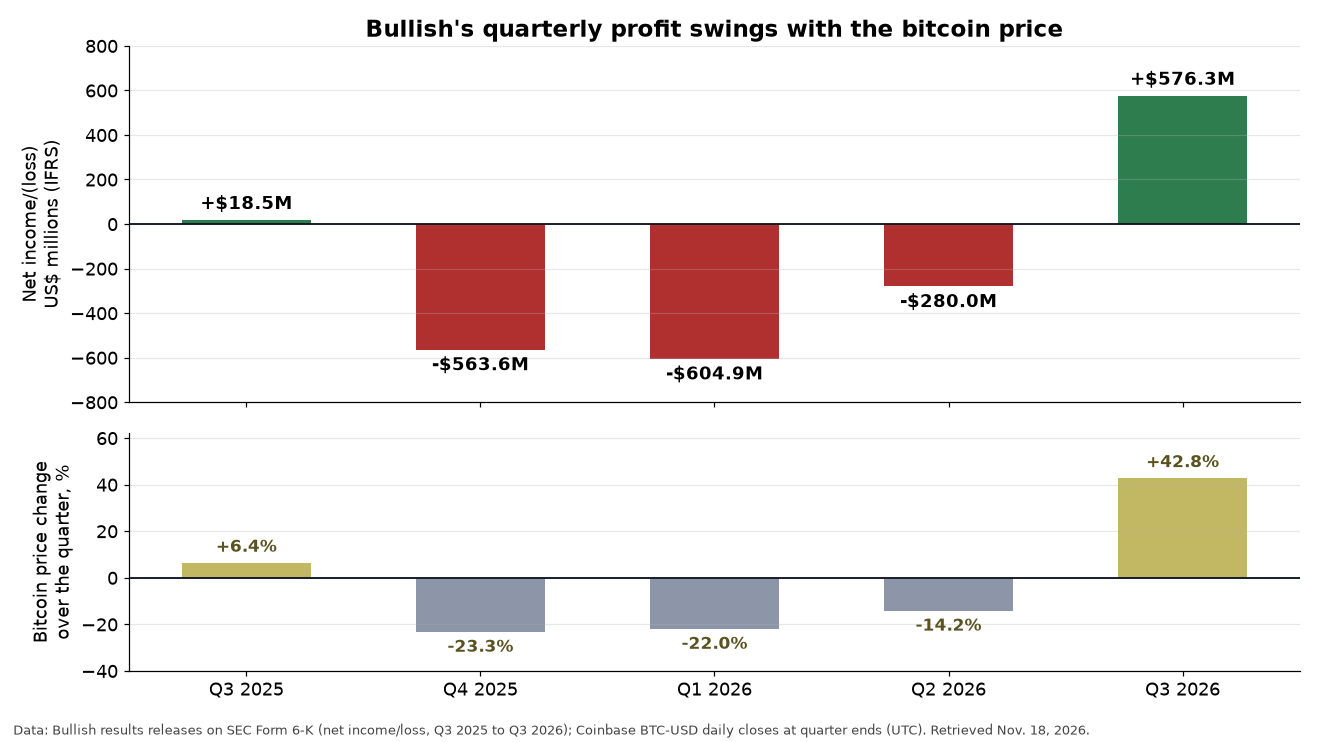
We believe that link is the clearest read of the report. Bullish is, in practice, a listed company with a large bitcoin balance sheet attached to an exchange.
Subscription Revenue Keeps the Core Business Profitable
Below the headline swing, Bullish’s recurring lines kept growing.
Subscription, services and other revenue rose 13% from a year earlier, according to the company. On the reported figures, it reached about $56.4 million, against $49.8 million.
Adjusted EBITDA has now been positive in each of the last five quarters, ranging from $28.6 million to $44.5 million.
That matters for anyone weighing BLSH stock as more than a bitcoin proxy, because it shows the platform covers its running costs even when trading volumes cool.
Management also refined its full-year 2026 guidance:
- Subscription, services and other revenue of $225 million to $235 million, narrowed from $225 million to $245 million in August.
- Adjusted operating expenses of $220 million to $225 million, trimmed from $225 million to $230 million.
- Finance expense of $60 million to $65 million, raised from $52 million to $60 million.
The lower top end on revenue is a modest step back. The lower cost range points the other way.
The $300 Million Buyback and the Equiniti Deal
The repurchase authorization is the clearest signal of how management views the shares. The company noted that the program does not oblige it to buy any set amount and can be changed or halted.
Bullish still expects its acquisition of transfer agent Equiniti to close in January 2027, subject to remaining regulatory approvals. It agreed to the $4.2 billion deal in the first quarter.
Chief executive Tom Farley framed the deal around tokenized equities. “I believe the move from electronic to tokenized shares is as inevitable as the move from paper to electronic,” he said in the release.
The company also named former NYSE Group president Stacey Cunningham as its president, and said its Issuer Token Coalition now counts the New York Stock Exchange among its members.
What Bitcoin Holders Should Watch Next
The same sensitivity that produced this quarter’s profit runs in both directions.
Bitcoin traded near $64,000 on Nov. 18, about 23% below its Sept. 30 close, after the slide we examined when bitcoin slipped under its 200-week average.
At that price, 19,680 BTC would be worth roughly $1.26 billion, so the fourth-quarter mark will depend heavily on where bitcoin closes the year.
For long-term holders, though, the bigger lesson is constructive. An NYSE-listed exchange grew its bitcoin holdings by about 9% this year despite a volatile market, and history has repeatedly rewarded that kind of patience, as our study of four-year bitcoin holding periods found.
We would watch three things into year-end: Bullish’s subscription revenue against its narrowed guidance, the pace of the buyback, and bitcoin’s ability to reclaim ground lost since September.
If bitcoin’s fixed supply and deepening institutional plumbing keep drawing in companies like Bullish, the next balance-sheet surprise may once again be on the upside.
DC Forecasts is a leader in many crypto news categories, striving for the highest journalistic standards and abiding by a strict set of editorial policies. If you are interested to offer your expertise or contribute to our news website, feel free to contact us at [email protected]












Discussion about this post