


MARA has lined up the last piece of financing for Long Ridge Energy, the Ohio gas-fired power plant it agreed to buy in April, and it now expects the $1.5 billion deal to close on Nov. 27.
In a Form 8-K filed with the SEC late on Nov. 17, the company said a subsidiary priced $185 million of 8.750% senior secured notes due 2032, sold at 99% of face value.
The notes come from Long Ridge Energy LLC, a unit of the business being acquired, and should settle the day the deal closes.
For Bitcoin investors, the bigger story is that one of the largest miners is about to own the power plant behind its machines.
The question now is whether owning the electricity can protect mining margins that have been squeezed hard in 2026.
What MARA Priced on Nov. 17
The $185 million offering adds to $600 million of identical 8.750% notes that Long Ridge first issued in February 2025, under the same indenture.
That takes the series to $785 million, the same figure MARA gave in April for the minimum debt it would assume, and the size of the 364-day bridge loan commitment Barclays provided to backstop the purchase.
MARA plans to use the proceeds and cash on hand to fund the purchase, repay part of Long Ridge’s debt and cover fees.
The timing matters. Under the April agreement, either side may walk away if the deal has not closed by Nov. 30, 2026, with a later date if certain regulatory conditions remain unmet, and MARA could owe a $75 million termination fee in some cases.

A Nov. 27 close lands three days inside that window.
What MARA Gets in Long Ridge Energy
Long Ridge Energy’s main asset is a combined-cycle gas turbine plant in Hannibal, Ohio, authorized to sell 485 megawatts, with nameplate capacity expected to rise to 505 MW in the first half of 2027, according to MARA’s latest quarterly report.
It also brings more than 1,600 acres with water, fiber and rail access, next to the data center MARA already runs there.
MARA Holdings says the plant generated about $144 million of annualized adjusted EBITDA based on second-half 2025 results, a non-GAAP figure, with all-in operating costs below $15 per megawatt-hour.
MARA expects the deal to lift its owned and operated capacity by about 65%, with total operating and development capacity of roughly 2.2 gigawatts.
The Federal Energy Regulatory Commission approved the acquisition on Nov. 4, finding it consistent with the public interest, which cleared a key condition to closing.
Why Power Has Become the Miner’s Edge
The economics explain the move. In the third quarter, MARA earned an average of $71,688 for every bitcoin it mined, down from $114,440 a year earlier.
Meanwhile, power bought for its owned sites cost $39,674 per bitcoin produced there, at about $0.04 per kilowatt-hour, or roughly $40 per megawatt-hour.
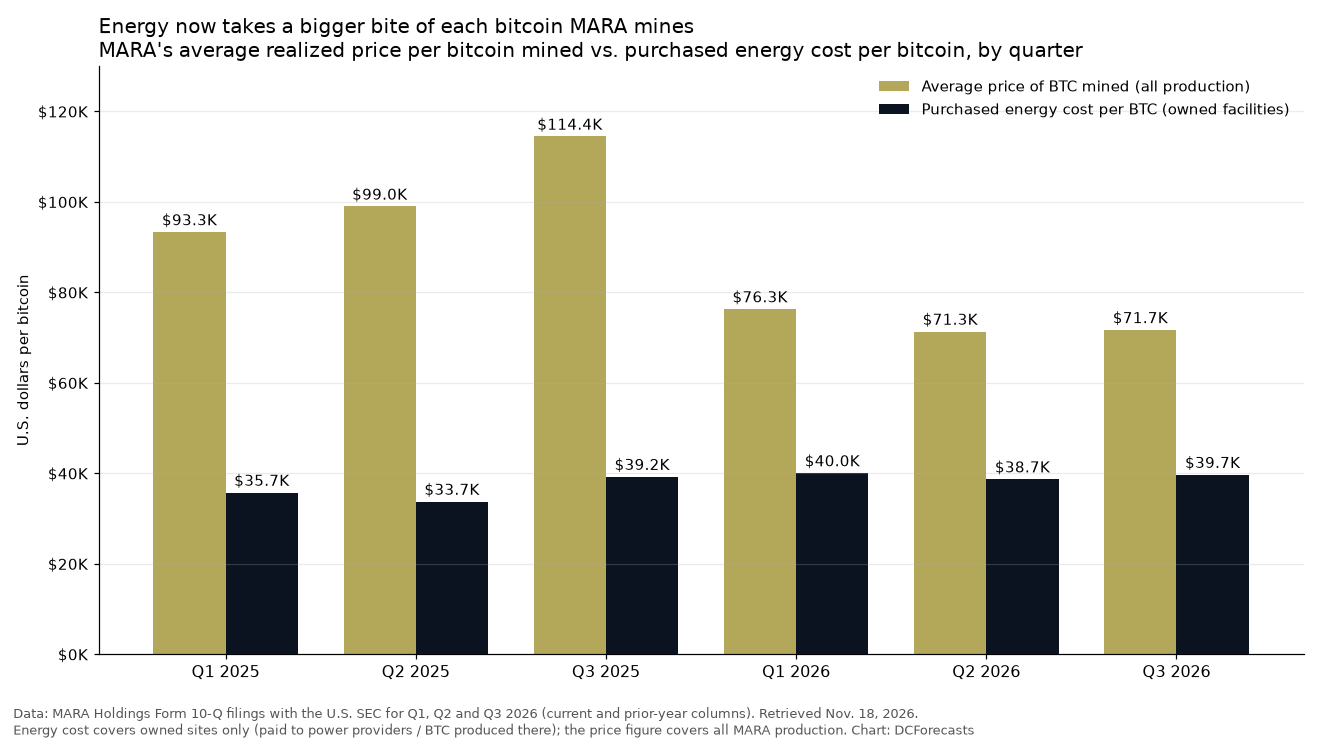
Those two figures are not perfectly comparable, since one covers all production and the other only owned facilities. Still, the gap tells the story: energy now absorbs a much larger share of each coin’s value.
We believe that is why owning generation at a quoted operating cost under $15/MWh is attractive, even if it is not a like-for-like comparison.
The operations keep growing. MARA reported 71.2 exahashes per second of energized hashrate at end-September, up from 60.4 EH/s a year earlier, and mined 6,916 bitcoin in nine months, up 2%.
That fits a wider pattern of resilience in the network, which we noted when Bitcoin’s hashrate rebounded 15% after the latest difficulty cut.
The Bitcoin Stack Behind the Build-Out
The expansion has been paid for partly in bitcoin. MARA’s total holdings fell from 53,822 BTC at the end of 2025 to 34,012 BTC on Sept. 30, after it sold about 26,984 coins for $1.9 billion over nine months.
About 15,133 of those sales funded the repurchase of roughly $1 billion of convertible notes in the first quarter.
After the quarter ended, MARA sold another 13,597 BTC for about $1.1 billion and repaid all $750 million of its bitcoin-backed loans, which returned 17,477 pledged coins to its balance sheet.
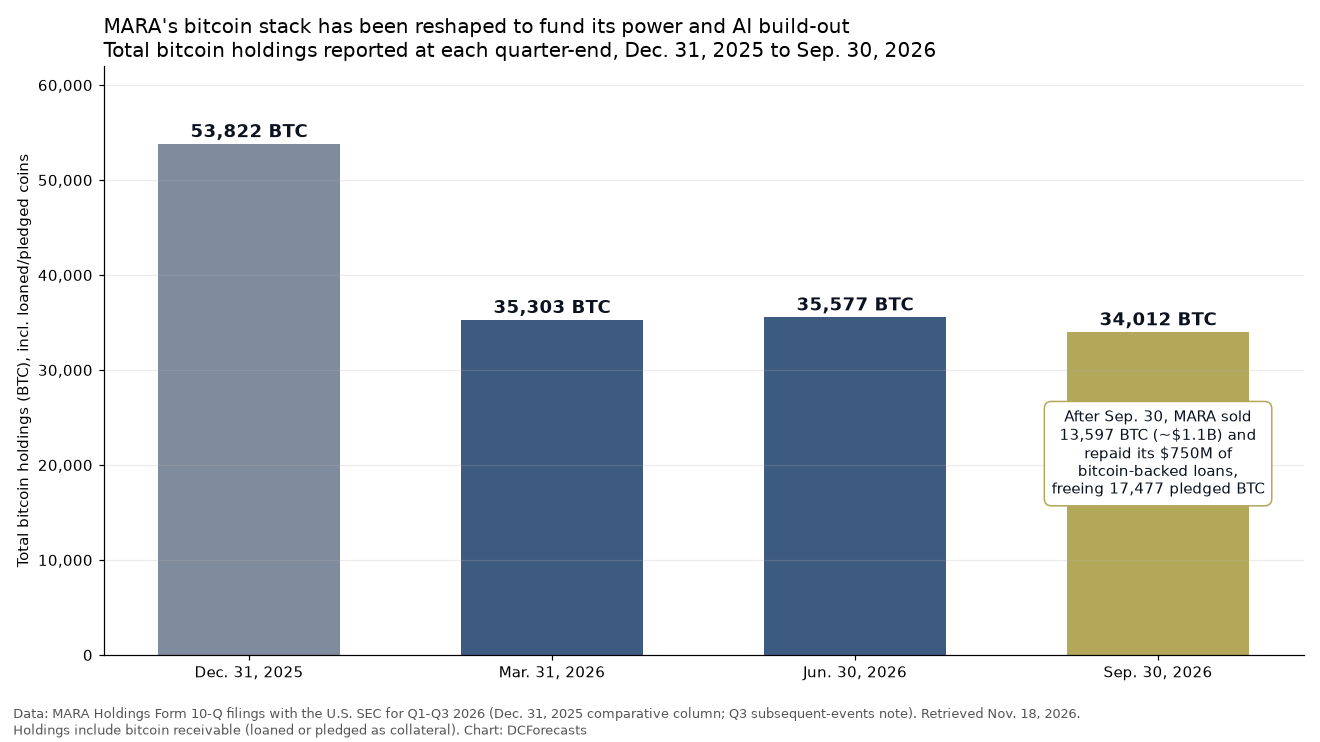
Those sales matter for anyone tracking corporate Bitcoin demand.
The constructive reading is that MARA used bitcoin as a deep, liquid reserve to clear debt and fund hard infrastructure. Few Bitcoin mining companies can raise more than $1 billion that quickly from a single asset.
According to its third-quarter 10-Q, MARA also held $946.5 million in cash at the end of September.
How MARA Stock Has Reacted
Investors cheered the deal at first. MARA stock rose 11.8% on April 30, the day the agreement was announced, to $11.99, according to Yahoo Finance data, and reached a 2026 closing high of $14.85 on June 22.
It has since slid to $6.42 at the Nov. 17 close, 40.1% below its April 29 level. Bitcoin fell 14.4% over the same stretch, from $75,753 to $64,873 on Coinbase.
In our view, that gap reflects execution risk in the AI plan more than the value of the coins MARA mines.
What Comes After the Nov. 27 Close?
MARA says it has received formal indications of interest from prospective investment-grade hyperscale tenants for the Hannibal campus.
It plans to start building an initial AI and critical IT phase in the first half of 2027, targets service by mid-2028, and sees a path to as much as 600 gross MW of compute load on the site.
MARA also lists flexible compute, including Bitcoin mining, among the site’s uses, and says rigs can earn revenue on newly energized sites while AI capacity is built.
We would watch three things next: confirmation that the deal closed on schedule, the first signed tenant, and whether MARA resumes adding to its bitcoin stack once the build-out financing is settled.
Bitcoin was trading near $64,500 on Wednesday morning. Its fixed supply has not changed, and miners that control cheap power are positioning to keep securing it through every price cycle.
DC Forecasts is a leader in many crypto news categories, striving for the highest journalistic standards and abiding by a strict set of editorial policies. If you are interested to offer your expertise or contribute to our news website, feel free to contact us at [email protected]











Discussion about this post