



The Office of the Comptroller of the Currency has approved 28 bank charter applications in the last two years, and several dozen more are waiting in the pipeline, Comptroller Jonathan V. Gould said on Nov. 18.
Speaking at the Exchequer Club in Washington, Gould said the agency received as many charter applications in 2025 as in the previous four years combined. “We have made clear that the OCC is now open for business,” he told the audience, according to the prepared remarks the agency published.
For the digital asset industry, the most important part of the speech came next. Gould tied that chartering push directly to the agency’s new stablecoin rules, and said community banks should have a seat at the table.
A Bank Charter Wave After a Long Drought
Gould framed the approvals as a fix for a problem that has been building since the 2008 financial crisis. Almost half of community banks have closed their doors since then, he said, “accompanied by an almost complete absence of new entrants.”
“This is the ideal formula for the mega banks to grow larger and the system to become less dynamic,” Gould said.
Federal data backs up the drought. According to the FDIC’s historical bank data, 223 new insured institutions were chartered in 2000. Between 2010 and 2016, the whole country added just 22, with none at all in 2014 or 2016.
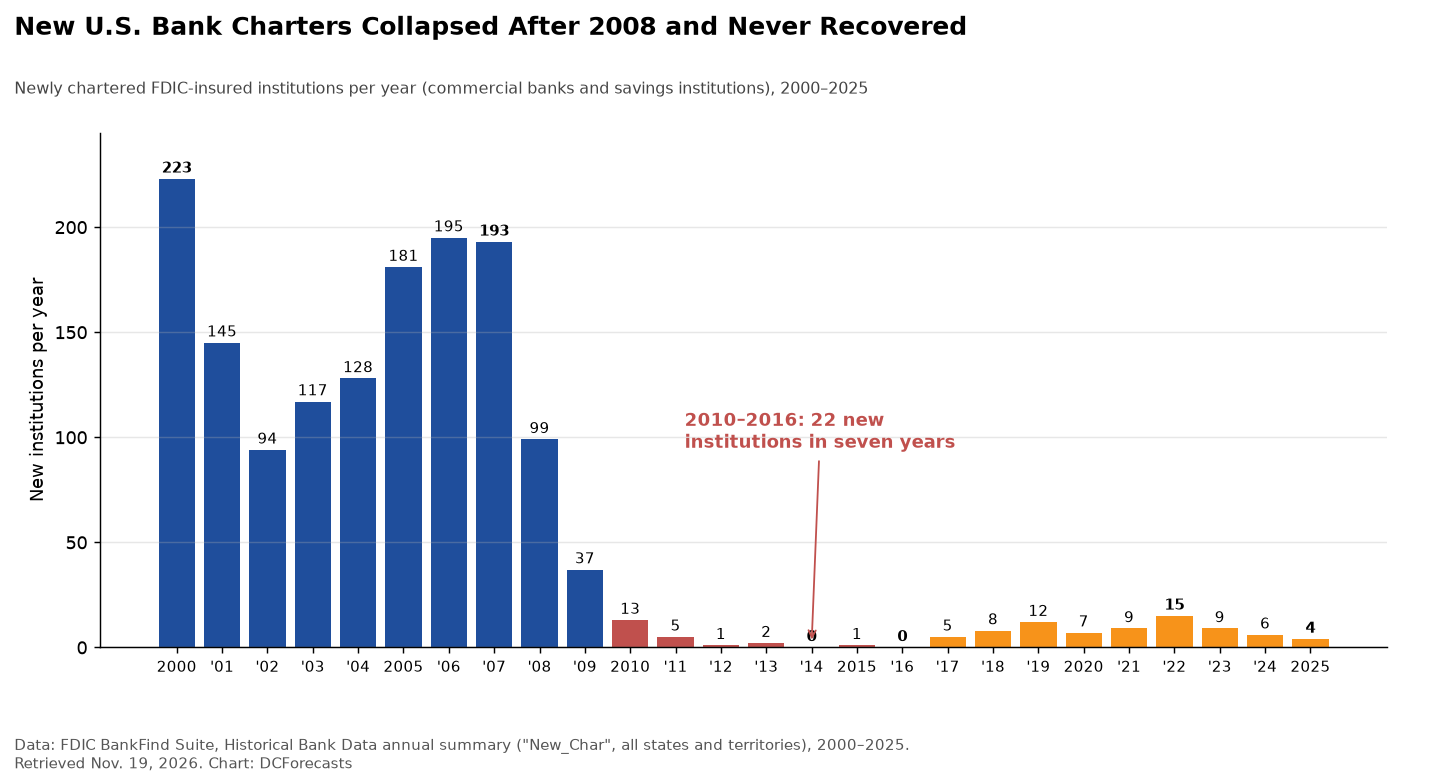
The recovery since then has been modest. New charters peaked at 15 in 2022 and fell to four in 2025, the FDIC figures show.
That gap between applications and openings is worth watching. Charter approvals take time to turn into operating banks, so the jump in 2025 applications Gould described should show up in the data only gradually. He also noted that the first new full-service national bank in more than five years opened during his tenure.
How the GENIUS Act Fits In
Gould described the agency’s stablecoin work as part of the same opening of the system. “Our implementation of the GENIUS Act carries that dynamism forward,” he said.

The OCC issued its final rule implementing the GENIUS Act on Oct. 21. It sets requirements for payment stablecoin issuers under the agency’s jurisdiction, including reserve backing, redemption and risk management, and it covers certain custody activities at OCC-supervised firms. The rule and the act take effect on Jan. 18, 2027.
In his Nov. 18 remarks, Gould stressed one feature in particular. The rule gives existing institutions a pathway to issue payment stablecoins through a subsidiary, with requirements “intended to fit the issuer’s size and risk.”
“The opportunities created by financial innovation should be within reach of Main Street banks,” he said.
We believe that line deserves attention. Until now, the stablecoin market has been dominated by a few large issuers. A framework sized for smaller banks could widen the base of regulated dollar tokens, and many of those tokens move on the same rails that crypto traders and Bitcoin holders already use.
One step is still missing. The OCC said in October that it would announce separately when it begins accepting applications and waiver requests from prospective issuers.
Crypto Firms Are Already Using the Door
The charter pipeline is not an abstract idea for the industry. Earlier this month, we reported that Coinbase’s custody arm moved into a federal trust bank that must hold $60 million in capital, one of the clearest signs that major crypto firms now see a national charter as a competitive asset.
Gould did not name individual applicants in his speech, and he did not break down how many of the 28 approvals involved digital asset businesses. But his message was plain: the agency wants new capital and new ideas inside the federally supervised system, “especially” as technology changes how Americans expect to receive financial services.
The OCC’s reach makes that stance significant. Gould said the agency supervises more than 1,000 institutions holding nearly $20 trillion in assets, around two-thirds of the U.S. banking system.
Debanking and the Fair Access Push
Gould also returned to debanking, an issue that has long frustrated crypto companies. He said the OCC’s review of the nine largest national banks found that all of them restricted access to financial services based on otherwise lawful activities or protected beliefs.
The agency’s October report on that review listed digital asset activities among the industry sectors that faced public or nonpublic restrictions, alongside sectors such as firearms, coal and oil and gas exploration.
“Banks are not a proper vehicle for achieving social or policy objectives outside of the legislative process,” Gould said on Nov. 18.
For Bitcoin businesses that spent years losing bank accounts, that is a meaningful shift in tone from the top bank regulator.
What Comes Next From the OCC
Gould said the agency would “double down” on its agenda over the next two years. He named three short- to medium-term rulemaking priorities: more risk-sensitive capital requirements, Bank Secrecy Act and anti-money-laundering reforms, and changes to the Community Reinvestment Act.
He added that the OCC has surpassed his predecessor’s rulemaking volume since July 2025 in one-third of the time. The agency has also been active on new technology, from a supervisory framework for banks’ use of advanced AI to guidance on preparing for quantum risk.
The market backdrop is difficult. Bitcoin traded near $62,600 early on Nov. 19, down about 3.3% over 24 hours, according to CoinGecko data.
Yet the policy direction keeps moving the other way. More charters, a stablecoin framework open to community banks and a regulator openly criticizing debanking all point to a banking system that is making room for digital assets rather than shutting them out.
For us, that is the longer story. Prices swing week to week, but the plumbing connecting Bitcoin to regulated finance is being built one charter at a time, and the Jan. 18 start date for the GENIUS Act rules is the next milestone to watch.
DC Forecasts is a leader in many crypto news categories, striving for the highest journalistic standards and abiding by a strict set of editorial policies. If you are interested to offer your expertise or contribute to our news website, feel free to contact us at [email protected]










Discussion about this post