


The Bank of Russia is preparing to let investment funds hold cryptocurrency directly, and the first such funds could appear in 2027. That would move Russian fund managers from betting on Bitcoin through derivatives to owning the coins themselves.
The plan surfaced on Nov. 18, one day after ordinary Russians gained a legal route to buy Bitcoin. Fund managers have already filed applications. What they still need is a rule change.
We believe this is one of the clearest signs yet that Russia’s crypto opening is moving from retail access into professional money management.
What the Bank of Russia Official Said
Olga Shishlyannikova, who heads the Bank of Russia’s Department of Investment Financial Intermediaries, spoke to the business broadcaster RBC on the sidelines of the Ural Conference of the National Association of Securities Market Participants in Yekaterinburg.
“Yes, we are considering the possibility next year of amending the relevant regulations so that funds intended for qualified investors can buy cryptocurrency,” she said, in a translation of her remarks.
She added that professional market participants have already applied to register such funds. If the amendments are adopted and registered by Russia’s Ministry of Justice, the first funds holding cryptocurrency could launch in 2027.
There is a clear limit. The regulator is not considering the same permission for funds sold to non-qualified investors at this stage.
Why Funds Cannot Own Bitcoin Today
Russian fund rules currently draw a hard line. Bank of Russia Directive No. 7330-U, dated March 30, 2026, and registered by the Justice Ministry on Sept. 15, rewrote the clause that governs fund assets.
The new wording states plainly that digital currencies cannot be part of the assets of unit or joint-stock investment funds.

The same directive opened a side door. Funds for qualified investors may hold derivatives whose value depends on cryptocurrency prices, as long as those contracts settle only in cash. The central bank announced the change on Sept. 23, saying qualified investors’ money could go into settlement instruments tied to crypto quotes.
That gives a fund price exposure without any coins in its portfolio. Direct ownership would be a different model, one that brings custody, safekeeping and liquidity questions that cash-settled contracts avoid.
Retail Bitcoin Access Came First
The fund proposal follows a fast sequence of steps for individual investors.
On Nov. 6, the central bank named the cryptocurrencies that non-qualified investors may buy: Bitcoin, Ether and Tether’s USDT. That directive took effect on Nov. 17, allowing exchanges to admit the three assets to public trading.
Ordinary investors can buy through a broker, a manager or a licensed crypto exchange operator, on or off an exchange, up to 300,000 rubles a year per intermediary. Every investor must first pass a test. Qualified investors face no purchase limit and can buy any crypto asset.
The regulator said it picked only the most liquid assets, judged by market capitalization, average daily trading volume and at least five years of price history on foreign venues. Bitcoin met every test. We covered the retail rules in detail earlier this month.
The intermediary layer is filling up quickly too. Alfa-Bank became the 31st name on the central bank’s register of crypto exchange operators on Nov. 18, joining Sberbank and VTB.
What the 300,000-Ruble Cap Buys Now
The timing of Russia’s opening has one practical upside for new buyers: Bitcoin is far cheaper in rubles than it was at the start of the year.
Using Coinbase daily closing prices and the Bank of Russia’s official dollar rate, one Bitcoin cost about 7.52 million rubles on Jan. 13, the first official rate date of 2026. By Nov. 18 it cost about 5.19 million rubles, a drop of roughly 31%.
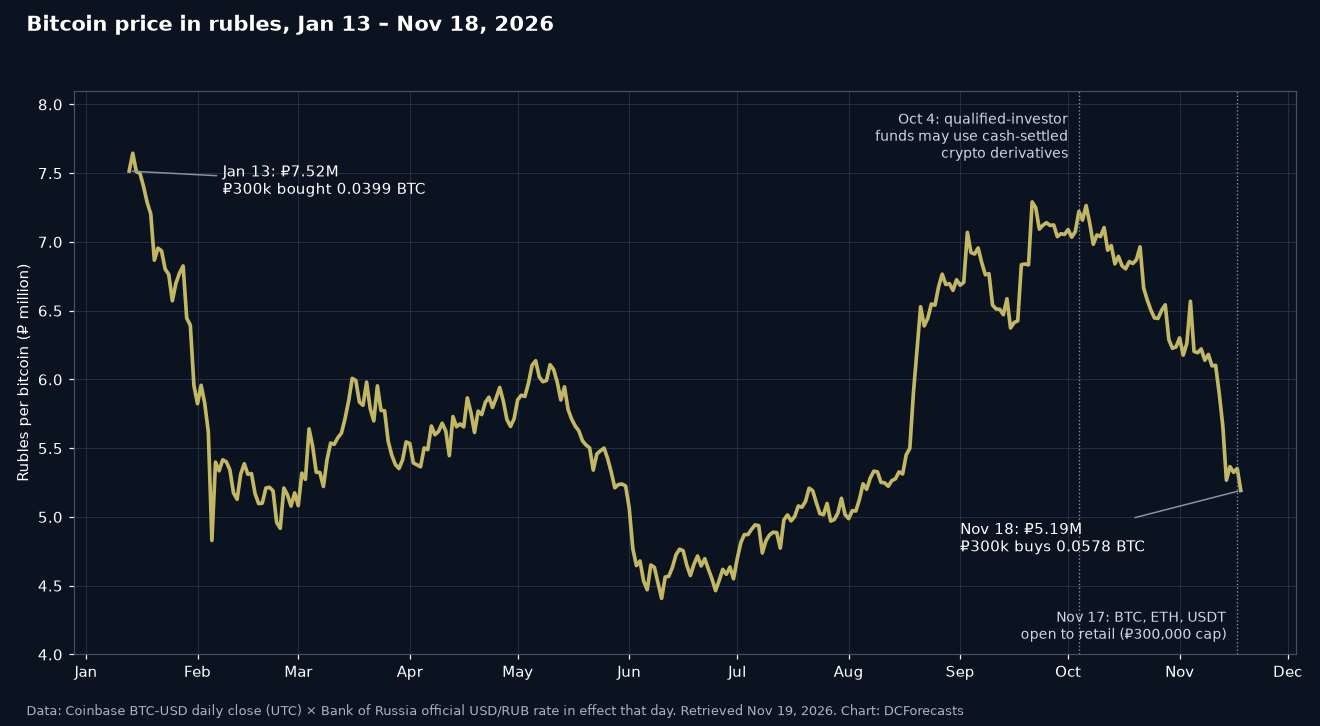
That means the full annual retail cap of 300,000 rubles now buys about 0.0578 BTC through one intermediary. In mid-January, the same sum would have bought about 0.0399 BTC. That is roughly 45% more Bitcoin for the same rubles.
The decline is real, and we do not want to dress it up. Bitcoin fell about 34% in dollar terms over the same period, from about $95,400 to about $63,000. A slightly weaker ruble, at 82.45 per dollar on Nov. 18 against 78.79 in January, softened the hit for Russian buyers.
In our view, a market that opens after a reset gives first-time buyers a better entry than one that opens at the top.
What Has to Happen Before 2027
Several conditions still stand between the proposal and a live fund.
- The Bank of Russia must draft and adopt amendments to its fund asset rules, which would replace today’s outright ban on holding digital currencies.
- The Ministry of Justice must register those amendments before they take effect.
- The pending fund applications would then need to clear registration under the new rules.
The central bank has not said which cryptocurrencies funds could hold, whether concentration limits would apply, or what custody standards it would require. Those details will matter as much as the headline permission.
Why This Matters for Bitcoin Adoption
Pooled funds are how many savers reach markets they cannot easily access on their own. Letting professionally managed funds own Bitcoin directly would add a regulated, institutional channel on top of the retail cap.
Because qualified investors face no purchase limit, funds aimed at them could hold far larger positions than any individual retail account.
Russia is building that stack in order: a legal framework, an approved asset list, licensed intermediaries, retail access and now funds. Each step has come within months of the last.
We believe the direction is unmistakable. Bitcoin is being written into the rulebook of one of the world’s larger economies, and the first fund managers are already lining up at the door.
DC Forecasts is a leader in many crypto news categories, striving for the highest journalistic standards and abiding by a strict set of editorial policies. If you are interested to offer your expertise or contribute to our news website, feel free to contact us at [email protected]












Discussion about this post